The House of Commons has released a thoughtful, critical report on UK research quality

The recommendations to government are excellent, both practical and progressive

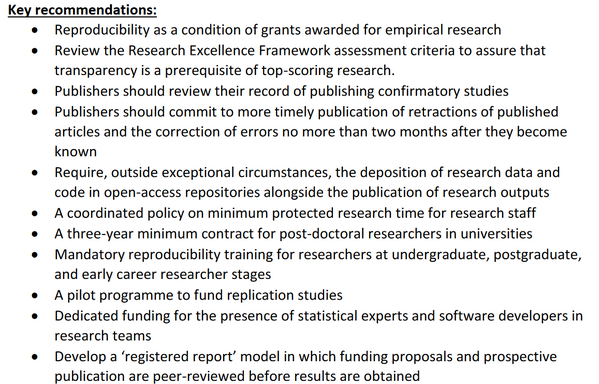
Highlights:

Make all research open access

Require data and code accompany all publications

Move peer-review and publication acceptance before data collection

Specifically fund replications

Remove “originality” from REF, instead require transparency

Impose a 3-year minimum term for all postdocs

https://publications.parliament.uk/pa/cm5803/cmselect/cmsctech/101/summary.html
The UK Government has published its formal response to the national inquiry into research quality

It's short and readable. The Government accepts responsibilty for implementing changes to improve research, putting a lot of weight onto changes being made for REF2028.

My favourite parts: agreeing to a move away from prestige publishing, and recognising the superiority of peer review before studies start (a.k.a. registered reports)

https://publications.parliament.uk/pa/cm5803/cmselect/cmsctech/1771/report.html

@JessButler

I wonder if University HR in our Union negotiations will take notice of the House of commons recommending that Post docs have a minimum 3-year contract.

@JessButler

Some aspects of the report show a remarkable lack of awareness. For example

"UKRI should consult with a representative sample of researchers to understand whether their grants allow them sufficient time and funding to do the work needed for ensuring their research is reproducible."

It appears nobody who wrote the report aware that overwork is one of the issues that Universities and #UCU are in dispute over?

@RichardShaw @JessButler

I don't think that funders can really mandate this without publishers also mandating it. Even if funders say they will provide extra funding etc, people will still try to fit the most they can in the funding envolope - they will just promise more if more funding is made available, and claim they will do the repro work for free. Which they won't do, unless some audits it. Even if someone does audit the person doing the repro for "free" will still win more grants.

@IanSudbery @JessButler

The only thing publishers offer is international prestige. It's the funders who determine who wins more grants, so can direct funding towards people doing good repro work.

The real problem is that funders are also senor academics and a lot of them seem more interested prestige than they are in methodological rigorous and useful research. They also tend to direct research towards what they are interested in.

@RichardShaw @JessButler Prestige = Ref *s.

Grant bodies will give money to peyote who promise to do good repro work, but ones who have done so. Publication hurdles reward those that have done so.

@JessButler This is a huge step forward in terms of positing open access to research.

@JessButler

Would all disciplines be made subject to this framework? Thinking from (social) anthropology, we don’t really have the same obsession with “reproducibility”, and publication of our research data is practically impossible without undoing huge parts of human subjects research ethics

@scottmatter @JessButler let’s hope they stop funding (social) anthropology then, if its just a bunch of stories
@JessButler This is amazing! So much better than we could reasonably have expected!
@JessButler @dimpase holy shit those are surprisingly very good items

@JessButler

I don't understand the rationale for a minimum 3-year term for postdocs. If they find a permanent academic job, like I did, in the first year of their postdoc, why shouldn't they take it?

It is already exploitation that people *have* to do postdocs to get permanent academic jobs.

In the current system, the earliest people get permanent academic jobs is at age 35, on average. This doesn't make any sense - socially or scientifically speaking.

@MartinEscardo
I guess the idea is that you as a postdoc could stop your postdoc earlier, but e.g. 1 year contracts are super unreasonable to have any stability,

I do agree, a tenure track for postdoc is better.

@JessButler

@MartinEscardo @JessButler Precarity. Short contracts are terrible for mental health and career progression. Uprooting your life every other year isn't fun for anybody, and disproportionately affects already marginalised researchers. And spending half of your time in a position looking for the next one isn't exactly conducive to good science.

A minimum contract length gives security, it doesn't stop people leaving a position early if they find something better.

@MartinEscardo @JessButler

Any employement contract can be terminated by an employee at any time (subject to contractual notice periods). A three year PDRA contract would not mean that a PDRA had to work a full three years. Nor would it mean a employer had to terminate the contract at 3 years. It would just mean an employer couldn't terinate a contract before 3 years soley for the reason that the fixed term was over.

@MartinEscardo @JessButler

Would it be better if the jobs that people had after finishing their PhDs, but before being ready to be research managers/team leaders/supervisors/teachers/adinimstrators were open-ended in nature? Certainly. Is a guarenteed minimum of 3 year better than what we have now? Must be (althougih I'll note its rare in my field for PDRAs to be less than 3 years anyway).

@MartinEscardo @JessButler

Note though that there is no such thing as a permenant job in the UK. My job isn't permenant, your job isn't permenant, nobodys is. They are "open-ended", but we can be got rid of when ever an employer decides our services are no longer required, and the law governing that is identical to the law governing making a PDRA at the end of a 3 year postdoc redundant.

@IanSudbery @JessButler

In the UK, when you have a lectureship or a professorship, you are fired only if you do something very wrong or the university goes rogue. That's a fact. For example, the math/cs department of Leicester University did go rogue. This only tarnished the reputation of the university.

@MartinEscardo @JessButler

Thats a myth. Thatcher ended academic tenure in 1988. Academics are subject to the same dismissal regulations as anyone else with more than 4 years continuous service in the UK.

There is a feeling that dispite the rules being the same, academics are just not let go, but that not true. The list of universities making redundancies is much longer than just Leicester - why were just in the news because of how egarious the selection proceedure was.

@MartinEscardo @JessButler

Here is a list of universities making redundenacies from 2018 - this is prepandemic!

https://medium.com/uukspin/festive-redundancies-in-uk-higher-education-94709a92cba0

Very recently UEA and Brighton have both announced redundancies.

At my own university, the both the archology and lanuage teaching departments have been closed. A long, hard local fight saved the academic jobs in archeology (if not the department), but no such guarentee has been secured for lanuages.

Festive redundancies in UK Higher Education - UUKspin - Medium

For amendments or additions, please email materials to [email protected]. All emails are permanently deleted every Saturday. We are also on Twitter @UUKspin. A ‘teach out’ is when a university…

UUKspin

@MartinEscardo @JessButler

Its not just redundancies either. In my own departments more than one academic has been "performance managed" out of their job for having an insufficient REF return in the last few years.

@MartinEscardo @JessButler It's not a requirement for hiring lecturers/professors but a lower limit on the length of postdoctoral employment contracts.
And since slavery is abolished, they cannot force the postdoc to work the full term.
As a postdoc, I have done 1y+1y+2y+1y+2y+2y+1.5y, in NL and DE. I've been already quite burnt out at that point, more than once, even, when I accepted a tenure-track in Singapore (which got stretched to 7 years, after which we packed up and went to Oxford). 1y postdocs are nonsense, and 2y postdocs aren't much better.
@JessButler I can see the logic behind this. What is missing is research on reproducibility. I am not aware of any evidence that would tell us what level of reproducibility is technically feasible in a given system. Moreover, we will have to change completely the way in which academic positions are filled. What will be the selection criteria? How will/ can we define good research? Do we really want to get completely rid of originality?
@JessButler At least most of these are improvements, though knowing UK academic working environments, the 3-year postdoc term sounds awfully easy to abuse.
Almost too good to be true! Switzerland next @SNF_ch? :)