 Andrea Magnorsky 😹 🦙
A team is a system 🎉
 Trond Hjorteland
@roundcrisis I tried to claim this too but was sternly corrected by Merrelyn Emery. A team is a part of a larger system, the organisation. Off course, if the the team is the org, then it is a system.
 Dawn Ahukanna
@trondhjort @roundcrisis
Curious Q: what's in-between an individual and the organizational system, if a team is not a system?
Curious Q: what's in-between an individual and the organizational system, if a team is not a system?
@dahukanna @roundcrisis Both the teams and the individuals are parts of the system that is the org. Treating them like systems in their own rights, in this context, will lead to problems.
I maybe missing some context cos of federation not showing all related messages, I can only see previous 2 before my question: Are you saying the socio-technical system in focus is the Organisation?
Because:
1. Organisations are part of wider society.
2. Individuals are made up of biological systems e.g. endocrine, circulatory,etc that affect individuals and proximal people.
@dahukanna @roundcrisis The sociotechnical systems is an joint optimisation of the technical and the social aspects of a system. And the teams are the ones doing that. All parts of the system that is the org. It's all about framing as I see it and seeing the teams as one isolated system will not be suitable as you will miss the interconnection with the other parts and their joint relation to the whole.
@dahukanna @roundcrisis The two examples are what Ackoff often did, framing it as a nested hierarchy. This is a closed systems model. The open ones conceptualise the environment as well, which all systems then have.
@trondhjort @roundcrisis thanks for clarification.
Containment (encapsulation abstraction) ≠ open system, if the container is not the environment.
Closed systems can contain other closed systems.
@dahukanna @roundcrisis Yes, and that can be a useful model too. But closing a system will limit it as it most likely is an open system really. I've seen arguments made that there are no closed system in nature and although we try, we have not been able to create one either. Closest is probably the space station. ☺️
@trondhjort @roundcrisis Interesting. I'm gonna noodle on that comment.
Is a laboratory an approximation of a closed system?
@dahukanna @roundcrisis We try, for sure, but do we manage it? Having a setting where no matter or energy is transferred? Or, even where we can disconnect ourselves completely? Closed systems are not a good approximation in many cases. Even in natural sciences where we have law that are not really applicable anywhere.
Ackoff is always a good source for this: https://www.youtube.com/watch?v=yGN5DBpW93g

Russell L Ackoff From Mechanistic to Systemic thinking
@trondhjort I agree that any grounded/real world system is an open system - intermingled and intertwined. Closed system abstraction can be useful as a simplified and scoped starting point for modelling, not a definitive reference.
As George E.P. Box says, " Essentially, all models are wrong (inaccurate) but some are useful".
As George E.P. Box says, " Essentially, all models are wrong (inaccurate) but some are useful".
@dahukanna Absolutely. Simply thinking in systems is doing that, or modularity in IT. Very useful, but find that we often then seem to forget the huge simplification we make doing that, even as systems thinkers. By taking the open systems approach this will be front and center.
 Ruth — of systems & design
@trondhjort @dahukanna is there something to point to where M Emery describes open and closed systems in such a way that open systems can’t be part of open systems — only environments (that are not systems)? (I’m sure you know exactly which of her papers would be good to read on this!) Be interesting to contrast with others in the systems space. :)
@RuthMalan @dahukanna One I keep coming back to is the Vienna briefing paper: https://www.bcsss.org/wp-content/uploads/2012/04/Vienna.OPEN-OR-CLOSED-SYSTEMS.pdf
The environment is by definition not a system. It is formed by the systems it is the environment for, but it is a different thing.
The environment is by definition not a system. It is formed by the systems it is the environment for, but it is a different thing.
@trondhjort @dahukanna yep. And it’s (informed) choices about how things are viewed.
@RuthMalan @dahukanna Indeed. Kinda surprised how little prevalent open systems thinking is. Not necessarily the Emerys' way, but in general. the environment is frequently ignored, or at best acknowledged but not conceptualized.
@trondhjort @dahukanna it’s quite prevalent. See for example (in the paper we read for yesterday’s systems discussion: http://documentacion.ideam.gov.co/openbiblio/bvirtual/017931/DocumentosIndicadores/Temasvarios/Docum8.pdf)
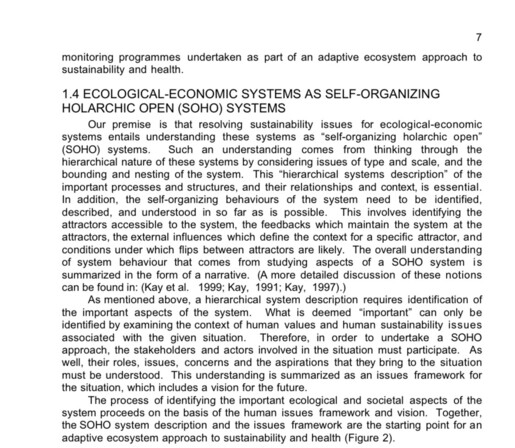
@RuthMalan @dahukanna Looks interesting. Hope you are right about the prevalence, but haven't seen it often myself. And OST is marginalized because of it.
@trondhjort @dahukanna maybe OST is marginalized for other reasons? Like, just one thought: the use of dp1 and dp2. It assumes folk have acquired a special purpose language… it’s an important short-cut within a group. I get that. But for new people…
@RuthMalan @dahukanna The lingo in any field of science feels a bit excluding to outsiders I guess, same here. And yes, it is something that needs to be adjusted, Just easier to write DP1 and DP2 instead of writing out what it is each time. 🙂
@RuthMalan @dahukanna I was more getting at that it is marginalized because people either do not like/belive in DP2 or believe that systems can be closed. Like in natural sciences. Or for other reasons,
Marginalization/misuse is systemic because people refuse to state descriptive adjectives or their assumptions.
People drop the "closed" and assume that is the missing, unstated adjective.
Abstraction: "open" and "closed" systems (simplification). By using the clarifying adjective or stating assumptions would help clarify.
Can you point to a definition of DP1 and DP2 as I don't have them memorized and the acronyms are not descriptive?
@dahukanna @RuthMalan Almost sorry for pointing you towards Twitter here, but I'm lazy... :-) https://twitter.com/trondhjort/status/1428668003923673096?s=20

Trond Hjorteland on X
Based on the discussion here yesterday and at @DDDBE MeetUp the day before it may be useful to explain what the the genotypical organisational design principles are, aka DP1 and DP2 respectively. Both can be described at ways to create redundancy, as illustrated here:
@dahukanna Then there is also this post: https://www.linkedin.com/pulse/enabling-learning-organisation-trond-hjorteland/

Enabling a Learning Organisation
As we know, a huge part of the work done in the software industry is non-linear and requires extensive knowledge, experience, and design skills to master. We also know that very few comes out of school ready to tackle the real world complexity of IT based product development and we all have to learn
@trondhjort Are you saying natural sciences views systems as closed?
@trondhjort oh! Sorry, I thought you meant by marginalized that there’s not a lot of uptake in practice in organizations (where it would be more important to think about approachability more than in science) …
@RuthMalan Gotcha. Yes, translating the theory and the academic work so that it's more approachable to the companies is for sure a challenge, but I'm optimistic that we will crack that nut soon. A next gen OST community is in the making, centered around the ones that attended Merrelyn's course. Exciting times ahead. ☺️
@trondhjort yep — i was just thinking that is a big part of what you’re doing :)