
When you post on Twitter(1) or Bluesky(2) you grant them a broad perpetual license to use, modify, and sublicense your content. You effectively make them co-owners of your content. They can mine it and monetize it. They can even sell it. When you post on Mastodon(3) most instances take no license at all. That's right, they tell you what they are doing with your content—storing posts and delivering them—but no license.

1/2
#twittermigration #TermsOfService #PrivacyPolicy #ContentLicense
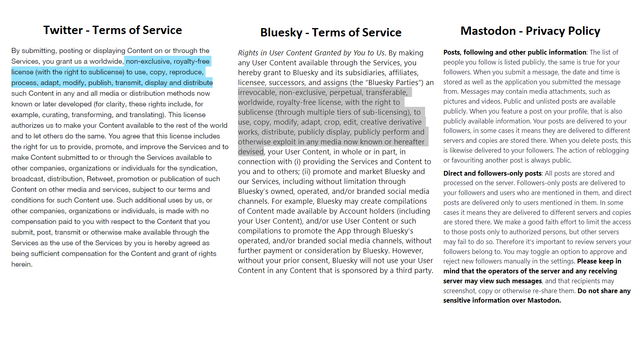
Twitter and Bluesky (and almost all corporate social media providers) say they need a broad license to do what they do. But the truth is that they don’t need a license to publish your content—or they could take a much more limited publishing only license—but they don’t because the way they make money is processing your content, profiling you, and selling information about you to ad tech companies. For this they need to co-own your content.

2/3
#twittermigration #ContentLicense #Bluesky

@mastodonmigration I sense a bit of FUD here. None of the ToS excerpts in the first post say anything about those services co-owning your content. I highly doubt that Twitter or Bluesky claims even partial ownership of the content you upload. (Otherwise why would they need a license?) And I'm pretty sure it *is* against the law (at least in the US and other jurisdictions with similar copyright laws) to operate a service like Twitter/Bluesky/Mastodon without obtaining a license to do certain things with the content, in particular making copies and distributing those copies.
@diazona A license is different from "ownership" of the content. You own the copyrite, but you give them a broad license to the content. What they get depends on the terms. In the case of Twitter and Bluesky, the license terms are very broad, giving them "effectively" co-ownership. But you are right, they do not own the content, just a perpetual license to it. It is not against the law to not have a license. That is just what they want you to think. Most Mastodon instances do not take licenses.
@mastodonmigration OK I suppose you can call it "effective" co-ownership - I wouldn't, but that's not important. But in the toot I was replying to it said simply "co-own your content". Nothing about "effective". That's misleading. And on the other point: can you offer anything to support your claim that it's not against the law to do what Twitter/Bluesky/Mastodon do without having a license to the content that users post? (Assuming I understood correctly that that's what you meant?) I'm referencing a specific law (https://www.law.cornell.edu/uscode/text/17/106) that those activities violate; what's the counterargument?
17 U.S. Code § 106 - Exclusive rights in copyrighted works

LII / Legal Information Institute

@diazona Thanks, sorry for the confusion. The post you replied to is 2/3 in a thread in which the top post says: "You effectively make them co-owners of your content." The sentence in 2/3 relates to that previous context, but it is not as clear as it should be. Secondarily, not sure, but the rationale could be along the lines of it being you that is reproducing the copies by posting your content. Mastodon may simply be the technology you are using to do so.

#twittermigration #ContentLicense

@mastodonmigration Ah, I see. Yeah, it wasn't clear to me that that statement was meant to be interpreted in the previous context; sorry about the misunderstanding. (1/2)

@mastodonmigration On the idea of you (the poster) being the one who is reproducing the content: that's an interesting angle but not one that I've ever seen put forward in my prior reading about copyright. The conventional interpretation is that you, the author, distribute a copy of your content to the website operator, e.g. the Mastodon server owner. The website operator will then choose to make additional copies of that content and distribute those copies to other people, e.g. end users or other server owners. The software of Mastodon/Twitter/Bluesky are simply means of making and distributing all those copies. I suspect it'd be a bit tough to argue that you (author) are the one making and distributing all the copies, because it's the site operator, not you, who is choosing who gets a copy. Dunno if things would be different from a legal perspective on a site with fine-grained access controls. (2/2)

#ContentLicense