The current record heat in Portugal and Spain is linked to hot air coming from the south-west, which is linked to a wave in the jetstream (blue). It goes anti-clockwise around a low pressure over the Atlantic, sitting above the cold patch in the North Atlantic sea surface. 1/x
Figures: https://climatereanalyzer.org/wx/todays-weather/?var_id=sstanom&ortho=1&wt=1
Apart from general global warming, there may be some interesting connections to dynamic climate changes here. For one, the jet going around this way is favored by the cold blob, as shown by Duchez et al. 2016. 2/x https://climatereanalyzer.org/wx/todays-weather/?var_id=sstanom&ortho=1&wt=1
Climate Reanalyzer

That cold blob in turn is enhanced by climate change weakening the Atlantic Meridional Overturning Circulation (AMOC) as explained e.g. in this blog. https://www.realclimate.org/index.php/archives/2020/09/new-studies-confirm-weakening-of-the-gulf-stream-circulation-amoc/ 3/x
RealClimate: New studies confirm weakening of the Gulf Stream circulation (AMOC)

RealClimate: Many of the earlier predictions of climate research have now become reality. The world is getting warmer, sea levels are rising faster and faster, and more frequent heat waves, extreme rainfall, devastating wildfires and more severe tropical storms are affecting many millions of people. Now there is growing evidence that another climate forecast is already

RealClimate | Climate science from climate scientists...
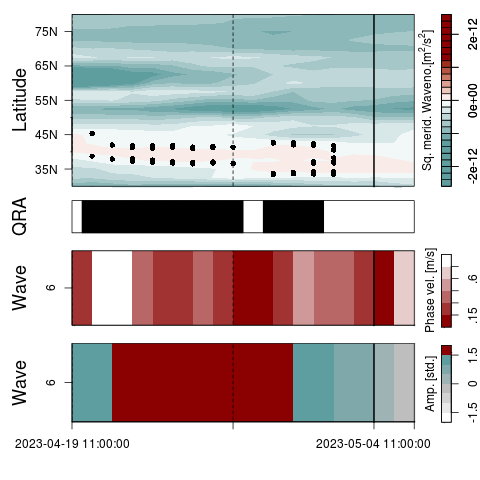
In addition, our automatic detection algorithm is showing resonance conditions for the jet stream wave 6, as well as anomalously high wave 6 amplitude, during the past week and ongoing. 4/x
The automatic wave resonance detection scheme by @KKornhuber and the type of figure shown in the previous tweet are described in this paper: https://link.springer.com/article/10.1007/s00382-016-3399-6 5/x
Evidence for wave resonance as a key mechanism for generating high-amplitude quasi-stationary waves in boreal summer - Climate Dynamics

Several recent northern hemisphere summer extremes have been linked to persistent high-amplitude wave patterns (e.g. heat waves in Europe 2003, Russia 2010 and in the US 2011, Floods in Pakistan 2010 and Europe 2013). Recently quasi-resonant amplification (QRA) was proposed as a mechanism that, when certain dynamical conditions are fulfilled, can lead to such high-amplitude wave events. Based on these resonance conditions a detection scheme to scan reanalysis data for QRA events in boreal summer months was implemented. With this objective detection scheme we analyzed the occurrence and duration of QRA events and the associated atmospheric flow patterns in 1979–2015 reanalysis data. We detect a total number of 178 events for wave 6, 7 and 8 and find that during roughly one-third of all high amplitude events QRA conditions were met for respective waves. Our analysis reveals a significant shift for quasi-stationary waves 6 and 7 towards high amplitudes during QRA events, lagging first QRA-detection by typically one week. The results provide further evidence for the validity of the QRA hypothesis and its important role in generating high amplitude waves in boreal summer.

SpringerLink
To conclude, it is plausible that this crazy extreme is not just due to the 🌍 getting generally warmer, but enhanced by dynamic changes in ocean and atmosphere also caused by fossil emissions. To check this needs further study of course. For now it’s a plausible hypothesis. 6/x

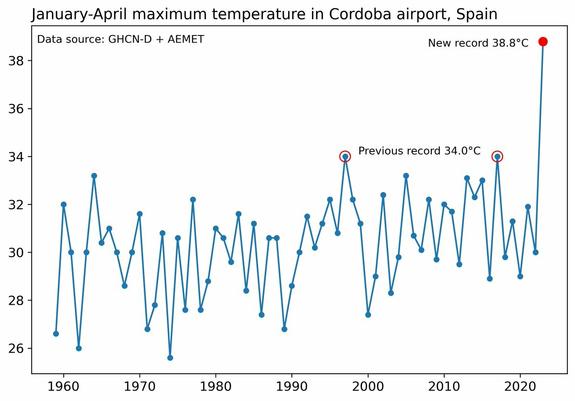
It is stunning that the heat record in Cordoba was almost 5 degrees C above the previous April record. This is statistically implausible without changes in the dynamics of weather activity (which in science we distinguish from thermodynamics). 7/x
---
RT @mikarantane
Lots of presentations this week in #EGU23 about record-shattering heat extremes by @erichfischer and many others.

The new April heat record in Cordoba airport just demon…
https://twitter.com/mikarantane/status/1651689341716922369

Mika Rantanen on Twitter

“Lots of presentations this week in #EGU23 about record-shattering heat extremes by @erichfischer and many others. The new April heat record in Cordoba airport just demonstrates the nature of these events: the records are not just broken, they are shattered.”

Twitter
And sorry for the wrong link in the tweet about the paper by Aurélie Duchez and colleagues, it’s this one and open access: https://iopscience.iop.org/article/10.1088/1748-9326/11/7/074004/meta
@rahmstorf Das kann man leider Vielen nicht verklickern, die begreifen a) die Statistik nicht und b) schreien die eh nur fake und die übrigen Schwachköpfe glauben es halt.

@rahmstorf

"Implausible" and "Statistically impossible" are words that we will see more often.
(Together is "Rapid intensification" of hurricanes, typhoons and cyclones in general).

As in,
"From 1959 to 2021, we found that 31% of Earth’s land surface has already experienced such statistically implausible heat."

https://theconversation.com/statistically-impossible-heat-extremes-are-here-we-identified-the-regions-most-at-risk-204480

'Statistically impossible' heat extremes are here – we identified the regions most at risk

Afghanistan and Central America have growing populations, limited resources, and the potential for more extreme heatwaves.

The Conversation
@rahmstorf Interesting. Sounds like this could be a positive feedback loop. Is this possible?