
@lauren Im still trying to confirm if this is their actual policy. That no user or server admin in bluesky can actually ban or delete content, but only end users can choose to see, or not see it.
So far, from what I see, it might be that later scenario.
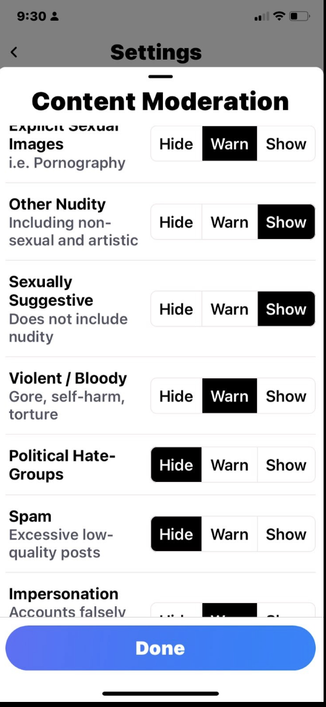
@lauren I was kinda amazed that any social network would launch with what in essence was a "Show bloody gore, spam and hate, and fake account content" toggle, too.
I was HOPING that like the Fediverse that each admin of a BlueSky service can mute or block or ban such content for all. But not sure that is so, yet.
@tchambers @lauren I don't believe "instance" admins have any say over what content federates and what doesn't.
As in, instances (or "nodes" in BS parlance, I think?) are just account/data storage. Admins, as far as I know, have no agency and barely any power in the system.
@lauren @tchambers I am too lazy to dig for it right now but I remember reading in their docs pretty explicit mentions that whole point is that from the user's perspective it should not matter which instance they are on.
I mean, even here:
https://atproto.com/guides/faq
> Account portability is the major reason why we chose to build a separate protocol. We consider portability to be crucial because it protects users from sudden bans, server shutdowns, and policy disagreements.
@lauren @tchambers also this:
https://atproto.com/guides/overview#speech-reach-and-moderation
> ATP's model is that speech and reach should be two separate layers, built to work with each other. The “speech” layer should remain neutral, distributing authority and designed to ensure everyone has a voice. The “reach” layer lives on top, built for flexibility and designed to scale.
"Speech" is what nodes do, "reach" is what (winner-takes-all bigger-is-better) recommendation algorithms do.
Node admins have no say over recco algos.
I read the same, but interpreted it differently. It's bad, but different bad?
I read it as:
* User data is stored in Merkle trees. Basically github repos where each post, like, comment etc, is like a commit.
* Each commit author is a DID, which is stable.
* You can host your GitHub repo of activity on any host. That's the "speech" part. You can set up your own lil nazi repo if you want.
* But search indexes across hosts. That's the "reach" part. Host admins filter
I see confusion/possible jeopardy in that today, because there's no distinction between the AT protocol (git in this analogy) and Bluesky (GitHub in this analogy). Because BlueSky is the only instance of the AT protocol.
The maintainers of git can say, "Hey, Nazis might use this! We have no control! Don't blame us!" but GitHub can't say the same if they host illegal/harmful content.
I do see the devs talking about actively building in the ability to block and ban users. I think block is coming this or next week.
And I think AT Protocol host admins can build their own pluggable indexers, and feed algorithms. So no one can make you host CSAM, or any content you don't want. At least, that's my understanding? I could be wrong.
Their "what's hot" feed is a placeholder implementation that just filters on likeCount > 8. But admins can roll their own
@lauren Those concerns are orthogonal from a technological perspective.
e.g. SILC (Secure Internet Live Conferencing) is end-to-end encrypted with Perfect Forward Secrecy & has mitigations to defend against malicious server operators from eavesdropping, yet it does not prohibit server operators or channel operators from kicking/banning abuse.
The falsehood that end-to-end encrypted messaging facilitates CSAM is a canard.
Also see: @alexwinter's TEDx Talk.
@lauren Push back may still be necessary. SILC (and SSH for that matter) were both developed at a time when even exporting so-called "strong cryptography" from the USA was considered illegal.
In other words: the world has gotten friendlier to cryptography, not the other way around.
Also see: https://en.wikipedia.org/wiki/Bernstein_v._United_States
@alexwinter @mekkaokereke @rysiek @tchambers
@lauren So I guess people should contact their legislatures?
As it stands: FreeS/WAN, OpenIKED, Vula, Wireguard, OpenVPN and more exist, with complete source code, accessible internationally. So, legislatures will be hard pressed to put that genie back into a bottle; particularly since USG and .mil utilize much of that already, as do Fortune 500 companies. You can't just legislate away functioning infrastructure via magic, it doesn't work that way. @alexwinter @mekkaokereke @rysiek @tchambers
@lauren Well, in my experience: all governments fall. Some sooner than later. The USA is in a Roman decline stage from my vantage.
Cuneiform, outlived Sumeria.
Hieroglyphs outlived Egypt.
Latin persists despite the fall of Rome.
I think code will be much the same.
The Great Firewall of China? Was supplied by Cisco last I checked.
DNS: open source.
So uhhh, you think open source doesn't help? I think you're off your rocker if so.
@alexwinter @mekkaokereke @rysiek @tchambers
@lauren ARPANet site 1 at UCLA, was still after Engelbart's group at SRI.
Also, after SAGE.
I think you think too highly of yourself and are resting on your laurels and it looks disgusting from here.
@lauren
"I don't mention anything about UCLA"
Sure seems to contradict:
"And by the way, I've been working on the Internet since before there was an Internet (ARPANET site 1 at UCLA), and on Open Source long, long, long before the term was coined." (https://mastodon.social/@lauren@mastodon.laurenweinstein.org/110268796785422058)
JFC, writing with you is exasperating.
Do you realize what this looks like to anyone else?
@lauren Yes, Please. LEAVE ME ALONE FOREVER.
Horrid person.