
@lauren Im still trying to confirm if this is their actual policy. That no user or server admin in bluesky can actually ban or delete content, but only end users can choose to see, or not see it.
So far, from what I see, it might be that later scenario.
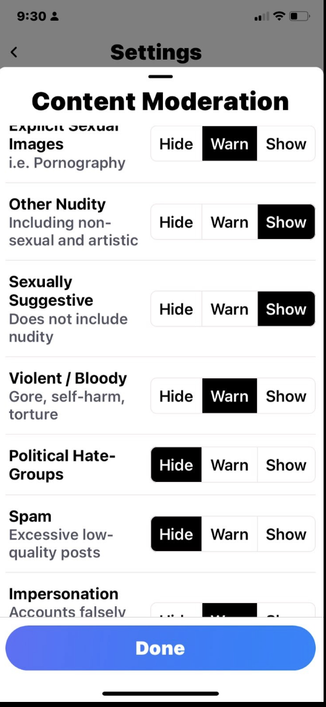
@lauren I was kinda amazed that any social network would launch with what in essence was a "Show bloody gore, spam and hate, and fake account content" toggle, too.
I was HOPING that like the Fediverse that each admin of a BlueSky service can mute or block or ban such content for all. But not sure that is so, yet.
@tchambers @lauren I don't believe "instance" admins have any say over what content federates and what doesn't.
As in, instances (or "nodes" in BS parlance, I think?) are just account/data storage. Admins, as far as I know, have no agency and barely any power in the system.
@lauren @tchambers I am too lazy to dig for it right now but I remember reading in their docs pretty explicit mentions that whole point is that from the user's perspective it should not matter which instance they are on.
I mean, even here:
https://atproto.com/guides/faq
> Account portability is the major reason why we chose to build a separate protocol. We consider portability to be crucial because it protects users from sudden bans, server shutdowns, and policy disagreements.
@lauren @tchambers also this:
https://atproto.com/guides/overview#speech-reach-and-moderation
> ATP's model is that speech and reach should be two separate layers, built to work with each other. The “speech” layer should remain neutral, distributing authority and designed to ensure everyone has a voice. The “reach” layer lives on top, built for flexibility and designed to scale.
"Speech" is what nodes do, "reach" is what (winner-takes-all bigger-is-better) recommendation algorithms do.
Node admins have no say over recco algos.