 Wonder of Science
This is what fine table salt looks like magnified 150 times with an electron microscope.
Credit: Todd Simpson/UWO Nanofab
CC BY-NC-ND 2.0
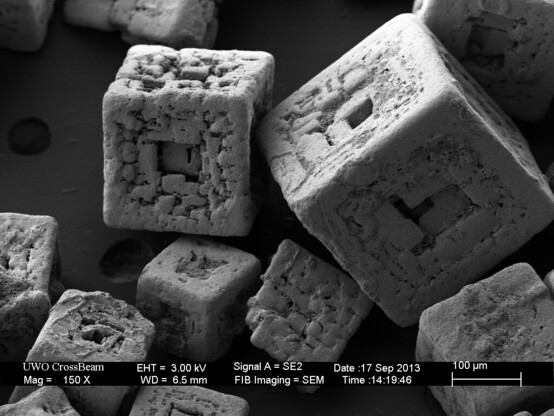
This is what fine table salt looks like magnified 150 times with an electron microscope.
Credit: Todd Simpson/UWO Nanofab
CC BY-NC-ND 2.0
@SylviaFysica @wonderofscience I read a couple of "Grow your own salt crystals", and I had a dumb question I couldn't easily find the answer to:
Is this actually "growing" more salt or is this simply "reforming" the existing salt into a different shape?
"Growing" salt confuses me. I'm not scientific, just a word nerd.
@SylviaFysica @wonderofscience Brilliant. I never thought of plants that way, as reformatted existing organic and inorganic stuff combined in a particular pattern to eggplant. Are we that way, too?
Makes me rethink the very personal interconnectedness and dependency we share with everything on the planet, with a dollop of extra-terrestrial sunbeams.
Just a poet, not a scientist. So, I am delighted to have my world upended and find a new world that's always been right in front of me.
Thanks!
 Patty Kimura
 Sylvia Wenmackers 🦉🍀