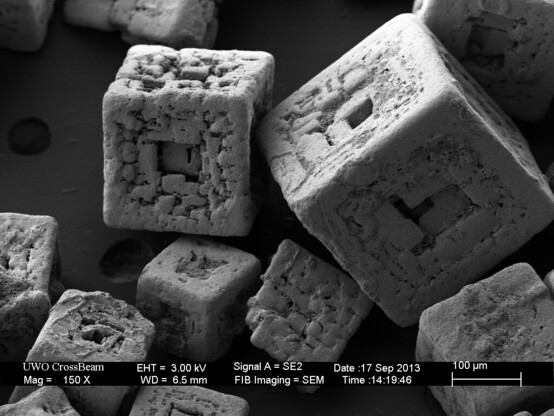
This is what fine table salt looks like magnified 150 times with an electron microscope.

Credit: Todd Simpson​/​UWO Nanofab
CC BY-NC-ND 2.0

@wonderofscience Cubes! Salt cubes! Is this shape natural or a result of the milling process?
@pattykimura
Sodium chloride naturally forms cubical crystals. (The specific crystalline form is called face-centered cubic.) https://en.wikipedia.org/wiki/Sodium_chloride
The small crystals in table salt form spontaneously by drying salt solution rapidly in a vacuum chamber. (Starting from seawater leads to 'sea salt'.)
These crystals can become much larger, and you can grow salt crystals at home.
@wonderofscience
Sodium chloride - Wikipedia

@SylviaFysica @wonderofscience I read a couple of "Grow your own salt crystals", and I had a dumb question I couldn't easily find the answer to:

Is this actually "growing" more salt or is this simply "reforming" the existing salt into a different shape?

"Growing" salt confuses me. I'm not scientific, just a word nerd.

@pattykimura if you think about NaCl, you have sodium and chloride, neither of which is salt, coming together to form a salt that wasn't there before. I don't know if what you were reading wanted you to create salt or simply refine it from an existing source though. Growing it does sound more like distilling it out of somewhere it is already spread out and concentrating, imo. Not sciency either though.
@pattykimura The atoms are already there in the solution, but they are only called a salt when they get together in a specific configuration (a specific type of crystal).
In that sense it's much like other types of growth, such as plants: the nutrients are already in the air and in the soil, but they come together to make a new solid form.
Hope this helps. :)
@wonderofscience

@SylviaFysica @wonderofscience Brilliant. I never thought of plants that way, as reformatted existing organic and inorganic stuff combined in a particular pattern to eggplant. Are we that way, too?

Makes me rethink the very personal interconnectedness and dependency we share with everything on the planet, with a dollop of extra-terrestrial sunbeams.

Just a poet, not a scientist. So, I am delighted to have my world upended and find a new world that's always been right in front of me.

Thanks!

@pattykimura Yes, our bodies are definitely that way, too! It's amazing to think how different the time spans are of 'stuff' residing in our bodies: from very short (water in all of our cells, which we lose constantly, for instance by breathing) to very long (calcium in our bones and teeth, but also certain parts of the brain IIRC).
@wonderofscience
@SylviaFysica @pattykimura @wonderofscience
When I was young, I remember creating sugar crystals by suspending a string in a super-saturated solution and letting it cool. Doing sugar and salt side by side would be a great way to show the different shapes that crystals can take.