Me and a few other climate folks on Twitter have noticed a very clear new prominence of climate deniers and delayers

So with some help, I gathered up some data and checked - it turns out that denial/delay, pro-fossil disinformation accounts have seen massive growth in their audience, while pro-climate-action accounts have either stagnated or shrunk.

Elon Musk is reshaping Twitter into a safe space for right-wingers, and in doing so, empowering climate change deniers, delayers and pro-fossil advocates more than ever before.

New post:

https://ketanjoshi.co/2023/03/28/musk-is-remaking-twitter-into-a-climate-denier-sanctuary/

Musk is remaking Twitter into a climate denier sanctuary

I got some data that analyses how climate deniers have changed their audience size, relative to pro-climate accounts, on Musk’s Twitter. It’s….not good.

Ketan Joshi
@ketan ironically, Elon's fortune comes from a company that sells electric cars, which is supposed to reduce carbon gas emitions
@serklarvel @ketan Battery electric cars are just a greenwashing exercise. The real future will be #hydrogen powered cars.
@Hypx @ketan agree, I don't believe electrical cars are the solution
@serklarvel @Hypx @ketan The future is going to be (or maybe just should be) good public transportation, and "small" vehicles like bikes, skateboards, and scooters :)
As for hydrogen fuel, I feel like it's best suited for use as backup power, but not as the primary power source since it's inefficient and costly (it takes way more power to produce than it puts out).
I don't have any idea what a good primary power source for civilian vehicles like cars should be, if not batteries (which blow up).

@blake @serklarvel @ketan The point of hydrogen is that it neither depends on fossil fuels nor excess raw materials. If we are going to have civilian vehicles (which face it, we will), it must be something like hydrogen cars.

The counterarguments are really just FUD from battery car companies. They don't even want you to know that a fuel cell is an electrochemical cell, and that FCEVs are EVs too. There's very little downside compared to other EVs.

@Hypx @blake @serklarvel @ketan
Re: fossil-fuel dependence
It's true that H2 production doesn't have to depend on fossil-fuels, but it currently does.

It's important to state that H2 as a green fuel requires a very large increase in renewable electricity to use to produce green hydrogen.

Building a retail hydrogen distribution system is also needed to be the auto fuel solution. Easier or harder than charging stations?

@joeinwynnewood @blake @serklarvel @ketan Let's just say BEVs will never be the solution for everyone and there must be an alternative.
@Hypx @blake @serklarvel @ketan What is undoubtedly true is that hydrogen will/must be instrumental in the decarbonization of heavy industry, air and sea transportation.
Beyond that I think is very much up in the air depending on how much green hydrogen is available how soon.
EV adoption could go much faster than H2 availability depending on several factors.
There is also the future grid stability benefit of distributed energy storage in millions of garages to be considered.

@joeinwynnewood @blake @serklarvel @ketan BEV adoption does not follow green electricity FYI. In many cases, they are just being powered by fossil fuels. We should not have a double standard here.

Using car batteries as a way to stabilize the grid is an incredibly dumb idea. Those batteries are not designed for that. Meanwhile, hydrogen for grid energy storage completely solves the problem.

@Hypx @joeinwynnewood @serklarvel @ketan Hydrogen production and storage is highly inefficient. It costs about 5 times more energy to make (and contain?) it than it produces.
Plus, the production of hydrogen, especially now, will likely use fossil fuels.
@blake @joeinwynnewood @serklarvel @ketan It helps to not swallow BEV propaganda on this subject. The efficiency between hydrogen and lithium is not significant, and both are vastly more efficiency than conventional internal combustion engines. This becomes more obvious once you realize the need for grid energy storage and the cost and raw material problems of li-ion batteries.
@Hypx @blake @joeinwynnewood @serklarvel @ketan Lithium batteries are extremely efficient on a columbic basis (you get in about 99% of the energy out what you put in https://www.nature.com/articles/s41560-020-0648-z). The main loss of energy is in the charger itself, and modern SMPS design can get that to around 90% efficiency. Hydrogen is considerably worse than this.
Understanding and applying coulombic efficiency in lithium metal batteries - Nature Energy

Coulombic efficiency (CE) has been frequently used to assess the cyclability of newly developed materials for lithium metal batteries. The authors argue that caution must be exercised during the assessment of CE, and propose a CE testing protocol for the development of lithium metal batteries.

Nature

@Hypx @blake @joeinwynnewood @serklarvel @ketan

Hydrogen production is at best about 80% efficient (https://www.sciencedirect.com/science/article/pii/S2589299119300035), the fuel cell is about 60% efficient (https://www.sciencedirect.com/science/article/abs/pii/S1364032111004709) and then you have another voltage conversion (another 90%ish efficient step). This doesn't include compression or liquefaction for transport.

All-in, then, hydrogen is only around 40% efficient (https://www.sciencedirect.com/science/article/abs/pii/S0360319908015061) at delivering electric energy to a motor vs. the 80-90% offered by BEVs.

@Hypx @blake @joeinwynnewood @serklarvel @ketan
Compressing or liquefying H2 for transportation requires another step of between 80% and 60% efficiency to be added on top (https://www.hydrogen.energy.gov/pdfs/9013_energy_requirements_for_hydrogen_gas_compression.pdf).

Thus, on a kWh-for-kWh basis, the hydrogen car is considerably less efficient (by about a factor of 2 to 3) compared to a BEV. The main advantage would be if you can make hydrogen without needing electricity.

@ckfinite @blake @joeinwynnewood @serklarvel @ketan This is mostly just propaganda. A fuel cell is an electrochemical system. It has more or less same rules governing it. Theoretical efficiency is 100% at every step. Real world analysis will also find that batteries have huge efficiency issues of their own (weight, production, parasitic losses, cold weather, etc.), and in practice there is little to no difference in efficiency.
@Hypx @blake @joeinwynnewood @serklarvel @ketan When you say 100% efficiency, what's that in relation to? Is it realized efficiency of the process compared to maximum theoretical performance or in terms of overall thermodynamic efficiency?
@Hypx @blake @joeinwynnewood @serklarvel @ketan I'm also sort of generally interested in why these papers that I've cited are propaganda.
@ckfinite @blake @joeinwynnewood @serklarvel @ketan Your citations are not supporting your claims. They are just pointing out current levels of technology. Future technology progress will eliminate the efficiency problem. Even today, it is already mostly irrelevant. Batteries are heavy and expensive, and fuel cells are already efficient enough to justify replacing the former with the latter.
@Hypx @blake @joeinwynnewood @serklarvel @ketan You specifically claimed that they were propaganda - I'm still interested in why. These papers clearly lay out why there is a current 2-3x efficiency gap between FCEV and BEV. To cite a modern paper, take for example Aminudin et al (https://www.sciencedirect.com/science/article/pii/S0360319922048534) who identifies electrical efficiency of the fuel cell itself (not including electrolysis) of 72%. Are you saying that 72% thermodynamic efficiency is ~100% of theoretical?
@Hypx @blake @joeinwynnewood @serklarvel @ketan Beyond these efficiency questions, what's your preferred hydrogen storage and transportation modality?
@ckfinite @blake @joeinwynnewood @serklarvel @ketan It literally isn't an issue because once you are creating hydrogen at nearly 100% efficiency, and converting back to electricity at a similar rate, the storage and transportation mechanism just becomes the equivalent of the electric grid. Losses are comparable and not something to worry about. This is arguably already true with 100% renewable electricity, since there are way more sources of losses with all electric solutions.
@Hypx @blake @joeinwynnewood @serklarvel @ketan Okay, so you're suggesting point-of-delivery hydrogen generation, so a filling station would do electrolysis from the grid to refill its storage? How does the car store the hydrogen, in that case?
@ckfinite @blake @joeinwynnewood @serklarvel @ketan No. You simply distribution hydrogen via pipeline. This does not have significant losses compared to the grid, and is cheaper by far.
@Hypx @blake @joeinwynnewood @serklarvel @ketan Okay, so to my second question, how do the cars store the hydrogen onboard?
@ckfinite @blake @joeinwynnewood @serklarvel @ketan Compression is not a challenge, at least not for cars. You can store enough energy for normal use, and you can even recover energy as it is another way of storing energy.
@Hypx Okay, so you're suggesting atmospheric pressure hydrogen storage or are you suggesting energy recovery from the compressed hydrogen?
@ckfinite The latter. Not that it matters, as losses are not that significant. Certainly better than hauling 500 kg of batteries with you at all times.
@Hypx The problem is that you're building a giant carnot engine this way where the hot reservior is allowed to equalize to the cold temperature before expansion. The energy that goes into compressing gas (particularly to the sorts of pressures needed for practical use in a car) is mostly lost as heat. If you allow the temperature of the compressed gas to equalize then you lose that work to the ambient environment.
@ckfinite The most efficiency way of compression hydrogen is via cryo-compression. You do not lose that much energy to begin with. You only need to recover some of the energy to reduce losses.
@Hypx Are you referring to cryo-compression such as described in this paper? https://www.sciencedirect.com/science/article/pii/S0360319914012907
@ckfinite No. Cryo-compression in this case refers to any process that involves chilling hydrogen to a very low temperature before compressing. This eliminate most of the losses. Your paper is talking about going to the next level, which is keep hydrogen both cold and compressed.

@Hypx Ah - then that runs into the same issue, where it's just a heat engine again. you're just putting back in the energy you removed as part of precooling the gas. Again, it's effectively a carnot engine with a very, very energy-leaky hot side.

One example that I can find that illustrates the problem is this concept for a filling station compressor https://iopscience.iop.org/article/10.1088/1757-899X/171/1/012013/pdf. It's losing about 20% of the entrained energy to heat and this does not include the energy for the LN2.

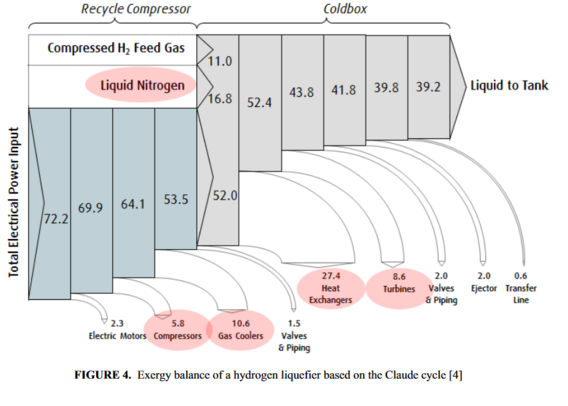
@Hypx There's a really fantastic illustration of that from an article that that cites, https://pubs.aip.org/aip/acp/article/1573/1/1311/880319/The-latest-developments-and-outlook-for-hydrogen that illustrates the very considerable amount of energy lost even with prechilled hydrogen compression to both the prechilling (LN2 production, in this case) but primarily due to adiabatic compression.
latest developments and outlook for hydrogen liquefaction technology

Liquefied hydrogen is presently mainly used for space applications and the semiconductor industry. While clean energy applications, for e.g. the automotive sect

AIP Publishing
@Hypx The end state here is liquefied hydrogen, rather than compressed hydrogen, but it illustrates just how substantial the losses due to adiabatic heating and then recooling down to ambient are. Much of the energy is metaphorically going over the side as low-temperature heat which cannot be recovered by a turbine or other system when decompressing the gas after it has been cooled.
@ckfinite Which are absurdly outdated systems. Modern systems are vastly more efficient.
@Hypx Can you please provide a paper that characterizes such a system?