 Benjamin Dumke-von der Ehe
I recently learned about a cool science experiment you can do at home. I tried it out today and it works!
Did you know you can **measure the speed of light** with a couple of marshmallows and a microwave oven?
🧵
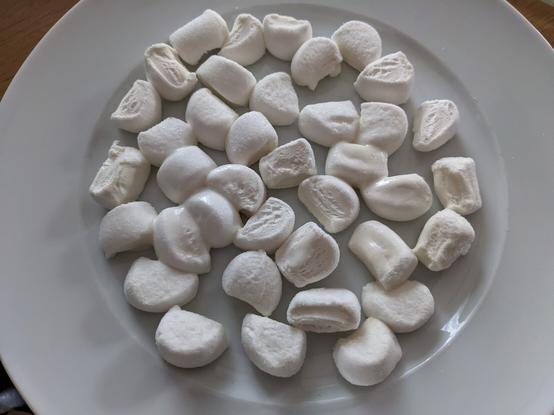
I recently learned about a cool science experiment you can do at home. I tried it out today and it works!
Did you know you can **measure the speed of light** with a couple of marshmallows and a microwave oven?
🧵
Remove the rotating plate from the microwave, and place a (stationary) plate with a bunch of marshmallows in it.
Let the microwave run in 5-second increments until you see the first marshmallows start melting (10-15 seconds total).
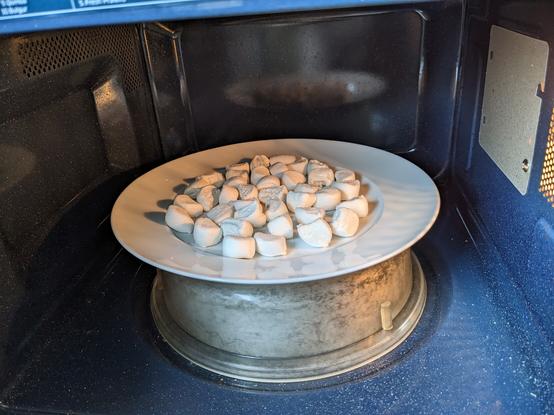
You'll see they only start melting in specific spots. That because the microwaves are standing waves, and so they only provide energy where the peaks and valleys are.
(That's why you usually have the rotating plate).
Find the centers of the melting areas and measure the distance between those.
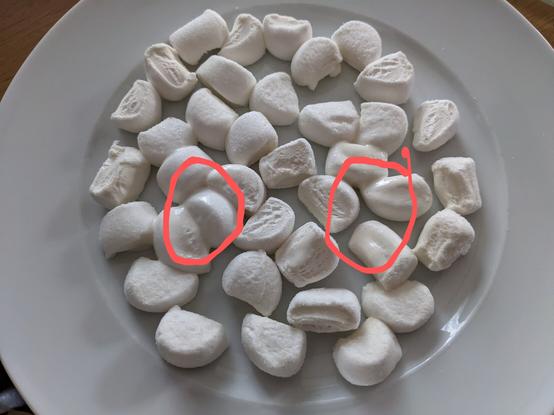
This distance is *half* the wavelength (because of how the waves oscillate). So you multiply it by two.
The frequency of the waves is usually written on a sticker on the microwave oven (it's probably around 2450 MHz).
And frequency times wavelength = speed of light.
I measured 343,000 km/s which is pretty close to the correct 299,792, considering the imprecise (and delicious) measuring device!
@revk True, but that's the case for most experiments. You take existing knowledge and your measurements and end up with new numbers.
Or you actually just do an experiment to *confirm* predictions of a theory, without uncovering anything new.
When you let high school students measure the gravitational acceleration by dropping a ball and timing it, it's kind of the same. Except that you don't have marshmallows 😄
@balpha Oh, I agree, I am just arguing that the existing knowledge being used is the thing you claim to be measuring 🙂
If the microwave manufacturer had taken the wavelength and used a completely different speed of light to calculate the frequency and used that on the label, you would have come up with that wrong answer.
But nit picking, as always...
 Graham Sutherland / Polynomial
 Teri Yaki 🖌️🎹🚲💻
 Cam
Cam RevK
RevK 
 Josh Gister