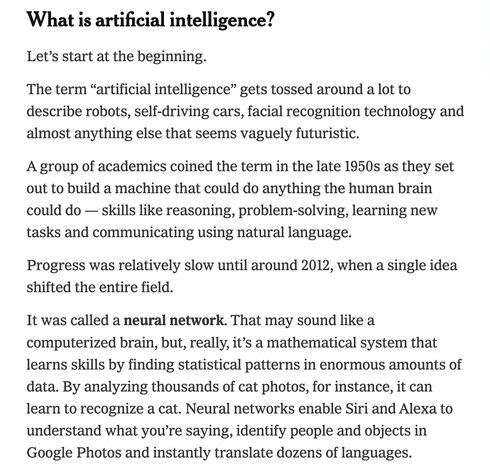
@Mer__edith So I guess nobody associated with this piece had ever seen T2: Judgment Day? Because in that, there's a bit where the T-800 says "My brain is a neural net processor. I can learn."
21 years before 2012.
It's like they didn't do even rudimentary fact-checking.
@Mer__edith @kagan Came here to mention T2. Nobody watches the classics any more. 😢
And while computing historians are great, taking 30 seconds to Google "neural network history" would be a good start. 😡
@Mer__edith that's so weird to read from them. In the early 2000s I had a book called "Yes, We Have No Neutrons" about cold fusion and other failed technologies. It included neural nets! Presented as a cool idea from the 80s that didn't work out.
In fact, it was also weird when I saw a talk in 2012 about new ML developments and realized it boiled down to "we figured out if we used enough computers, neural nets start to do what we were hoping."
Thanks for pushing back on the NYT!
A lot of what we're seeing now falls under the purview of the Chinese Room problem, formally presented as such by John Searle in 1980 but with a rich history going all the way back to Liebniz and even before. This is hardly new philosophical or even technological ground.
But in obfuscation and mysticality, the narrative serves a purpose in attracting those investors who are always after the new, the magical, the wondrous, and unwilling to crack open a history book.
@Mer__edith yeah, apparently the world forgot about deep blue and others.
I remember back in 2008-2010 bumping into a bunch of shitty chat bots in secondlife.
Only recently has their been hype again. Why?
-its matured enough that it might be practical for a non-compsci major to leverage
-its matured enough to have more obvious practical applications (generating scripts and regular expressions as a programmer)
-its been opened to the public so they can play with it, leverage it