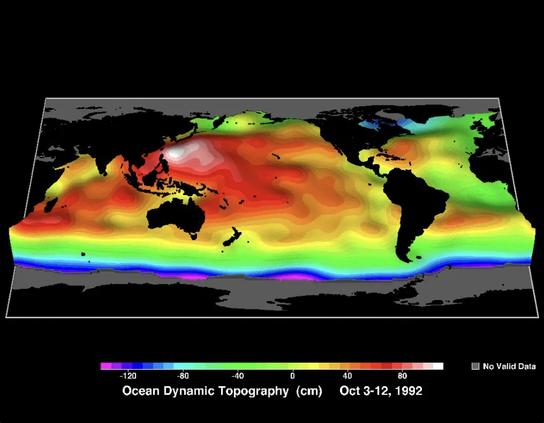
Even if you took away the waves, the ocean surface would not be flat.  Thatโ€™s partly because Earthโ€™s gravity varies across the surface, pulling water around and creating huge lumps and holes up to 100m high/deep. But then temperature, salinity, atmospheric pressure and currents add extra dynamic bumps on top of this of a few tens of cm.  Tracking these lets us measure ocean currents from satellites, which is an astonishing feat.
 
#ocean #satellites #OceanPhysics
@helenczerski whaaaaaaaat!!! It has been a long time since a scientific fact caught me so off guard!!
@helenczerski Wow! Every day really is a school day! Thank you!! Set out like that you can see just how vast the Pacific Ocean is too.
@helenczerski I remember reading a Popular Science article in the 80's about a US N sea height study, mind-boggling variation.
@helenczerski Is not the variation due to changes in gravity still flat, as that's the definition of flat
@iccaldwell @helenczerski Well, the earth is a globe so if nothing else it will vary over distances due to that.
@helenczerski WHUT?!?!๐Ÿ˜ณ๐Ÿ˜ฑ
@helenczerski very wow.....๐Ÿค”๐Ÿค”๐Ÿค”๐Ÿค”
@helenczerski I was thinking about this yesterday. I was like "is sea level the same everywhere, really? ๐Ÿค”"
@helenczerski Should 100m high/deep be 100cm as the key indicates?
@allanwolfe @helenczerski I'd suggest 100 meters is relevant.
@allanwolfe The picture shows dynamic topography, which is as the key indicates - tens of cm. But the geoid variations - the bigger, fixed hills and troughs - are indeed of the order of tens of metres. The dips just south of India is around 70 metres deep.

@helenczerski @allanwolfe

Do you have an image that is more recent than 1992 ?

@helenczerski Thanks for the lucid explanation. I appreciate and enjoy your toots.
@helenczerski Not a lot of people know the word 'scend'.
Definition of SCEND

Definition of 'scend' by Merriam-Webster

@helenczerski But if you shrank it down to the size of a billiard ball the earth would stil feel smoother over most of it's surface but for some rough spots for the himalayas and marianas tranch; (there's even a very in depth (lol) study :) https://billiards.colostate.edu/bd_articles/2013/june13.pdf.

@helenczerski

Can these ocean models and satellite imagery systems track the "stuttering" of ocean currents, like the Gulf jet stream in the Atlantic that warms the UK & Scandinavia?

Or the Humboldt current along the West coast of the Americas?

https://www.cnn.com/2021/08/06/world/climate-gulf-stream-collapse-warning-study-intl/index.html

@helenczerski sorry i stopped at "Earthโ€™s gravity varies across the surface"

i'll read the rest later

@helenczerski FASCINATING!! So does this mean "sea level" is not constant in the seas?

@helenczerski Mountain heights are generally expressed as an elevation from the 'closest' sea level.
These huge deviations of the sea level, when compared to a fictive sphere, means that "4000 meters above sea level" in two different regions of the earth could not be blindly compared. Something high-mountain climbers are very much aware of.

It also makes me smile when people dispute the altitude of a given mountain top. Like: is it 4800 or 4810 meters high? ๐Ÿ˜„

@helenczerski

100 *meter* variation due to varying local gravity, or 100 *centimeter* variation due to gravity? 100 meters would be a LOT.

@helenczerski okay I knew this was happening to some degree but my mental image of it was off by over an order of magnitude. A hundred meters is wild
Why isn't the Earth a perfect sphere?

Donโ€™t worry, youโ€™re not alone โ€“ our planet is bulging slightly around its midriff as well.

BBC Science Focus Magazine
@helenczerski Are there similar maps for the 100m variations? The image shows only ~2m span of variation, unless I'm misinterpreting it. I'm astonished it's as much as 100m variation. What kind of differences in crust & below give rise to such big variations in gravity? Metal flows/concentrations in core? Or in crust?

@helenczerski

Fascinating how complex it all is.