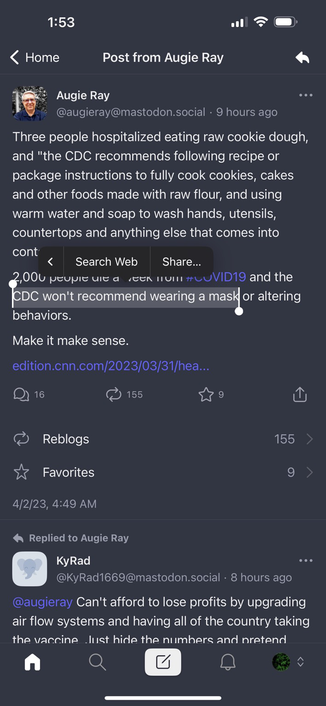
Three people hospitalized eating raw cookie dough, and "the CDC recommends following recipe or package instructions to fully cook cookies, cakes and other foods made with raw flour, and using warm water and soap to wash hands, utensils, countertops and anything else that comes into contact with raw four."

2,000 people die a week from #COVID19 and the CDC won't recommend wearing a mask or altering behaviors.

Make it make sense.

https://edition.cnn.com/2023/03/31/health/salmonella-outbreak-flour/index.html

@augieray Can't afford to lose profits by upgrading air flow systems and having all of the country taking the vaccine. Just hide the numbers and pretend Covid is gone.
Masks and Respirators

Wear a mask with the best fit, protection, and comfort for you.

Centers for Disease Control and Prevention

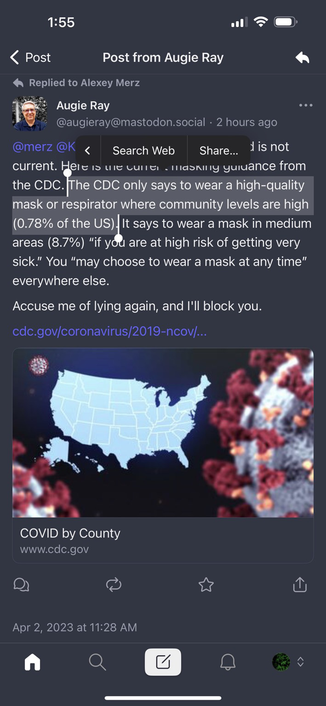
@merz @KyRad1669 That info you shared is not current. Here is the current masking guidance from the CDC. The CDC only says to wear a high-quality mask or respirator where community levels are high (0.78% of the US). It says to wear a mask in medium areas (8.7%) “if you are at high risk of getting very sick.” You “may choose to wear a mask at any time” everywhere else.

Accuse me of lying again, and I'll block you.

https://www.cdc.gov/coronavirus/2019-ncov/your-health/covid-by-county.html

COVID by County

COVID-19 Community Levels help you decide your prevention steps.

Centers for Disease Control and Prevention
@iamverysleepy @merz @KyRad1669 Not sure the point you think you're making. If you think the CDC lightly recommending less than 1% of the US mask contradicts my other statement statement,i think you're wrong. Half the US is at high or substantial transmission. COVID is rising in wastewater. Around 2,000 Americans die from COVID weekly. Suggesting 0.78% of the US mask is NOT reasonable or serious mask guidance.

@augieray @iamverysleepy @KyRad1669 At this point morbidity and mortality are comparable to a relatively bad seasonal flu year. And a large majority of that morbidity and mortality are due to lack of vaccination or under-vaccination. But highly effective COVID-19 vaccines are in fact available.

Sure, mask in public indoor spaces, on transit, etc. I do. But I don't pretend that masking is remotely as important as vaccination and the bivalent boost.

Because it's not.

@merz @augieray @iamverysleepy @KyRad1669 That's not remotely true. This year was a bad flu year, do you want to see how it compared to covid deaths?

@sashafox @augieray @iamverysleepy @KyRad1669

What I wrote: "At this point morbidity and mortality are comparable to a relatively bad seasonal flu year."

What part of "at this point" are you finding it difficult to parse?

Please let me know. I'd be delighted to help you understand this.

PS, take a look at the CURRENT situation (as in, right now — that means the farthest right part of the graph, i.e., "At this point") and how far the red line is from the double black line. It's not far.

@merz @augieray @iamverysleepy @KyRad1669 The data shows that is not true.

@sashafox @augieray @iamverysleepy @KyRad1669 The data shows that what, exactly, is not true?

Be specific. Show your work.

@sashafox @augieray @iamverysleepy @KyRad1669

The lower black line shows expected flu and pneumonia (which is largely due to un-coded flu) mortality for a typical year. We can see this pattern with the overlay of the red and black lines in 2019.

The red line is not "many times" higher in 2023. It's about 1.5X to 2X as high. And right now, it's only a few percent higher.

In other words, for 2013 generally, COVID-19 mortality is indeed comparable to flu mortality.

@merz @augieray @iamverysleepy @KyRad1669 Do you believe that every single pneumonia death that isn't covid is caused by the flu? Because that isn't true. The increase you saw during the flu season was mostly because of the flu, but many other illnesses can cause pneumonia, and are present all year.

@sashafox @augieray @iamverysleepy @KyRad1669

The largest fraction of pneumonia deaths have historically been from secondary infections due to influenza. That's been established for decades.

Do not confuse *coded* flu deaths (on the graph you posted) with TOTAL flu deaths.

Graph: Time series graph of influenza as a proportion of total pneumonia and influenza mortality, all ages

https://www.ncbi.nlm.nih.gov/pmc/articles/PMC3827586/

Influenza as a proportion of pneumonia mortality: United States, 1959–2009

As causes of death, influenza and pneumonia are typically analyzed together. We quantify influenza’s contribution to the combined pneumonia and influenza mortality time series for the United States, 1959–2009. A key statistic is I/(P+I), ...

PubMed Central (PMC)

@sashafox @augieray @iamverysleepy @KyRad1669 As the above linked article says, "What gets recorded on the death certificate and why has long been a subject of interest for historical demographers (Alter and Carmichael 1996, 1997, 1999). This study shows that, influenza versus pneumonia death classification is, in part, influenced by medical-social factors...

These results strongly endorse the standard practice of combined analysis of pneumonia and influenza mortality."

@merz @augieray @iamverysleepy @KyRad1669 It's not rational to assume that they are just far worse at testing for flu than they are for covid, and to just dismiss what the actual data shows.

@sashafox @augieray @iamverysleepy @KyRad1669 It's not a question of testing. It's a question of what the death certificate says. And, as the linked article shows, that is wildly variable.

That's why the graph you posted specifies *coded* flu deaths, and why estimates of flu prevalence, morbidity, and mortality are always much higher than the number of coded cases.

@merz @augieray @iamverysleepy @KyRad1669 I'm talking about the actual data showing confirmed cases.

@sashafox @augieray @iamverysleepy @KyRad1669 Those data don't tell you about actual clinical outcomes. What does? The black and red lines on the graph that you posted.

Note that the worse the flu data are for 2022-23 season, the smaller the fraction of that red line that's attributable to COVID-19.

@sashafox @augieray @iamverysleepy @KyRad1669

And, again, note that people who have been vaccinated and boosted with the bivalent booster are FOURTEEN (14) times less likely to die from COVID-19 than people who are unvaccinated.

https://www.cdc.gov/mmwr/volumes/72/wr/mm7206a3.htm

Going back to the original post in this thread, there is no field study of mask efficacy that shows anything remotely like that protective effect.

COVID-19 Incidence and Death Rates Among Unvaccinated ...

This report describes higher protection against COVID-19 infection and death among people who received an updated booster than people who received a monovalent booster.

Centers for Disease Control and Prevention

@merz @augieray @iamverysleepy @KyRad1669 If your argument is just "vaccines are more effective than masks, so we don't need masks", that's also another completely illogical argument.

That's like saying "If the most effective way to reduce your chance of a car accident is to not drive drunk, then I don't need to bother with anything else as long as I'm sober."

You still want to use turn signals and not speed.

@sashafox @augieray @iamverysleepy @KyRad1669

How large do you think the protective effect of masks is? And on what basis do you think that?

I think there are good laboratory studies indicating that an N95 offers some protection, depending on fit, exposure time, exposure risk, etc.

I know of very, very few field studies that show much benefit.

So my answer is this: if we are to make evidence-based choices, vaccination is a slam-dunk. Masks are "probably useful, but don't know how much."

@merz @augieray @iamverysleepy @KyRad1669 So why do you believe far fewer people are catching the flu and it was much easier to contain now that people are masking?

@sashafox @augieray @iamverysleepy @KyRad1669

If the protective effect of masks is large, it should be easy to measure the effect size.

Point me to the peer-reviewed papers showing large protective effect sizes for mask use.

I think masks help. I don't pretend to know whether the protection is 1.2X or 10X. But if it's the latter, that should be easy to show.

Respiratory virus shedding in exhaled breath and efficacy of face masks - Nature Medicine

A study of 246 individuals with seasonal respiratory virus infections randomized to wear or not wear a surgical face mask showed that masks can significantly reduce detection of coronavirus and influenza virus in exhaled breath and may help interrupt virus transmission.

Nature
@merz @augieray @iamverysleepy @KyRad1669 (seasonal human coronavirus is not covid btw)