
ChatGPT Outperforms Crowd-Workers for Text-Annotation Tasks

with Meysam Alizadeh & Maël Kubli

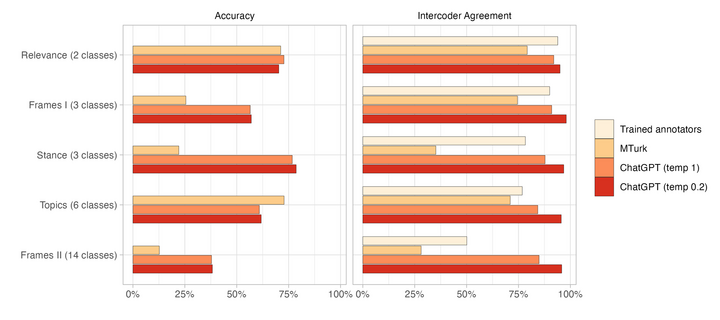
We find that zero-shot #ChatGPT:
> has better accuracy than #MTurk
> has better intercoder agreement than MTurk and trained coders
> is 20x cheaper than MTurk
https://arxiv.org/abs/2303.15056

ChatGPT Outperforms Crowd-Workers for Text-Annotation Tasks

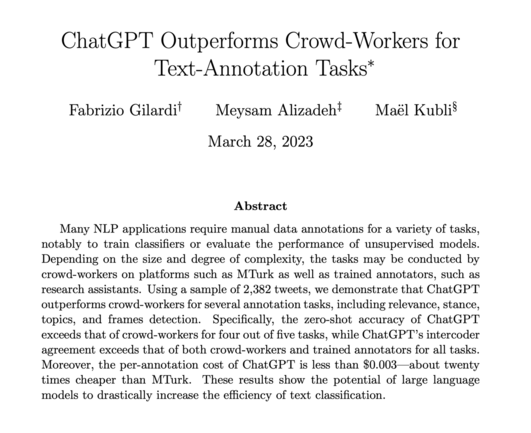
Many NLP applications require manual data annotations for a variety of tasks, notably to train classifiers or evaluate the performance of unsupervised models. Depending on the size and degree of complexity, the tasks may be conducted by crowd-workers on platforms such as MTurk as well as trained annotators, such as research assistants. Using a sample of 2,382 tweets, we demonstrate that ChatGPT outperforms crowd-workers for several annotation tasks, including relevance, stance, topics, and frames detection. Specifically, the zero-shot accuracy of ChatGPT exceeds that of crowd-workers for four out of five tasks, while ChatGPT's intercoder agreement exceeds that of both crowd-workers and trained annotators for all tasks. Moreover, the per-annotation cost of ChatGPT is less than $0.003 -- about twenty times cheaper than MTurk. These results show the potential of large language models to drastically increase the efficiency of text classification.

arXiv.org

@fgilardi Cool! Looking forward to see if I can replicate some of this on my data - I already wrote Mael about this but I'd hypothesize it will be harder for an LLM to do this for my local discourse data... but it will be interesting to see how the purposes of human expert annotation will shift. I think in some ways it becomes even more important.

Also: you had good codebooks - how much were these the results of knowledge gained from iterating at the beginning of annotation?

@mario_angst_sci we didn't test different codebooks on ChatGPT because we wanted to use exactly the same we used for research assistants
@fgilardi Yeah that makes a lot of sense. I was more alluding to the fact that (at least for me), the final production codebooks are often the results of iterative rounds of annotation and discussions within the team.
That is one example in my opinion of where the purpose of annotation might shift to - codebook development, test set creation, refinement of complex concepts...
@mario_angst_sci oh yes absolutely, our codebooks involved the process you describe
@fgilardi which in a way then is somehow important in this context - the LLM implicitly still relied on/ probably could not have worked so well without human annotators creating quality codebooks through immersion in the corpus. I think these nuances are going to be quite relevant to figure out in future workflows.