Okay, so that AI letter signed by lots of AI researchers calling for a "Pause [on] Giant AI Experiments"? It's just dripping with AI hype. Here's a quick rundown.

First, for context, note that URL? The Future of Life Institute is a longtermist operation. You know, the people who are focused on maximizing the happiness of billions of future beings who live in computer simulations.

https://futureoflife.org/open-letter/pause-giant-ai-experiments/

#AIhype

>>

Pause Giant AI Experiments: An Open Letter - Future of Life Institute

We call on all AI labs to immediately pause for at least 6 months the training of AI systems more powerful than GPT-4.

Future of Life Institute

For some context, see: https://aeon.co/essays/why-longtermism-is-the-worlds-most-dangerous-secular-credo

So that already tells you something about where this is coming from. This is gonna be a hot mess.

>>

Why longtermism is the world’s most dangerous secular credo | Aeon Essays

It started as a fringe philosophical theory about humanity’s future. It’s now richly funded and increasingly dangerous

Aeon

There a few things in the letter that I do agree with, I'll try to pull them out of the dreck as I go along.

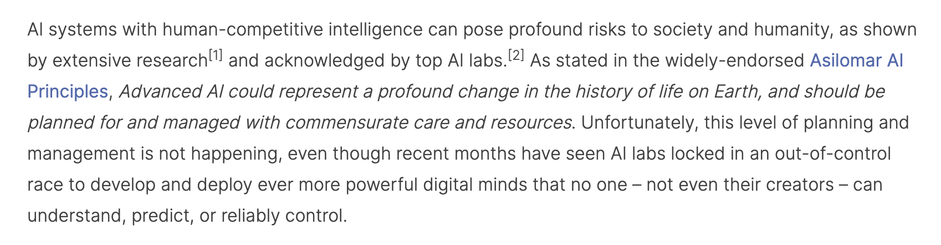
So, into the #AIhype. It starts with "AI systems with human-competitive intelligence can pose profound risks to society and humanity, as shown by extensive research[1]".

>>

Footnote 1 there points to a lot of papers, starting with Stochastic Parrots. But we are not talking about hypothetical "AI systems with human-competitive intelligence" in that paper. We're talking about large language models.

https://faculty.washington.edu/ebender/stochasticparrots/

And the rest of that paragraph. Yes, AI labs are locked in an out-of-control race, but no one has developed a "digital mind" and they aren't in the process of doing that.

>>

Emily M. Bender

Emily M. Bender, Professor and Director, Professional MS in Computational Linguistics, Department of Linguistics University of Washington.

And could the creators "reliably control" #ChatGPT et al. Yes, they could --- by simply not setting them up as easily accessible sources of non-information poisoning our information ecosystem.

And could folks "understand" these systems? There are plenty of open questions about how deep neural nets map inputs to outputs, but we'd be much better positioned to study them if the AI labs provided transparency about training data, model architecture, and training regimes.

>>

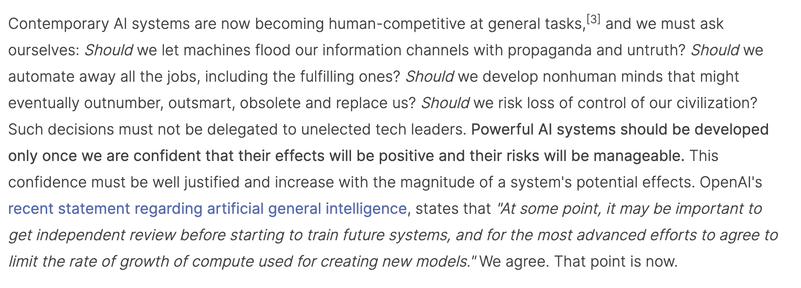
Next paragraph. Human-competitive at general tasks, eh? What does footnote 3 reference? The speculative fiction novella known as the "Sparks paper" and OpenAI's non-technical ad copy for GPT4. ROFLMAO.

>>

@[email protected] on Mastodon on Twitter

“Remember when you went to Microsoft for stodgy but basically functional software and the bookstore for speculative fiction? arXiv may have been useful in physics and math (and other parts of CS) but it's a cesspool in "AI"—a reservoir for hype infections https://t.co/acxV4wm0vE”

Twitter

I'm mean, I'm glad that the letter authors & signatories are asking "Should we let machines flood our information channels with propaganda and untruth?" but the questions after that are just unhinged #AIhype, helping those building this stuff sell it.

>>

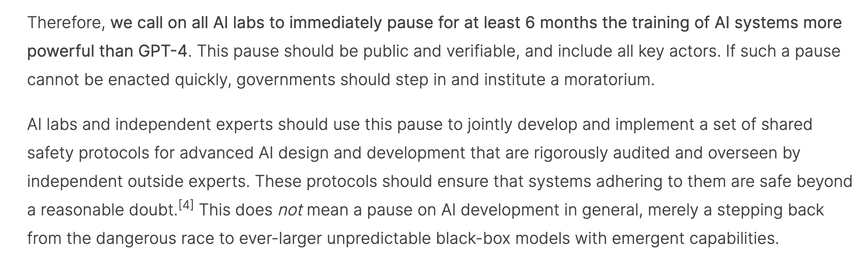
Okay, calling for a pause, something like a truce amongst the AI labs. Maybe the folks who think they're really building AI will consider it framed like this?

>>

Just sayin': We wrote a whole paper in late 2020 (Stochastic Parrots, 2021) pointing out that this head-long rush to ever larger language models without considering risks was a bad thing. But the risks and harms have never been about "too powerful AI".

Instead: They're about concentration of power in the hands of people, about reproducing systems of oppression, about damage to the information ecosystem, and about damage to the natural ecosystem (through profligate use of energy resources).

>>

They then say: "AI research and development should be refocused on making today's powerful, state-of-the-art systems more accurate, safe, interpretable, transparent, robust, aligned, trustworthy, and loyal."

Uh, accurate, transparent and interpretable make sense. "Safe", depending on what they imagine is "unsafe". "Aligned" is a codeword for weird AGI fantasies. And "loyal" conjures up autonomous, sentient entities. #AIhype

>>

Some of these policy goals make sense:

>>

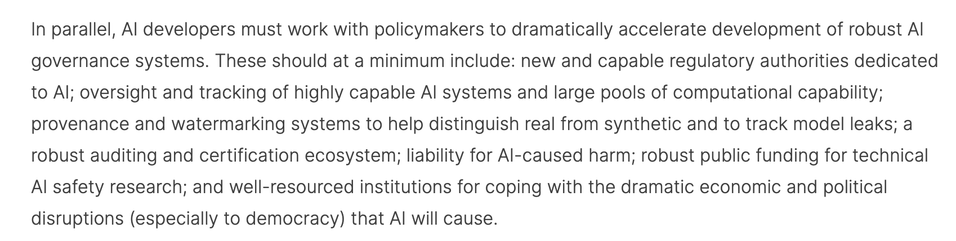
Yes, we should have regulation that requires provenance and watermarking systems. (And it should ALWAYS be obvious when you've encountered synthetic text, images, voices, etc.)

Yes, there should be liability --- but that liability should clearly rest with people & corporations. "AI-caused harm" already makes it sound like there aren't *people* deciding to deploy these things.

>>

Yes, there should be robust public funding but I'd priortize non-CS fields that look at the impacts of these things over "technical AI safety research".

Also "the dramatic economic and political disruptions that AI will cause". Uh, we don't have AI. We do have corporations and VCs looking to make the most $$ possible with little care for what it does to democracy (and the environment).

>>

@emilymbender

> I'd priortize non-CS fields that look at the impact

Thank you for this important observation. ICYMI, I wrote about this in WIRED this week https://www.wired.com/story/tech-governance-public-health/

To Hold Tech Accountable, Look to Public Health

The field of public health has transformed medicine, yet failed the most vulnerable. This trajectory can be avoided.

WIRED