Another long đź§µ on #COVID19 status & risks. I was inspired as a result of traveling this week. It's simply astonishing how many people are pretending the risks are the same as they were in 2019. While COVID isn't likely to swamp hospitals as it did in 2020 and 2021, we still face significant health threats that should not be ignored. You don't need to isolate, but there's a wealth of things you can do between the two extremes of locking yourself at home and pretending COVID risks don't exist.
A recent CDC report on COVID as a cause of death noted: “Emerging evidence suggests that SARS-CoV-2, the virus that causes COVID-19, can have lasting effects on nearly every organ and organ system of the body weeks, months, and potentially years after infection. Documented serious post-COVID-19 conditions include cardiovascular, pulmonary, neurological, renal, endocrine, hematological, and gastrointestinal complications, as well as death.”
https://www.cdc.gov/nchs/data/nvss/vsrg/vsrg03-508.pdf
(Despite the voluminous evidence that COVID is more a hazard of longer-term complications than severe, acute illness, the CDC continues to emphasize the Community Levels map, which is only based on hospitalizations, rather than the Transmission map. Currently, the Community map is mostly green, but two-thirds of the US remains in the high or substantial transmission level.)
https://covid.cdc.gov/covid-data-tracker/#county-view?list_select_state=all_states&list_select_county=all_counties&data-type=Risk
COVID Data Tracker

CDC’s home for COVID-19 data. Visualizations, graphs, and data in one easy-to-use website.

Centers for Disease Control and Prevention
A recent report from DHS notes: “COVID-19 symptoms commonly persist for weeks to months after initial onset in up to 73% of those infected. In a cohort of COVID-19 patients, 39% reported symptoms 7-9 months after initial infection. One year after intensive care unit (ICU) admission for COVID-19, lingering physical (74% of 246 ICU patients), mental (26%), and cognitive (16%) symptoms were common, with 58% of patients experiencing issues with returning fully to work.”
https://www.dhs.gov/publication/st-master-question-list-covid-19
Dr. Leora Horwitz, of NYU Langone, was interviewed on NPR and said, “It's clearly a meaningful proportion of people who originally get COVID who go on to still have symptoms months later... We don't know very much yet about treating it. Right now, people are mostly treating the symptoms... I think it is important that we learn how to live with a virus that's never going to go away. But I think what that means is trying to minimize our risk.”
https://www.npr.org/2023/03/11/1162836454/heres-what-we-know-about-long-covid-and-its-treatment
The AMA notes reinfection risks: “Each subsequent COVID infection will increase your risk of developing chronic health issues like diabetes, kidney disease, organ failure and even mental health problems... This dispels the myth that repeated brushes with the virus are mild and you don’t have to worry about it. The more times you get COVID, the more likely you are going to get a possible complication, be it lung complication, heart complication or mental health problems.”
https://www.ama-assn.org/delivering-care/public-health/what-doctors-wish-patients-knew-about-covid-19-reinfection
What doctors wish patients knew about COVID-19 reinfection

Newer COVID-19 variants are contributing to second or even third SARS-CoV-2 infections. Learn how to avoid the worse outcomes linked to reinfection.

American Medical Association
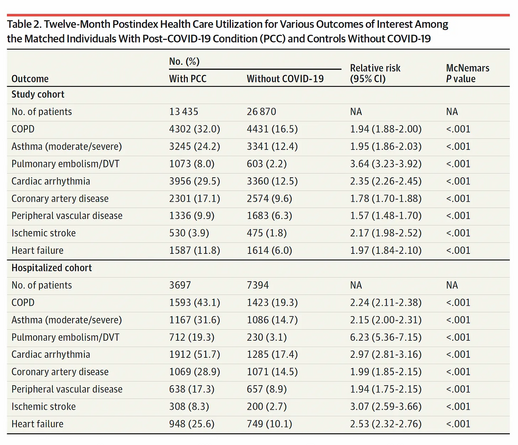
One recent study (see image) found that, compared with those who hadn't had #COVID19, patients with post-COVID Condition (PCC) had double the risk of asthma, COPD, and heart failure and more than double the risk of stroke and cardiac arrhythmia.
https://jamanetwork.com/journals/jama-health-forum/fullarticle/2802095
One-Year Adverse Outcomes Among US Adults With Post–COVID-19 Condition vs Those Without COVID-19

This cohort study aims to quantify 1-year outcomes among individuals meeting a post–COVID-19 condition definition compared with a control group of individuals without COVID-19.

In fact, the number of studies that find #COVID19 can have longer-term effects on brains, hearts, immune systems, reproductive systems, and cause other health impairments is now approaching almost 200 in number.

https://docs.google.com/spreadsheets/d/12VbMkvqUF9eSggJsdsFEjKs5x0ABxQJi5tvfzJIDd3U/edit?usp=sharing

COVID-19/SARS-CoV-2 Studies

Google Docs
The WHO continues to urge masking, saying we should, “Make wearing a mask a normal part of being around other people.” It states you should #WearAMask “When in a crowded, enclosed or poorly ventilation area. If you have any doubts regarding the quality of ventilation, wear a mask.” None of us are truly certain about the quality of ventilation in the conference rooms, theaters, airports, and trains we're in, so that means we should be wearing a mask.
https://www.who.int/emergencies/diseases/novel-coronavirus-2019/advice-for-public/when-and-how-to-use-masks
When and how to use masks

WHO's guidance and advice on the use of masks to protect against and limit the spread of COVID-19.

On planes, there is this belief that air quality is better, and it is--once in the air! But during boarding, taxiing and deplaning, the amount of rebreathed air is very high, which means viral transmission can be great. A study several months ago found 81% of international flights at JFK had toilet samples positive for COVID. You should assume any sufficiently crowded plane (or conference room or bus) has someone with #COVID19 and act accordingly.
https://www.irishtimes.com/business/transport-and-tourism/are-planes-as-covid-safe-as-the-airlines-say-1.4485547
Are planes as Covid-safe as the airlines say?

Boarding, disembarking and passport control appear the big risks

The Irish Times

A word on masking: For weeks, the media has been full of headlines about a supposed “gold standard” study in the Cochrane Review that found masks don't work. It was a ridiculous finding on the face of it, and the criticism of the study's methodology and authors was immediate. Now, in fact, the Cochrane Review itself has made a statement indicating that the study and its findings were “misinterpreted.”

https://www.cochrane.org/news/statement-physical-interventions-interrupt-or-reduce-spread-respiratory-viruses-review

https://www.nytimes.com/2023/03/10/opinion/masks-work-cochrane-study.html

Statement on 'Physical interventions to interrupt or reduce the spread of respiratory viruses' review

COVID is not anywhere near done evolving. New variants are emerging after XBB.1.5. No one is sure what the next variant will be to knock down XBB.1.5, but XBB has spread so widely and mutated so rapidly, scientists ran out of characters. New descendants are named things like EK.2, and many have more immune-evasive attributes than any variant we've yet seen. (It's too early to say, but the EK variants are showing an almost 50% growth advantage in the very early going.)
https://cov-spectrum.org/explore/World/AllSamples/Past6M/variants?nextcladePangoLineage=EK*&
covSPECTRUM

covSPECTRUM is an interactive platform aiming to help scientists investigate and identify variants of SARS-CoV-2.

Meanwhile, we are less able to track and stay informed of how COVID is changing. Johns Hopkins stopped COVID tracking, and the UK ONS survey says it will end this month. Governments and institutions are ending COVID monitoring despite WHO advising against this. Maria Van Kerkhove, WHO's COVID-19 Technical Lead, just tweeted a thread saying, “Governments need to be vigilant. Do not let down your guard. Do not dismantle systems.” But, no one is listening.
https://twitter.com/mvankerkhove/status/1634485429465407488
تغريدة / Twitter

Twitter
FreebirdFrolic (@[email protected])

Attached: 1 image @[email protected] In Canada, you can consult, The Canadian Covid Hazard Index. Updated stats on Fridays. @[email protected] Our Canadian Treasure. https://covid19resources.ca/covid-hazard-index/

Universeodon Social Media