📣 New #BMJ paper 📭 with colleagues from #KCE 🇧🇪, https://twitter.com/KCEfgov

Is replacing randomized controlled trials #RCTs 🎲 ⚖️ with real-world data #RWD 👩‍⚕️ 🗒️ for regulatory decisions a self-fullfilling prophecy?

How does the enthusiasm for observational data from routine practice affect the availability of robust #evidence 🔎 for decision making in our health care systems? 🏥

As a brief introduction to the topic, read our #thread of 8 posts 🧵

https://www.bmj.com/content/380/bmj-2022-073100

KCE (@KCEfgov) / Twitter

Federaal Kenniscentrum voor de Gezondheidszorg-Centre Fédéral d'Expertise des Soins de Santé-Belgian Health Care Knowledge Centre

Twitter

2/

Attempts to accelerate drug #approval have resulted in more limited evidence on benefits and harms of new #drugs at marketing authorisation.

This makes it difficult to place these drugs in the treatment landscape and to determine appropriate prices.

Because this is affecting decision making in health care systems, the debate about the evidence required for regulatory approval is relevant beyond regulatory agencies:

https://www.nejm.org/doi/full/10.1056/NEJMsb1901642

https://ascpt.onlinelibrary.wiley.com/doi/10.1002/cpt.2083

3/

Investigating new drugs in routine practice after marketing authorisation (i.e. using #RealWorldData has been an integral part of accelerated approval concepts.

Recently, the debate was fuelled by availability of large data sets from electronic sources, e.g. electronic health records, claims data or patient registries.

In addition, there is the narrative of #RCTs becoming more and more difficult due to small patient populations or high costs.

4/

Observational data from routine practice (#RWD) are promoted to be a way out of these problems.

The use of observational RWD might even expand into drug development before regulatory approval: external control arms from the 'real world' are suggested as an alternative to RCTs.

(#FDA, however, seems to be sceptical, see recent guidance: https://www.fda.gov/regulatory-information/search-fda-guidance-documents/considerations-design-and-conduct-externally-controlled-trials-drug-and-biological-products )

Considerations for the Design and Conduct of Externally Controlled

Considerations for the Design and Conduct of Externally Controlled Trials for Drug and Biological Products

U.S. Food and Drug Administration

5/

A case study of pivotal trials in #EMA approvals of new cancer treatments in r/r #DLBCL showed that RCTs were available for 2 out of 6 approvals; 4 only had single-arm trials (Table in https://www.bmj.com/content/380/bmj-2022-073100).

However, the number of included patients was similar or even larger in single-arm studies than in RCTs

➡️ using single-arm studies 1️⃣ 💪 💊 does not seem to be related to the size of the patient population, it seems to be a choice rather than a necessity.

Replacing RCTs with real world data for regulatory decision making: a self-fulfilling prophecy?

Real world data are advocated as an alternative approach to RCTs for closing knowledge gaps on drugs, but Beate Wieseler and colleagues argue that this approach is the wrong remedy for current challenges in drug development ### Key messages Attempts to accelerate the provision of new treatments have led to evidence that is limited in quantity and quality being submitted for regulatory approval in recent years.12 Approvals based on single arm trials, for example, have become more frequent, such as for lisocabtagene maraleucel, a CAR-T cell therapy for patients with B cell lymphoma. Single arm trials are not informative enough to enable us to select the best therapy for a patient among several options. This lack of robust evidence, especially the lack of comparisons with standard care, has implications for decision making in clinical practice and health policy, as the place of new drugs in the treatment landscape remains unclear, and reimbursement and pricing decisions cannot be adequately informed.34 Current discussions of the most suitable study types for regulatory approval and the question of whether observational data instead of data from randomised controlled trials (RCTs) would suffice are relevant beyond regulatory agencies.56 The question is intertwined with the potential use of routine practice data, often referred to as real world data or real world …

The BMJ

6/

The narrative: 💬 RCTs are no longer possible due to small populations & RWD are readily available to solve the issue.

Is this decreasing the acceptance of RCTs? Is it affecting their perceived feasibility and thus becoming a self-fulfilling prophecy?
What's the problem with observational RWD?

This data can answer certain questions, e.g. about the size of a specific patient group. But it is ill-suited to measure treatment effects, i.e. health outcomes caually related to treatments.

7/

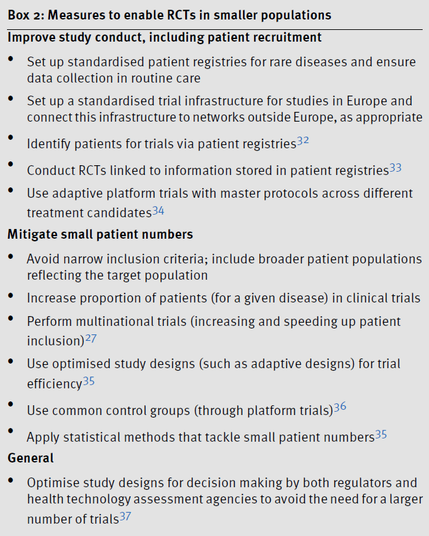
Given the inherent advantages of randomisation, the aim should be to ensure an
easier 🙂,
faster🏎️
and cheaper 💰
conduct of RCTs, also in small populations.

Here are our suggestions how to achieve this: Box 2 in https://www.bmj.com/content/380/bmj-2022-073100

DARWIN EU already integrates European disease registries; it’s scope should be expanded beyond non-interventional studies. DARWIN EU should enable registry-based pragmatic RCTs in routine practice settings.

Replacing RCTs with real world data for regulatory decision making: a self-fulfilling prophecy?

Real world data are advocated as an alternative approach to RCTs for closing knowledge gaps on drugs, but Beate Wieseler and colleagues argue that this approach is the wrong remedy for current challenges in drug development ### Key messages Attempts to accelerate the provision of new treatments have led to evidence that is limited in quantity and quality being submitted for regulatory approval in recent years.12 Approvals based on single arm trials, for example, have become more frequent, such as for lisocabtagene maraleucel, a CAR-T cell therapy for patients with B cell lymphoma. Single arm trials are not informative enough to enable us to select the best therapy for a patient among several options. This lack of robust evidence, especially the lack of comparisons with standard care, has implications for decision making in clinical practice and health policy, as the place of new drugs in the treatment landscape remains unclear, and reimbursement and pricing decisions cannot be adequately informed.34 Current discussions of the most suitable study types for regulatory approval and the question of whether observational data instead of data from randomised controlled trials (RCTs) would suffice are relevant beyond regulatory agencies.56 The question is intertwined with the potential use of routine practice data, often referred to as real world data or real world …

The BMJ

8/8

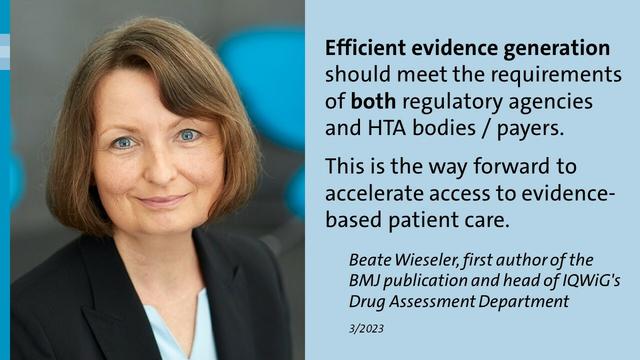
#EMA and #HTA bodies together should ensure pre-registration platform trials meet regulatory and HTA requirements.

Giving EMA a mandate to initiate these trials can support drugs development in small populations more efficiently than turning to non-randomised studies.

-
EDIT 📣

Our press release has just been published: https://www.iqwig.de/en/presse/press-releases/press-releases-detailpage_89728.html

Efficient RCTs with real world data for benefit assessments of drugs: accelerating evidence-based care

Together with authors from the Belgian HTA agency KCE, three IQWiG authors argue in the BMJ for efficiently planned and conducted RCTs, even in supposedly difficult areas.

IQWiG
KCE on Twitter

“New @bmj_latest paper 📭 with colleagues from https://t.co/ybem0vFc5z Is replacing randomized controlled trials #RCTs with real-world data #RWD for regulatory decisions a self-fullfilling prophecy? read it here https://t.co/K5YmFvOdMJ”

Twitter