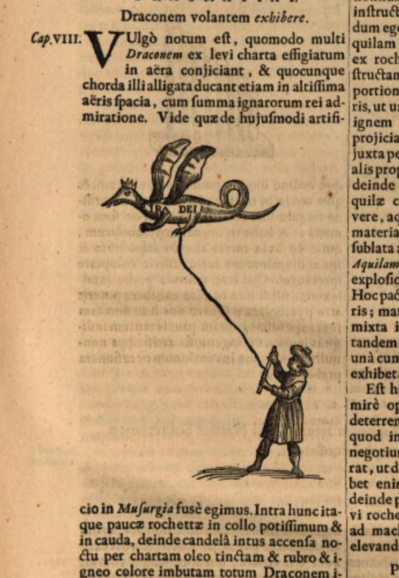
Take your dragon out for a fly. This is an early modern advice (from Athanasius Kircher), on how to and when to use your private #dragon to make an impression.

The image is part of his 1678 "Mundus Subterraneus" (access: https://www.digitale-sammlungen.de/de/view/bsb10806648?page=557 ), and describes the way of using a dragon by Jesuit missionaries to impress Non-Christians. When you zoom in, you see that the dragon features the Latin "Ira Dei": the wrath of God.

#Histodons @histodons

'Athanasii Kircheri E Soc. Jesu Mundus Subterraneus : In XII Libros digestus ; quo Divinum Subterrestris Mundi Opisicium, mira Ergasteriorum Naturæ in eo distributio, verbo pantamorphon Protei Regnum ; Universæ denique Naturæ Majestas & divitiæ summa rerum varietate exponuntur ... ; Ad Alexandrum VII. Pont. Opt. Max.. 2' - Digitalisat | MDZ

@dbellingradt @histodons Ironic, since later folklore often presents dragons as demonic familiar spirits.
@dbellingradt @histodons wait, is there a connection to the fact that the german words for kite and dragon are the same, "drachen"?

@b_age @dbellingradt @histodons
Yes, according to Wiktionary, although it seems the more common word for 'dragon' is Drache, & Drachen more specifically refers to 'kite' or 'fierce older woman'!
https://en.m.wiktionary.org/wiki/Drachen

Leo confirms this, but other words for kite also seem to exist (at least in regional dialects), like Windvogel (only kites with a line - but don't all kites have lines?) & Papierdrachen.
https://dict.leo.org/forum/viewWrongentry.php?idThread=967145&idForum=6&lang=en&lp=ende

Drachen - Wiktionary

@gardenvarietylinguist @dbellingradt @histodons yes, they state the connection is because dragons fly, and that is exactly what i supposed before seeing that picture. now i get the idea that it is maybe because those missionaries used dragon-shaped kites in specific. may be silly, but that's what triggered my "wait, ..."

@b_age @dbellingradt @histodons
Yeah exactly - what an interesting bit of history & etymology! I was also wondering if Papierdrachen might be an older form, which was shortened to Drachen in Standard German, but preserved in regional dialects.

If so, this would be a case of compound clipping similar to English 'microwave', which is most commonly a shortened version of 'microwave oven', but can also refer directly to a high frequency electromagnetic wave, depending on the context.

@gardenvarietylinguist @dbellingradt @histodons as a german who now existed quite a few decades i think i have _never_ heard anyone use the term papierdrachen, if not to distinguish it from kites made from some other, sturdier material or to explicitly make clear they're not talking about dragons. but maybe it just got replaced by the quite often used lenkdrachen, which means a steerable one with 2 lines. there to make clear what kind of drachen they mean, e.g. when asking for one in my toy shop
@dbellingradt @histodons For those who don't know German, the word Drachen means both dragon and kite (the toy, not the bird). And what I can read of the Latin here suggests that the dragon pictured is made of paper and glue, and has a candle in it for scaring people at night.
@y6nH Slight correction. In the dictionary, the headword for the beastie is Drache.
@dbellingradt This is why you always read the fine print before you convert.
@dbellingradt @histodons Geh zu ihr und lass deinen Drachen steigen!