
๐Ÿšฒ Maximizing bike infrastructure: how to connect a fragmented network using #python ๐Ÿ
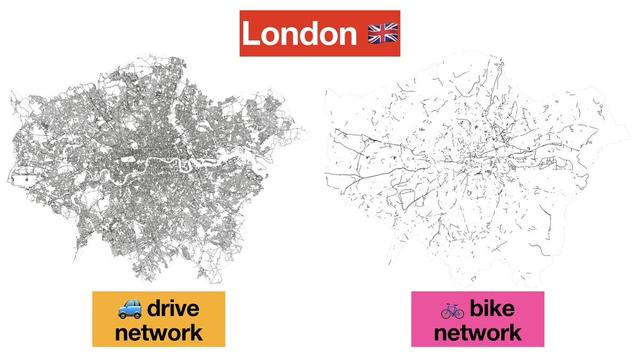
Take #London, a city with a drive network connected in one component, while their bike network has more that 3,000 patches.
(Read the full post here: https://luisnatera.com/posts/2023/02/maximizing-bike-infrastructure-how-to-connect-fragmented-bicycle-network-using-python/)
Maximizing bike infrastructure: How to connect a fragmented bicycle network using python

Recently I wrote about how fragment bicycle infrastructure can be (If you dinโ€™t get the email, make sure to subscribe here), even Amsterdam has some missing connections in its bicycle network, although not as many as London. Getting to know that the network is not complete is the first step towards having a good bicycle infrastructure network. The next step? Connect it.


Luis Natera, Ph.D.
How could it be connected? One approach is to find the two largest components, find the shortest distance between them and connected. Repeat until you have only one component.
This is an effective approach and it can be done in #Python
Following this approach and repeating it until all the components are connected into one single network can have a great impact in improving the bicycle connectivity in a city. See the example for Budapest:

Just by investing in five new kilometers, the network gets from bellow 25% of their connections in one component to more than 50% ๐Ÿคฏ. It is a great return of the investment.

https://luisnatera.com/posts/2023/02/maximizing-bike-infrastructure-how-to-connect-fragmented-bicycle-network-using-python/

Maximizing bike infrastructure: How to connect a fragmented bicycle network using python

Recently I wrote about how fragment bicycle infrastructure can be (If you dinโ€™t get the email, make sure to subscribe here), even Amsterdam has some missing connections in its bicycle network, although not as many as London. Getting to know that the network is not complete is the first step towards having a good bicycle infrastructure network. The next step? Connect it.

Luis Natera, Ph.D.
If you like this thread, make sure to share it ๐Ÿ˜‰
Also, if you are interested in software, and cities, join us in the newsletter: https://buttondown.email/natera
---
RT @natera
๐Ÿšฒ Maximizing bike infrastructure: how to connect a fragmented network using #python ๐Ÿ
Take #London, a city with a drive network connected in one component, while their bike network has more that 3,000 patches.
(Read the full post here: https://luisnatera.com/posts/20โ€ฆ
https://twitter.com/natera/status/1626223691658067971
Luis Natera's newsletter

A newsletter about software and cities. Because bots love cities. ๐Ÿค–๐Ÿ’™๐Ÿ™๏ธ

@natera I'm sending your blog post and paper to a member of our #bike coalition who is handy with python, we will try this for Quรฉbec city, to help us advocate for certain new #bikepaths ! #urbanism
@naubinhorth awesome!! The whole code is open sourced here: https://github.com/nateraluis/bicycle-network-growth
Hope it is helpful, and always happy to chat more about it!
GitHub - nateraluis/bicycle-network-growth: Code for the paper Developing optimal bicycle network growth strategies

Code for the paper Developing optimal bicycle network growth strategies - GitHub - nateraluis/bicycle-network-growth: Code for the paper Developing optimal bicycle network growth strategies

GitHub