
New: Data brokers are selling extremely sensitive info on Americans' mental health. One company advertised the names and home addresses of people with depression, anxiety, post-traumatic stress or bipolar disorder

https://www.washingtonpost.com/technology/2023/02/13/mental-health-data-brokers/

Now for sale: Data on your mental health

For years, data brokers have collected and resold Americans’ personal information. But the pandemic-fueled rise telehealth and therapy apps has spurred an even more contentious product line: Americans’ mental health data.

The Washington Post

Ten years ago, Congress was told of a data broker selling a list of "rape sufferers." No laws have reformed the practice since - and, in some ways, the health-data trade has gotten worse.

"They’re building inferences and scores and categorizations from patterns in your life, your actions, where you go, what you eat — and what are we supposed to do, not live?"

https://www.washingtonpost.com/technology/2023/02/13/mental-health-data-brokers/

Now for sale: Data on your mental health

For years, data brokers have collected and resold Americans’ personal information. But the pandemic-fueled rise telehealth and therapy apps has spurred an even more contentious product line: Americans’ mental health data.

The Washington Post

The great @alng has more on the new mental-health data-broker research here:

https://subscriber.politicopro.com/article/00000186-3d43-d45e-a18e-fd63faa40001

POLITICO Pro

Data Brokers and the Sale of Americans’ Mental Health Data - Tech Policy @ Sanford

Data Brokers and the Sale of Americans’ Mental Health Data The Exchange of Our Most Sensitive Data and What It Means for Personal Privacy  By: Joanne Kim   Overview: This...

Tech Policy @ Sanford
@drewharwell what??? Never heard of this.
@drewharwell That should constitute a grave breach of medical confidentiality, and should also be considered a criminal act.
@drewharwell that should be a breach of HIPAA law

@drewharwell Is it new? Or is it just a new article?

I really wish we would take consent to the next level. GDPR is a good start. It would be even better if my preferences could be set from within my browser rather than each and every website I click on. Surely it can't be that hard?

@funficient @drewharwell The technical part isn't the problem. It's trivial.

The #DoNotTrack header has existed for a long time, but it's completely ignored & actually used as another point of data for tracking by malicious actors.

The problem is meaningful legal enforcement of non-consent to tracking.

@lispi314 @drewharwell Yes. It would be great if it was possible to have some kind of consequence.
@drewharwell thank god for SSL-everywhere
@billseitz @drewharwell That doesn't help when the endpoint you're browsing is malicious or includes trackers from malicious parties (isn't this just the same?).

@lispi314
@billseitz @drewharwell
I am not entirely sure that this fixes this last part but there are a few tools that block trackers.

UBlock Origin
Privacy Badger
Ghostery
Privacy Possum

All are available in Firefox which has itself heightened privacy protections which can be activated in Settings -> Privacy.
Going for the Custom option and activating everything is the optimal option.

@Estelle4565 @billseitz @drewharwell Those can help depending on how they're including the tracking and specifics of implementation.

But in general, the 100% certainty way is to interact with neither malicious parties nor those that support them.

@lispi314
@billseitz @drewharwell
Of course. I was talking about the present and with what tools already exist.

Other than forcing a change in the laws, I do not see how not interacting with bad actors is even possible in the US at the moment.

You need a GDPR of your own. And ours needs some serious improvements like some very enhanced penalties and better implementation.

@lispi314 @drewharwell yes, my snarky point is that the SSL bandwagon may have been solving the wrong problem, at the cost of stack complexity.

@billseitz @drewharwell I disagree, drive-by interactions on public wifi were an increasingly significant problem at the time (and would still be here & in any other country where datacaps are a thing), and ISPs haven't gotten any more trustworthy in the decades since.

Particularly with governments adding mandatory retention requirements.

Both are problems that needed addressing. Only one has been more or less addressed.

@drewharwell "**There are six worst offenders.** Apps with the very worst privacy and security are Better Help, Youper, Woebot, Better Stop Suicide, Pray.com, and Talkspace. Their flaws entail incredibly vague and messy privacy policies (Better Help, Better Stop Suicide); sharing personal information with third parties (Youper, Pray.com, Woebot); and even collecting chat transcripts (Talkspace)." https://foundation.mozilla.org/en/blog/top-mental-health-and-prayer-apps-fail-spectacularly-at-privacy-security/
Top Mental Health & Prayer Apps Fail at Privacy, Security

Despite dealing with issues like depression, suicide, domestic violence, and PTSD, these apps share data freely and raise many security concerns

Mozilla Foundation
@drewharwell God, fucking hate this country. Doxxes their own citizens for a profit. In other parts of the world, they have data protection laws
@drewharwell
this is a massive issue especially when applied to stigmatized conditions like addiction
better regs, more enforcement is urgent
@drewharwell John Oliver collected data from targeted ads in Washington
He should really release that Info
I wanna know who clicked on Ted Cruz erotic fan fiction
@drewharwell I mean it's pretty much everybody anyway tho
@drewharwell I got hit badly by this one. Clicked attending on an event where someone killed themselves, I've been getting hounded by mental health ads for the past 6 years.
@drewharwell This is so highly disturbing.

@drewharwell So, I read the article and then found the reference study:
https://techpolicy.sanford.duke.edu/wp-content/uploads/sites/4/2023/02/Kim-2023-Data-Brokers-and-the-Sale-of-Americans-Mental-Health-Data.pdf

I understand the legal issues that may have arisen if Duke had published names instead of "Data Broker X," but I wish Kim had published names. Oh well, guess I'll contact my telehealth provider.

@drewharwell
Probably wouldn't be legal in Europe…
@drewharwell I take it that, somehow, there's a loophole in HiPAA that allows this to happen?
@drewharwell "Several senators, including Elizabeth Warren (D-Mass.), Ron Wyden (D-Ore.) and Bernie Sanders (I-Vt.), backed a bill that would strengthen state and federal authority against health data misuse and restrict how much reproductive-health data tech firms can collect and share."

@drewharwell

Thank god for the European Union and the General Data Protection Regulations

#privacy #dignity #HumanRights

@drewharwell Our lives are open books now for exploitation. We aren't people, just potential units of profit.
@drewharwell Anyone who thinks private corpserations are any better than than government entities has never worked for either
@drewharwell oof. That's gonna keep even more people from seeking treatment. :T
@drewharwell
Sad. Just what we need: a reason for people not to seek help.
People will always rise to your worst fear and profit off of any human suffering.

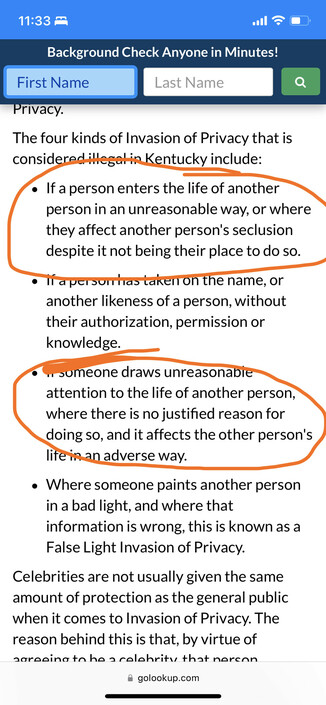
@drewharwell This seems to be getting pretty close to the tort of Invasion of Privacy.

I’d be interested to know if there are any cases attacking data brokers and the sale of sensitive health information.