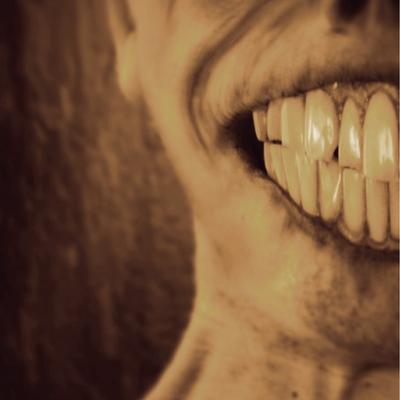
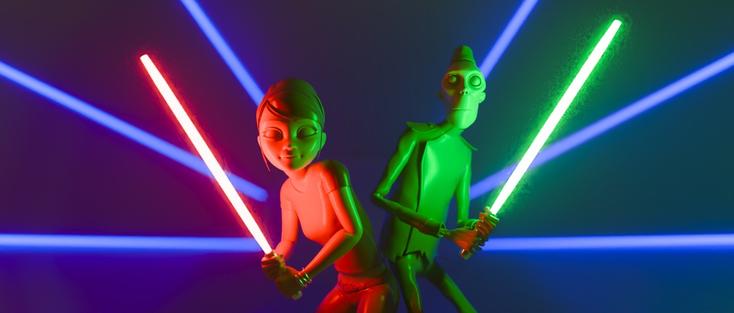
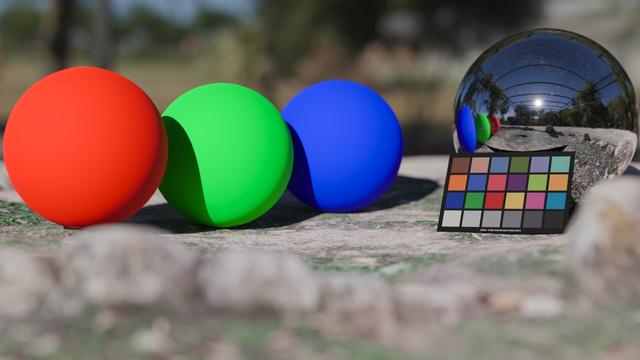
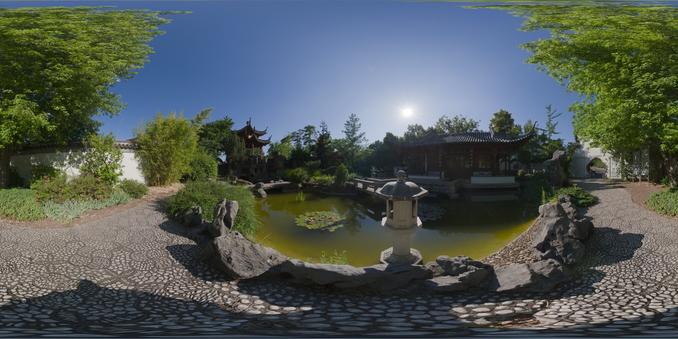
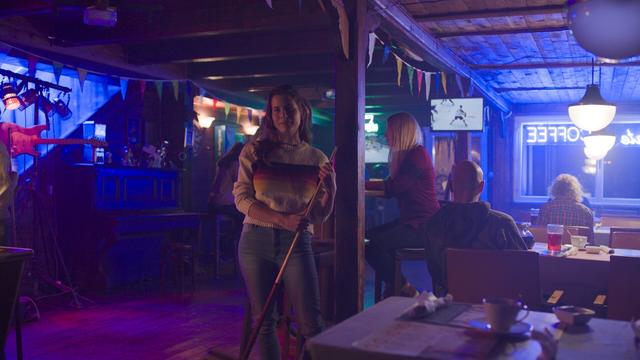
Interestingly… one can arrange the working system such that the flight of chromaticities toward blackness and whiteness is inverted; toward blackness will converge to complements, and toward whiteness toward primaries. Leads to some subtly nuanced results. (No attempt at tuning. Some posterization manifesting.)

#picture_theory

@troy_s would be good to have direct comparisons to really see the differences. Without that context though, it certainly looks neat
@troy_s Can you do the sweep please
@nihal_rahman @kram1032 Anyone can experiment!
@troy_s @nihal_rahman
Sure, in principle. If you know what exactly there is to do here.
I'm not sure what you did though, so I can't reproduce and try variations on it.
@kram1032 @nihal_rahman Check the BA thread. Gives you the entry point.

@troy_s @nihal_rahman

can you link to the specific post that talks about this particular idea? I might have missed that

@kram1032 @nihal_rahman Last post I made.

@troy_s @nihal_rahman

what, this?
https://blenderartists.org/t/feedback-development-filmic-baby-step-to-a-v2/1361663/1829

that's just three numbers.

Presumably meant to be angles to rotate the primaries by for an adjusted color space? - You kinda dropped those numbers in there without any explanation or context what so ever. Didn't even share the results you showed here over there, so probably a lot of people in that thread haven't even seen what you did here.

But ok, that makes sense, so you are saying all that needs to be done for this is to try to do really extreme rotations of the primaries before applying the sigmoid. I can see how that would effectively flip the relationship of black and white with respect to color mixing. The high end gets soft-clamped towards the opposite of the primary, and the low end gets soft-clamped towards the primary, so if you sufficiently rotate the primary, those things will switch roles.
And then, after the sigmoid, stuff gets inverted.

It's neat, that that still results in reasonable images.

Feedback / Development: Filmic, Baby Step to a V2?

-pr 55.0 70.0 40.0

Blender Artists Community

@troy_s @nihal_rahman

could be fun to do a movie of how this choice affects the end result, simply sweeping through all choices of angles across like, say, 24 frames or so (so each frame would uniformly rotate the primaries by an additional 15° - more frames would allow for a finer sweep of course)

@kram1032 @nihal_rahman 100%! This is a terrific idea!

The only tricky part would be to illustrate how the chromaticity flights shift when we collapse the angles between primaries, as there are infinite combinations here, and the three primaries’ relationships are complexly intertwined.

Still would be interesting to see an animation done in 3D!

@troy_s @nihal_rahman

Yeah you could shift three different angles, so exploring the entire parameter space in a smooth way is gonna be tricky. You could definitely find paths thruogh that space inspired by space filling curves or the like though.
Or in a different approach, you rotate them by different frequencies, say, based on sqrt(2), sqrt(3), and sqrt(5), so they drift out of sync and slowly explore the entire space. Would take many more frames tho.

However, even just a lockstep rotation (all primaries by the same amount in the same direction) would be a good starting point as a first visualization. You'd just have to pick an arbitrary initial phase and then go from there.

@troy_s @nihal_rahman

also, wouldn't there be a state where, like, subtractive and additive "cancel out" or "are in balance"? Like, if you rotate by 180°, you're definitely gonna swap additive and subtractive notions. But what happens around the 90° mark?

@kram1032 @nihal_rahman I don’t think there has been much examination here, at all.

We also need to consider that it’s an additive medium, so most certainly not subtractive. This is on my radar as I’d be interested to see how the trichromatic model fares with actual subtractive-like attenuation of channels.

+

@kram1032 @nihal_rahman - The main reason is *not* as a destination, but more as to the general mechanics. For example, plot a max(RGB) - min(RGB) on the more or less acceptable AgX-like sweeps to get a sense of how purity shifts.

@kram1032 @nihal_rahman Yes.

I’ve been wanting to do a fully subtractive approach in its simplest form for a while. I have a hunch it would be interesting to look at the flight paths of chromaticity sweeps.

Still would like to, but it remains somewhat elusive.

@kram1032 @nihal_rahman The reason that these sorts of completely weird transforms are an important thing in my mind, is that it helps to identify general trends in picture literacy.

For example, I can dump quantal catches to a display medium like sRGB, and for the most part, the picture will be read fine, and it can be read as “a creative choice”.

Some values however, will remain curious or uncanny.

In order to arrive at a general protocol, I strongly believe +

@kram1032 @nihal_rahman - that we ought to be sinking a good deal of effort in finding limits and edges where things are more or less agreed upon as uncanny / weird. Perhaps through the exploration of those edges, trends can be generally found, and possibly predictions made.

Once we wake up from the notion that “ideal as measured” replication is *not* a reasonable ground truth for picture making, many of these easily-discarded-as-creative-choice results take on a +

@kram1032 @nihal_rahman - new and fascinating meaning.

For example, quantal catches dumped as BT.709 / sRGB…

@troy_s @nihal_rahman
I suspect as an artistic choice it could be particularly interesting whenever you go for something like a comic book -esque or painterly feel