Well! It has been a while since I did a historical bio thread. Project
#EuropeanBios is over and so is Twitter. The successor is a new medium, Mastodon, and a new project,
#OneThousandYearsOfWomen, historically important women from approximately 1000CE to present. Here is Empress Matilda, born 1102, who spent decades trying to become queen of England and failed, and had to accept as consolation seeing her son become king and being direct ancestor to all British royalty right up to today.
The
#EuropeanBios threads have been rescued from the sinking ship of Twitter and are currently being cleaned up and edited into at least a website, possibly a book.
#OneThousandYearsOfWomen doesn't have a primary list or a website or anything yet, so this is the first one but may not end up being first chronologically. Forgive me, this isn't my full time job or anything.
Matilda's dad was King Henry 1 of England, himself the son of William the Conqueror, the French/Viking dude who conquered England in 1066. Henry had become king by being physically nearby when his brother William Rufus, king at the time, died in a hunting accident. Henry basically grabbed the crown, jammed it on his head and shouted "no backsies" which was at the time considered a reasonable method of becoming king assuming you had a lot of armed men to back you up.
This method of royal succession -- grabbing power by force -- would eventually be replaced by more peaceful heredity, but it hadn't yet. Specifically to become king you had to have a coronation, literally have the crown placed on your head by an important religious figure, in England's case the archbishop, in London. If you didn't physically get the crown you weren't king no matter how good your claim. This fact is key to Matilda's story.
Matilda's dad was also notable for having an absurd number of children, so many we're literally not sure how many, somewhere between 22 and 25. Most of them were children of "various mistresses" rather than his official wife though, so only Matilda and her brother William were considered legitimate, and because William was a boy he was the only one eligible to inherit the crown (although, see earlier, passing the crown to your children was convention rather than a law).
Being surplus to requirements, Matilda was used as a bargaining chip to cement a political alliance: she became engaged to be married at age 8 to the king of Germany, Henry V, who was 24 years old at the time. This is pretty creepy but was run of the mill at the time. The marriage itself would be completed when she "came of age" which was considered age 12, no less creepy. She was sent to Germany to live with her future husband, learned than language and became thoroughly Germanicized.
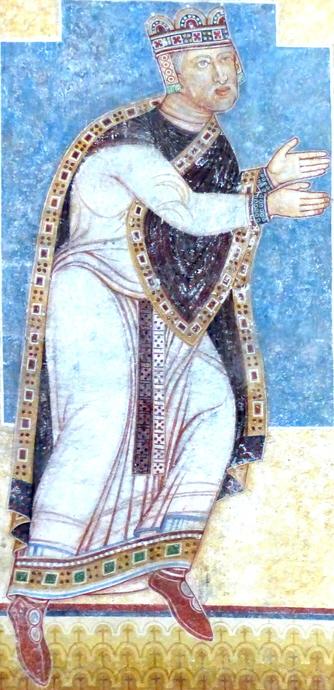
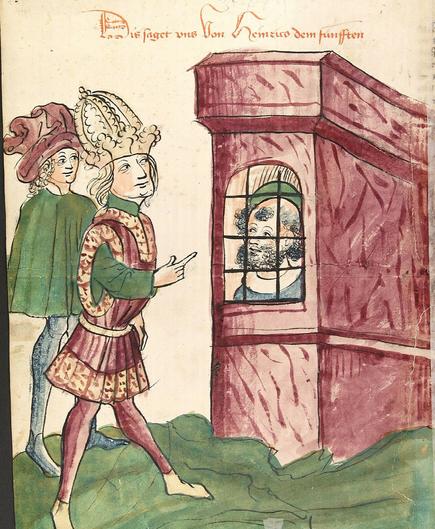
We have no idea what Matilda looked like, or Henry for that matter. This was before Europeans had got the hang of drawing and painting people, and in any case the artists and chroniclers were terrified of their powerful subjects and so would only give vague, flattering descriptions like "noble" and "well formed" to describe basically every royal person.
Henry V (her husband not her dad) was just then in the middle of a boring and complicated religio-political dispute with the Pope, which had unexpectedly resulted in him kidnapping and imprisoning the pope in order to get his way. The pope said whatever Henry V wanted to get released and then immediately reneged and excommunicated Henry, a big deal at the time, so Henry re-invaded Italy to discuss matters but this time the pope fled Rome rather than be kidnapped a second time.
This is relevant to Matilda because Henry was also trying to get himself crowned as Holy Roman Emperor (a German title since Charlemagne's time) and without the pope present that couldn't be done. Henry fudged and got the highest-ranking available bishop in Rome to crown him and Matilda Emperor and Empress, titles which despite being invalid they used for the rest of their lives.
At some point during this period there was a rebellion back home in Germany and Henry had to head back to take care of that so he left Matilda, then aged 16, to rule all of Italy in his place. This went surprisingly well and she by all accounts did a decent job and got a taste for absolute power, something it's hard to give up once you've acquired it.
Unfortunately Henry died of cancer just 7 years later. This left Matilda as a widowed empress, very popular in Germany, a pretty decent outcome and she could have retired in reasonable comfort for the rest of her life. But she was just 23 and not inclined to spend her entire life somebody's widow, especially since a series of unlikely events had put her a lot closer to being queen of England than previously.
The kingship of England had been set to fall neatly on William, Matilda's younger brother (because sexism) but an event called the White Ship Disaster had seen William and also nearly every other young royal of the 1120s board a fancy new ship, get really drunk, try to go too fast in the dark, hit a rock in the harbor and sink. The disaster messed up the succession of England, since William and also nearly every other male relative of his all died at the same time.
Matilda's dad started trying to have another male child immediately but as a backup he declared that if he couldn't manage to produce a boy child then Matilda would become king (there was not yet, linguistically, a name for a queen who actually ruled the country and wasn't just the king's wife). This was very unusual and controversial so he got all of his nobles and barons to swear, one by one, personally, in front of him, that they would support Matilda's claim to the throne.
Meanwhile he married Matilda off again, this time to Geoffrey of Anjou, a French/Viking noble back in Normandy where their family had come from originally. Unlike her first husband, Matilda did not get along with Geoffrey at all. Showing what was again highly unusual independence for a noblewoman on the 1100s she left Geoffrey and went back to England, but after much arm-twisting by her father she agreed to go back and dutifully produced 2 sons, delighting Henry-her-dad since they were male.
Then in 1135 Henry-her-dad died. Matilda was inconveniently pregnant with a third child and far away in France when this happened, which allowed a man called Stephen of Blois, a nobleman who was just physically nearby at the time of the king's death, to become king through the jamming-crown-on-head-no-backsies technique mentioned earlier. Nearly all the nobles who'd sworn loyalty to Matilda immediately reneged and backed Stephen, primarily because they were sexist and wanted a male king.
This left Matilda, 33, married to a man she didn't like in a country she didn't want to be in because she'd agreed to do those things in exchange for a crown she was suddenly not going to get. Predictably enraged, she invaded England and kicked off a completely brutal, decades-long civil war with Stephen and the shifty nobles on one side and a handful of loyal nobles on her own.
War is dull and civil war is confusing on top of that as people keep changing sides so I am going to skip nearly all of it. But Matilda was a hands-on general, getting into several dangerous scrapes. At one point Stephen captured her and, for reasons understood by nobody, let her go. She went right back to war with him. The war went back and forth with both sides laying waste to the countryside and setting fire to various quite large towns, to the distress of the citizenry.
 Laurie Voss
 Jami
Jami 
 Kyle Rose
 Lars Trieloff
 Mike Mathew
 Christophe Porteneuve
 Maggie
 Carl Poppa 🛸
 Yet Water Was