Analysis: E-bike subsidies are more cost-effective than EV subsidies

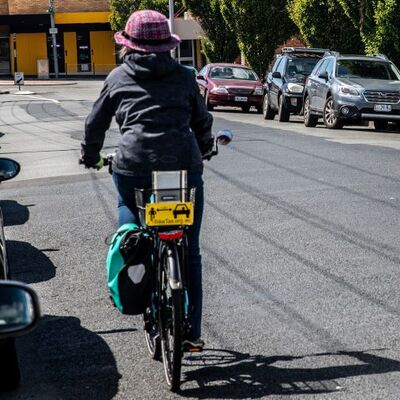
When it comes to reducing gasoline-powered travel, what gives states the most bang for their buck? David Edmondson finds that e-bike subsidies are 2.9 times more effective per dollar at displacing gasoline-fueled travel miles than zero-emission vehicle subsidies.
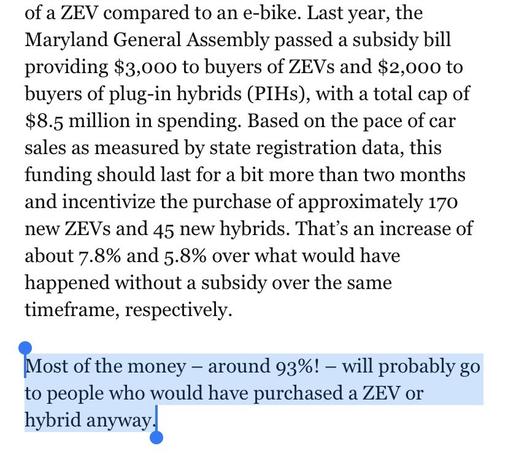
“Most of the money – around 93%! – will probably go to people who would have purchased a zero-emission vehicle or hybrid anyway.”
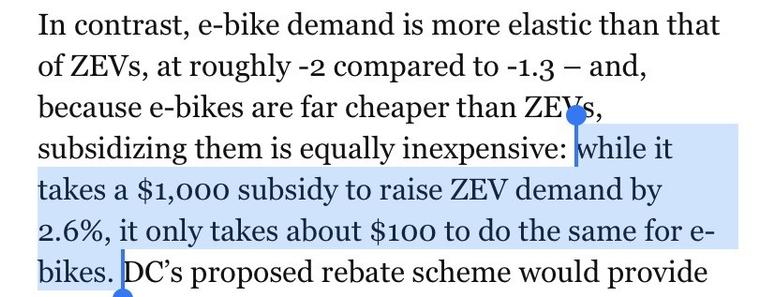
“…while it takes a $1,000 subsidy to raise zero-emission vehicle demand by 2.6%, it only takes about $100 to do the same for e-bikes.”
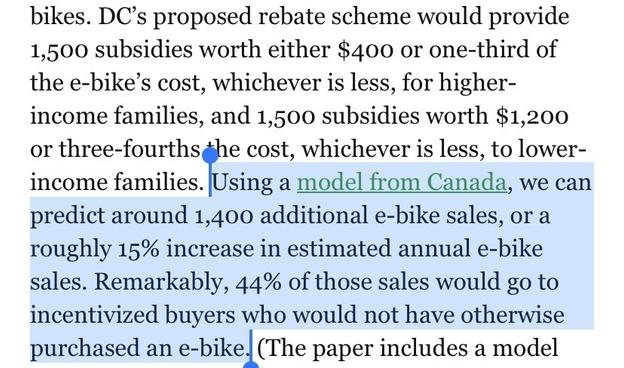
“Remarkably, 44% of those [e-bike] sales would go to incentivized buyers who would not have otherwise purchased an e-bike.”
“Without the proposed cap of just 3,000 rebates, DC could expect to see around 8,000 additional e-bike sales, nearly doubling demand…”
“an e-bike subsidy is 2.9 times more effective per dollar at displacing gasoline miles than a zero-emission vehicle subsidy.”
“…DC will displace around 2.6 million gasoline VMT per year with its e-bike rebates at a cost of around $3.10 per mile, a more cost-effective push that leads to roughly 1.4 times as many miles displaced as Maryland’s zero-emission vehicle policy.”
“if Maryland had invested its $8.5 million in e-bikes in the same way DC’s legislation proposes, instead of in zero-emission vehicles and hybrids, it would have saved almost triple the gasoline miles…”
Analysis: E-bike subsidies are more cost-effective than EV subsidies

When it comes to reducing gasoline-powered travel, what gives states the most bang for their buck? David Edmondson finds that e-bike subsidies are 2.9 times more effective per dollar at displacing gasoline-fueled travel miles than zero-emission vehicle subsidies.
@allinsea @bicyclealison @bicyclenetwork
@allinsea Wonder if there is also data for investing in bikelanes compared to subsidising e-bikes. Experience in the Netherlands is that is gov puts a bikelane, people will invest in bikes themselves.