
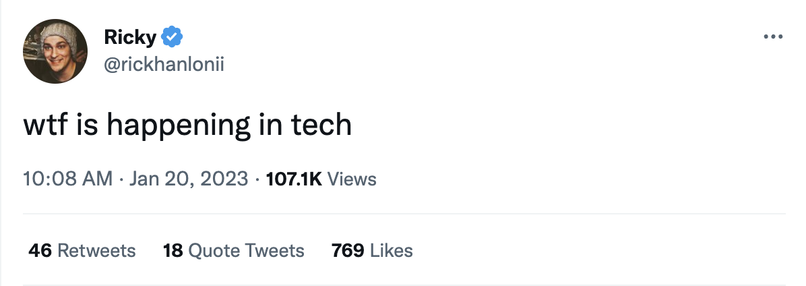
Early 2000s profitable startups gave their handful of workers novel perks/freedom. These cos/their workplace culture got big. Late 2010s tech labor gained power + made demands. Now a hint of recession = excuse to break promises/reestablish dominance over workers. It's not about $
@Mer__edith my different theory is that top tech firms strategized to forestall competition, by hiring people who would otherwise fuel startups or build open source. The main threat now is anti-big-tech regulation, tho, not startups.
@twersh I don't buy it in large part because startups don't compete with big tech anymore. They license big tech infrastructure and compete with each other to get acquired by big tech.

@Mer__edith @twersh it's almost like "look how competent and keen we are with the economy: we are laying off tens of thousands of people."

And "what? You are not laying off tens of thousands? You are not fit to be CEO."

@locksmithprime
and looks like the case. most are laying off just because others are laying off too, as per this stanford prof.
news.stanford.edu/2022/12/05/e…
@twersh @Mer__edith
What explains recent tech layoffs, and why should we be worried? | Stanford News

As layoffs in the tech sector mount, Stanford Graduate School of Business Professor Jeffrey Pfeffer is worried. Research – by him, and others – has shown that the stress layoffs create takes a devastating toll on behavioral and physical health and increases mortality and morbidity substantially. Layoffs literally kill people, he said.

Stanford News