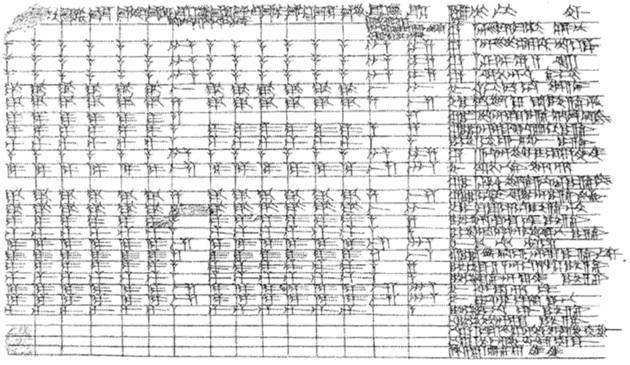
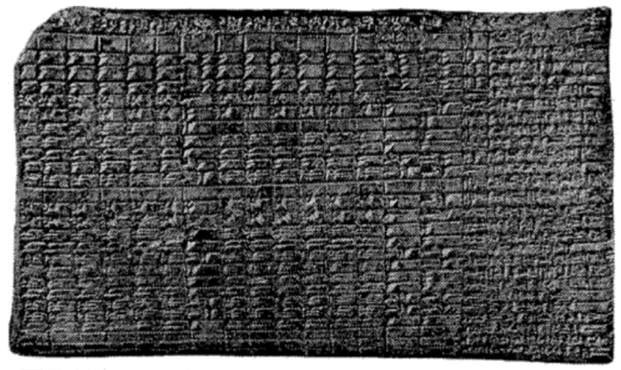
I've been collecting interesting examples of information organisation in history, focusing on non-Western civilisations. I came across this example of an ancient Mesopotamian spreadsheet! It records wages paid to temple workers in 1295 BCE.

#History #AncientHistory #Cuneiform #Mesopotamia #CognitiveHistory
P.S. If this interested you, maybe you can help me out by pointing me to people researching this topic. I'm especially interested in how different languages/writing systems affect how people make catalogues/taxonomies/indexes.
@michelleful I’d love to learn about what you discover in this research!
@michelleful I'm also interested in this, I'm happy to share anything I may find in my researches 🥰
@michelleful I suspect you already know of Carrie Brezine finding double entry book keeping in Inca knotted khipu records...
@nebogeo I feel like I've heard a bit about quipu decipherment (wasn't there some Harvard undergrad who managed something a few years ago?) but haven't looked into it in great detail. Thank you for letting me know, I will check out Dr. Brezine's work!

@michelleful
One way to find people is to follow hashtags. I don't know if it works in mobile apps. But setting the web browser view of a Mastodon to "advanced view" gives you a multi-column layout where you can add/pin more columns, for example for hashtags followed.

Once you pinned 1 followed # you can add more # to the pinned column and tell the system to collect all of them, and also to exclude others.
Eg., you'd follow #language but exclude #school so as to not get any posts that discuss language as a school subject.

@michelleful In France, sociologists such as @olivier_martin or historian of mathematics like Grégory Chambon (who worked on sumerian math) might have interesting pointers.
@michelleful the only meaningful way I have to contribute to your research is to suggest to make an account in vkontact (Russian facebook) and try to reach someone from Russia.
@michelleful The Tripitaka Koreana! It is probably the single greatest act of knowledge preservation in human history. https://en.wikipedia.org/wiki/Tripitaka_Koreana
Tripitaka Koreana - Wikipedia

@michelleful

Fascinating area. I've been thinking about initiatives to decolonize archive/collections records (metadata). Specifically the insertion of contemporary indigenous terminology i.e. literal translations w/out broader cultural context and meaning (present or past). I can see how it becomes a very complex and difficult task, very quickly but I feel (data & info science background) much of this is due to trying to fit - physically and conceptually - into unsympathetic DB structures.

@michelleful
Indexing by CJK ideographs (eg. in dictionaries) is also rather interesting topic - there is some concept or 'radicals' - minimal building blocks, and the characters are in some way sorted by the used radicals.
@michelleful so this has not a lot a lot to do with your research but in comparistic linguistics there's a ton of analysis of various special fields and there nomenclature. E.g. Everything around Steel is classified completely different in EN vs DE. Or look at chemical combinations between DE EN (and FR if I remember correctly). Now include Japanese or Chinese technical languages and u have an entire field to crawl through. (I'm coming at this topic from a translators point of view.)