In pop culture, computing & programming are often depicted with “tech bros.” But the first computer programmer was a brilliant woman.

Augusta “Ada” Lovelace was born in 1815. Her notes include an algorithm designed to be carried out by a machine & she envisioned that computers could go beyond calculations. Lovelace described “how individuals & society relate to technology as a collaborative tool.”

Lovelace passed away in 1852 at just 36. https://www.newyorker.com/tech/annals-of-technology/ada-lovelace-the-first-tech-visionary #HistoryRemix #history #science

Ada Lovelace, the First Tech Visionary

Lovelace, known as the first computer programmer, has been recognized annually to highlight the often overlooked contributions of women to math and science.

The New Yorker

Ada Lovelace demonstrates that women are just as capable at excellence in computing as their male counterparts.

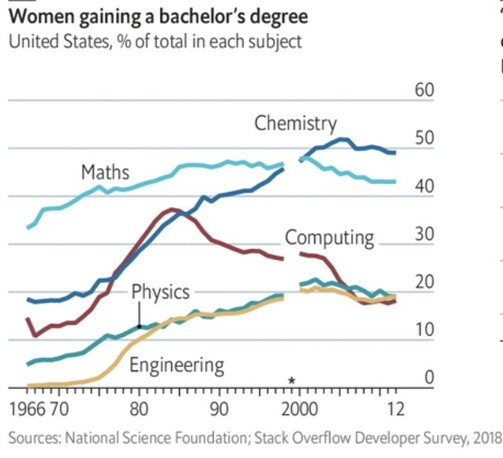
However, men are more likely to “feel they belong than women” (see link). And the share of bachelor’s degrees in computing awarded to women has halved since 1985.

Anecdotally, my female friends in computer science have experienced bullying & harassment, or been ignored & overlooked. /2

https://www.economist.com/graphic-detail/2018/10/22/why-the-future-isnt-female-in-computing

Why the future isn’t female in computing

Women are less likely to feel part of the coding community

The Economist
@Sheril 25 years ago in Romania's Polytechnic University Computer Science department, considered the best and the toughest in the country, there were 9 women out of 350 students in the year. Today there are more women than men there.
@iar81b @Sheril This is really interesting. It does look like there is something odd going on in certain countries . The uk seems light years behind & im not sure why .

@stroppypanda @Sheril România complicated story in this regards.

To start with there was a certain reminiscent culture left from the socialist times where discrimination of women was very low in academeia. There is a book about this subject. There was some polarization such as men tended to be engineers but women were doing economics. Overall there was more or less parity.

On top of this there was a massive boom in It sector. Employers could just not afford to be picky over maternity.

@iar81b @Sheril I think this is very interesting .I have friends who were from East Berlin. I understood that nurseries were seen as normal not a luxury . Arguably in uk the spiralling costs of childcare has also worked against women. I suspect there is a significant number of women that for many reasons have left the labour market but have the skills . I’m genuinely staggered that Torypolitical leadership is so misogynistic hope that education improves.

@stroppypanda @Sheril

It is an interesting discussion

https://www.theguardian.com/books/2018/nov/09/why-women-have-better-sex-socialism-kristen-ghodsee-review

It is an interesting take. Living through the period I do not agree entirely. In Romania due to the ban on abortions it was terrible actually.

However there are other points which are spot on on my view.

Why Women Have Better Sex Under Socialism by Kristen Ghodsee – review

Did East German women have more orgasms than those in the west? How market forces affect sexuality

The Guardian