
This is what a single trip to the hardware store looks like out where my parents live.

Notice the miles driven, time it took, and remaining battery status (started this at 100%).

But by all means, please keep telling us electric cars only work in cities.
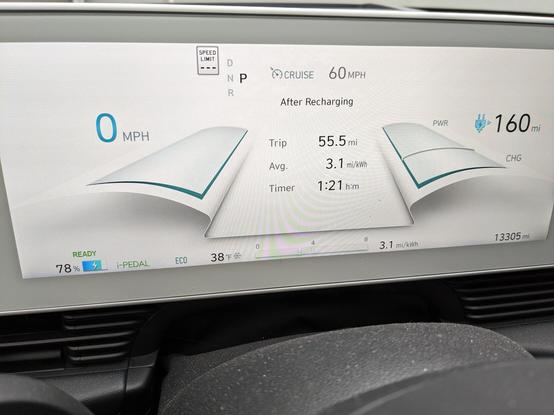
Oh right, and I should add that to recover this charge on a 7.2 kW charger would take about 2 and a half hours.

Again - you really don't need a giant charger.

@TechConnectify the only place where I see electric vehicle a bit behind is very long trips, like cross country. But the infrastructure just needs to be build, just like gas stations.
@tebrown Have you seen his video on this https://youtube.com/watch?v=sZOuz_laH9I
The tech which can charge an electric car in 10 minutes

YouTube
@alassek Yup! We just need more of those!

@tebrown @TechConnectify I had a winger try to tell me once that electric cars couldn't work because of the lack of charging stations.

I told him I had faith the free market would provide a solution.

@davidr @tebrown @TechConnectify
The best places for chargers for longer distance travels is going to be plazas with restaurants and other shopping. Plug in, get some food and stretch legs. When you are done eating, your vehicle should be full enough for the next leg of the journey.

@tebrown @TechConnectify

And towing. Towing things is not very effective for full electrics. But is theoretically a great place to use hybrids.

@Ancients @TechConnectify what kind of towing? I really believe electric is the future for everything.

@tebrown @Ancients They *can* tow right now but range loss is severe. Like, depending on the trailer, it can exceed 60%. Aerodynamic affects are monstrous.

It's about the same as a liquid-fueled car, to be clear, but towing rigs have big gas tanks and can refuel quickly.

Add to that the fact there there's essentially no pull-through rapid charging infra and even I, a person who thinks EVs can work for just about anyone with a tiny bit of work, will admit they are shit for towing right now.

@tebrown @Ancients
Granted, that's caveated with *long-haul* towing.

If all you need to tow is a trailer to Home Depot and back, then by all means - you're not gonna care.

But if you want to tow a camper on a road trip?

That's a yikes, and is unlikely to change.

@TechConnectify @tebrown
Even medium haul. Doing a long trip into the city from a rural area with a load is gonna be pretty terrible.

But day to day in-city work trucks are gonna handle the transition to electric pretty easily.

@TechConnectify @tebrown
I cry thinking about the 110 mile round trip to go to the movie theater when I was in college 😭

@TechConnectify @tebrown @Ancients all the people i know who do day to day in-city work hauling live 30-60 min outside the city.

so i don’t see it working for that either.

@amy @TechConnectify @tebrown @Ancients I know a few contractor friends who live in the city\suburbs. It'd work great for them, for any job also in the city. Depending on the specific friend, they'll range as far as a hundred miles from the city (or further, if the money is right to get hotels). I think it'll be a bit before they change over.

I'm curious to see if we'll see battery packs in the trailers to supplement the trucks battery when towing.

@TechConnectify @rusozoll @tebrown @Ancients the reports on the electric ford truck say it can go about 60-80 miles before needing a recharge, when you’re towing
@amy @TechConnectify @tebrown @Ancients sure, but there is nuance. If you run a landscaping business and service locations in the area you live, that could be plenty. In suburbia, that is totally viable. Same for things like mobile repair services, especially for urban service areas. Even some construction work, if you drop the trailer at the beginning of the project (and then the lightnings ability to be used as a mobile power point can be leveraged).

@amy @TechConnectify @tebrown @Ancients I still agree that it isn't ready for most people doing a lot of towing, but its getting more viable for more people.

Zach (JerryRigEverything) had a recent video on cold weather towing, Rivian R1T. It isn't much better on that side. It really highlights the charger problem for tailers.

https://youtu.be/U8zDGN2Fdt4

I tried towing 10,000 pounds in freezing weather... My EV Truck Lied!

YouTube

@TechConnectify @tebrown @Ancients

I wonder if we'll start seeing trailers with their battery and motors in wheel to offset these issues.

@ihddn @TechConnectify @Ancients airstream makes one (a camper trailer)
@TechConnectify @tebrown @Ancients Since the aerodynamics are a big factor, design down the road could make a big difference. The rate of adoption will make a big difference of when that happens-same with quick charging stations for jumbo battery packs.
@tebrown @TechConnectify hardly. I’ve done like 6 2000+mi road trips since I got my car in 2021 and it’s been nbd.
@tebrown @TechConnectify I’d actually argue that long road trips are way less of an issue for EVs than home charging solutions for renters and apartments
@TechConnectify Unless you enjoy football in New York (technically New Jersey) and Los Angeles!

@TechConnectify We at @show took our Bolt EV to Texas from Portland, our Niro EV from Seattle to Los Angeles...and that same Bolt from Portland to Las Vegas many times.

EVs are ready for nearly all use cases, and have been for several years. The charging networks still need work but honestly the times I charge en-route are vanishingly small - driving to Portland and back, if I need to, I just top up at my friend's house.

@TechConnectify 3.1 mi/kWh? The 2020 Nissan Leaf gets 4.2 ...
@SvenGeier A) It's cold B) this trip was mostly highway driving and C) the Ioniq 5 is a pretty big car, y'know
@TechConnectify cars don't work in cities.
@joshix I'm increasingly in agreement!
@TechConnectify you should see how bad the traffic is here (Bangkok). It’s famously horrible. I would MUCH rather drive an electric vehicle than the diesel beast I have, but there are reasons why that’s extremely difficult for foreigners living in Thailand (we can’t own property except for condos - so no personal parking spot to put your own charger on). I’m looking for a workaround though
@TechConnectify was true back when car batteries and low mile cars were the norm but now they're more or less feature paroty with regular cars.
Still though plug in hybrids are my personal favorite since they're both a decent electric car and very fuel efficient gas car

@Jessica I have mixed feelings about plug-in hybrids. I suppose that's appropriate ;)

If they all worked like the OG Volt, where the car could offer 100% power at any time without using the engine, I'd be more receptive to them. But way too many will start the engines up for more power, and are compromised as EVs.

They're also just... really hard to get people to use correctly, unfortunately. A lot of the Gen 1 Volts just don't get charged at all by their second and third owners.

@TechConnectify at the very least they're using the battery to get a more efficient car so they're at the very least using less gas than normal.
Wasted opportunity though
@TechConnectify tho I guess with the gas prices rising would push more people to considering pluging their car in.

@Jessica That's the trouble, though, a plug-in hybrid that never gets charged is worse than a conventional hybrid. They're almost always less-efficient on gas because of the added weight.

So unless you can *and will* charge them, you're better off with an ordinary hybrid.

This isn't to say there aren't plenty of folks charging theirs as often as they can, but it's a complication to consider on a lifecycle basis.

@TechConnectify @Jessica am not too familiar with electric vehicles (other than the misinformation my far-right dad tells me about them :/). what’s the difference between a conventional hybrid and a plug-in hybrid?
@catgirl @TechConnectify plug in hybrids will let you directly charge the battery, normal hybrids charge via gas
@catgirl @TechConnectify *both will charge via gas but plug in let's you charge electric
@Jessica And usually a plug-in has a much larger battery to give meaningful driving range. Conventional hybrids only use the battery to aid in acceleration and thus allow for the use of smaller, more energy-efficient engines.
@Jessica @TechConnectify a conventional hybrid kinda just sounds like a gas car with an extra step though? feel like im missing something here

@catgirl @Jessica It's a little too complex for a toot, but basically most cars use engines that are really big and inefficient because accelerating a big hunk of metal is hard. They lug that engine around all the time and even use it for cruising.

A hybrid, though, will use a small engine running on the more-efficient Atkinson cycle which basically only has a bit more power than you need for high-speed cruising. An electric motor supplants it when accelerating.

@catgirl @Jessica The battery's primary purpose in a conventional hybrid is to collect energy when braking (which would otherwise be lost as heat) and release it when you need to accelerate, thus letting the engine run at a fairly constant output which always stays in the most efficient parts of its powerband.
@TechConnectify @catgirl @Jessica video idea: explain the differences between and the advantages/disadvantages of Plug-in/normal Hybrids and petrol cars. Would educate more people on the topic, especially with how you present information.
I know I'd benefit from it.
@TechConnectify You will never convince the EV haters. It is a religion.
@TechConnectify chuckling to myself that “mi/kWh” is what the Americans settled on for EV efficiency units.
@krssctt In a land that uses miles-per-gallon, it makes perfect sense.
@TechConnectify @krssctt The UK uses miles per gallon too, only our mile is infinitesimally smaller and our gallon is a hair over 20% bigger.
@nowster @TechConnectify @krssctt miles per gallon? Speak for yourself, I use furlongs per pint.

@jake_arkinstall @TechConnectify @krssctt Don't mix up your units in the furlong firkin fortnight system.

(Curiously you could use attoparsec per microfortnight as a substitute to measure tape speeds and the numbers would be almost the same as ips.)

@nowster @TechConnectify @krssctt the UK mile is the same as the US mile (63,630 inches to the mile, and the inch is 25.4mm), but for some crazy reason the US redefined their pint to be 16 fl.oz instead of the 20 fl.oz of the UK pint, so the US gallon is only 80% of the UK gallon, making the UK gallon 25% larger than the US gallon. But more bizarrely, the UK measures fuel consumption in miles per (UK) gallon, but sells fuel in litres. That’s what makes no sense to me :)
@scottearle @TechConnectify @krssctt UK fluid ounces are smaller than US fluid ounces as they're based on a different gallon. The UK standardized on the volume of 10 pounds of water at 62°F as being a gallon but the US stayed with the Queen Anne wine gallon (231 cubic inches).
@nowster because of course they did

@krssctt @TechConnectify it gets more amusing: “MPGe” exists and is the figure that the US government typically uses to report their efficiency

(which is really miles per 33.7 kWh, the approximate energy content of a gallon of gasoline using the lower heating value)

@bhtooefr @TechConnectify basing it on the energy of a gallon of gasoline is actually way more in line with what I would expect for a Freedom Unit
@krssctt @TechConnectify Guess we forgot to create a freedom unit for kWh so we have to use that one.... For now.

@betazed @krssctt @TechConnectify Tons of TNT! That's a good unit of energy for Freedom-lovers!

kWh IS a funny unit, converting a unit of power back into a unit of energy, but it's what we're billed in, so it's really the only logical thing here.

@TechConnectify Funnily, around me in the UK, EVs working in rural areas is actually easier. The area I live in was built in the 1860s, so (weirdly to a lot of people it seems) doesn't have off road parking to charge a BEV. And at 79p/unit for the chargers 16 miles away ($0.97 kWh) it's a very expensive option. :(