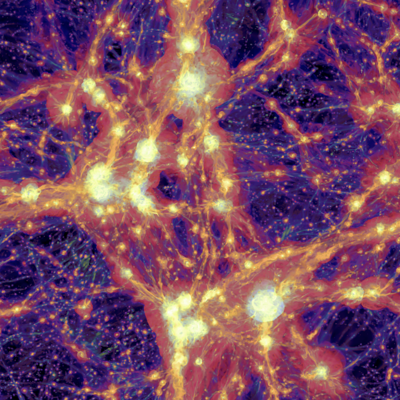
#18 of #SimulatedUniverses

This is the simulated evolution of two radio jets, inflating radio lobes, over about 4 billion years.

Even considering the relatively coarse resolution which could be achieved here (8kpc) at the beginning the source show many salient features of real ones, and it looks like a Fanaroff-Riley type 1 galaxy.

At late times however, the lobes bend and mix creating very a-symmetric pattern.

What is happening in the simulation?
#Astrodon #fedimovie #astronomy

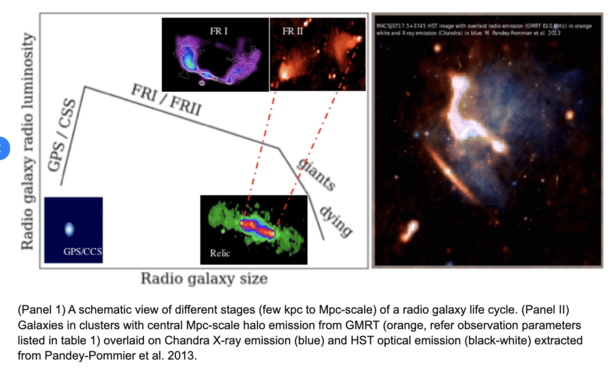
First, a few words bout Fanaroff-Riley type I (FR1) radio galaxies:
a high power, they are the dominating radio sources in clusters of galaxies (but this is not true in general, see seminal recent works by @ognimaeb et al with LOFAR), their jets is already sub-relativistic at >kpc scales, and we can usually see the radio jets flaring in lobes over ~100kpc scales from the central galaxy, usually sitting at the centre of the cluster potential well.

https://en.wikipedia.org/wiki/Radio_galaxy

Radio galaxy - Wikipedia

So, if the simulated radio galaxy is at the centre of a potential well, why the fuzzy motions?

Do jets produce such a turbulent medium while they propagate, so that the latter is perturbing them back?

This can happen at times, but the most important factor here..

..is that this simulation is fully cosmological, meaning that the cluster where the jets form moves and it is continuously growing matter via (trans/super sonic) accretion of other gas satellites. This creates perturbations which push and bend and mix the material ejected by jets.

Here a movie in the simulation reference frame, in which we can also see the gas temperature (blue) and density (green).

After an initial stage of "free" expansion, jets are bent by "cluster weather".

The turbulent velocity field that particles in the lobes experience is well shown in this moving plot, where the color coding give the amplitude of the velocity field (|v|) which the particle are subject to.

There are several 100km/s of difference across the lobes, which cause the lobe to shred and mix on ~Mpc scales with the surrounding gas in the simulated cluster atmosphere.

This is also a way to enrich the innermost cluster volume with magnetic fields, initially high and confined within jets.

The same evolving plot show how the typical magnetic field within jets goes from 10-20μG to even ~0.1μG, because the same magnetic energy is spread to a large volume over time.

[important caveat: the simulation cannot capture small-scale dynamo amplification in detail, so the drop in the fields is probably too large]

Since the evolution of the relativistic electrons is tracked in this #SimulatedUniverse, we can also have an idea of the ageing (via radiative losses) and re-energisation (by getting energy from the surrounding cluster weather, via Fermi I/II acceleration) the electrons are subject too.

This cause variations in their emission spectra [I(ν)~ν^(-α)] where α typically starts with 0.6, and then "steepens" to 2, meaning that most of high energy particles have lost their energy.

My goal in life now?
(among other things...) is to have this level of detail for many different radio galaxies at a time, in the same large cosmological simulation, with my favourite code (enzo-project.org).

(hard) work in progress.

the super low resolution impression of it is in the movie, which shows the formation of several such radio galaxies (marked with contours) in the cosmic web.

All the above was pretty much covered by these two A&A papers:
https://arxiv.org/abs/2210.01591
And
https://arxiv.org/abs/2102.04193
..and a third one is on the launching platform.
Life cycle of cosmic-ray electrons in the intracluster medium

We simulate the evolution of relativistic electrons injected into the medium of a small galaxy cluster by a central radio galaxy, studying how the initial jet power affects the dispersal and the emission properties of radio plasma. By coupling passive tracer particles to adaptive-mesh cosmological MHD simulations, we study how cosmic-ray electrons are dispersed as a function of the input jet power. We also investigate how the latter affects the thermal and non-thermal properties of the intracluster medium, with differences discernible up to $\sim$ Gyr after the start of the jet. We evolved the energy spectra of cosmic-ray electrons, subject to energy losses that are dominated by synchrotron and inverse Compton emission as well as energy gains via re-acceleration by shock waves and turbulence. We find that in the absence of major mergers the amount of re-acceleration experienced by cosmic-ray electrons is not enough to produce long-lived detectable radio emissions. However, for all simulations the role of re-acceleration processes is crucial to maintain a significant and volume-filling reservoir of fossil electrons ($γ\sim 10^3$) for several Gyrs after the first injection by jets. This is important to possibly explain recent discoveries of cluster-wide emission and other radio phenomena in galaxy clusters.

arXiv.org