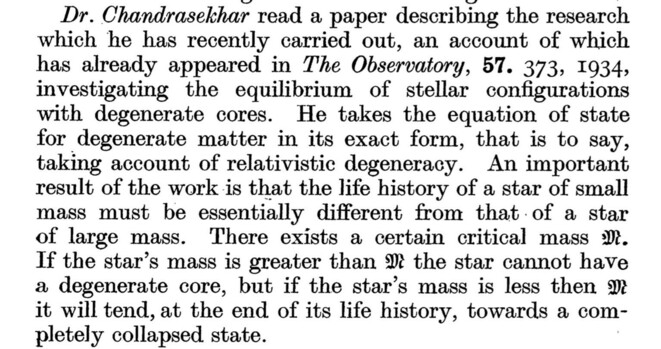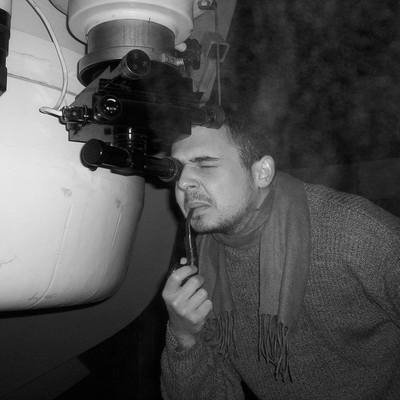
Young astrophysicist Subrahmanyan Chandrasekhar presented his results on electron degeneracy pressure and the maximum mass of a stable white dwarf star to a meeting of the Royal Astronomical Society #OTD in 1935.

This maximum mass is now known as the "Chandrasekhar Limit." It is about 1.4 M☉, or 3 x 10³⁰ kg.

Below this mass a spent star settles down into a stable white dwarf. More massive stars continue to collapse, eventually becoming neutron stars or black holes.

Photo: Getty Images

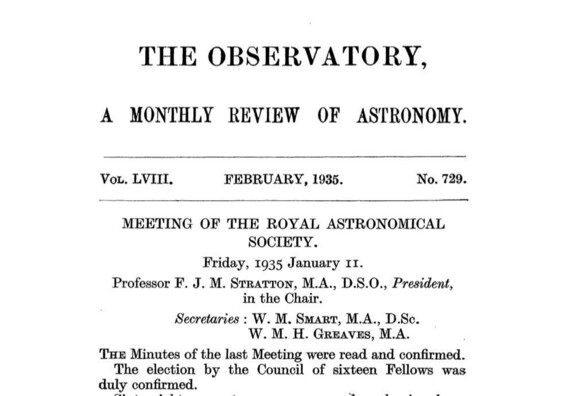
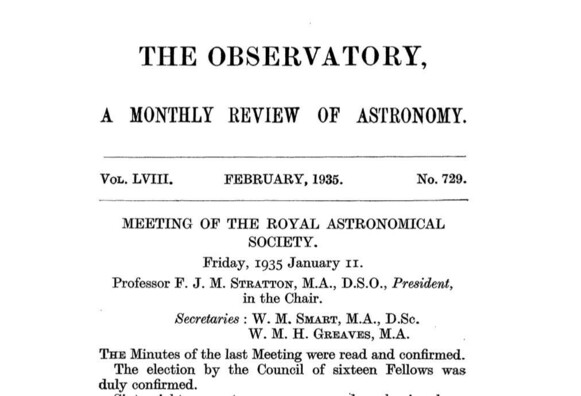
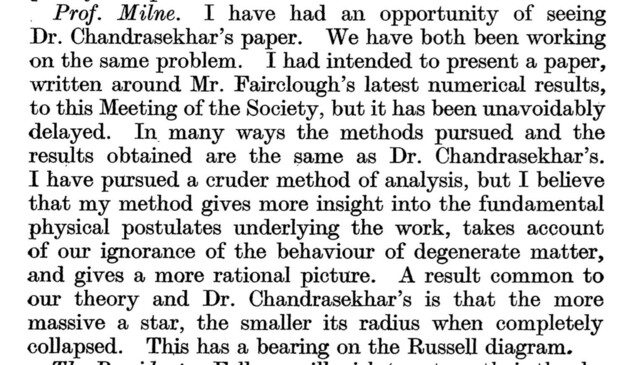
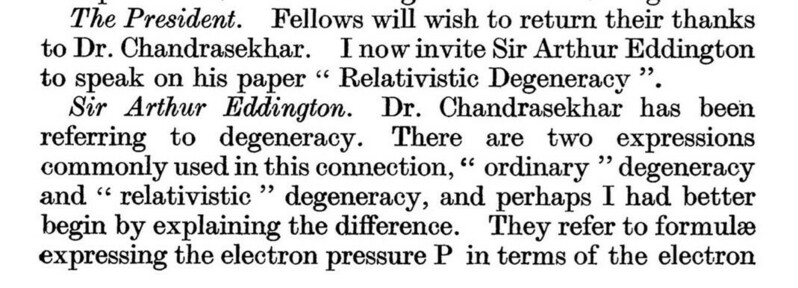
You can see the original summary of Chandrasekhar's presentation in this issue of "The Observatory."

https://ui.adsabs.harvard.edu/abs/1935Obs....58...33./abstract

Edward Arthur Milne immediately spoke up after Chandra’s presentation to say he was working on the same problem and had obtained similar results.

1035 January 11 meeting of the Royal Astronomical Society

NASA/ADS

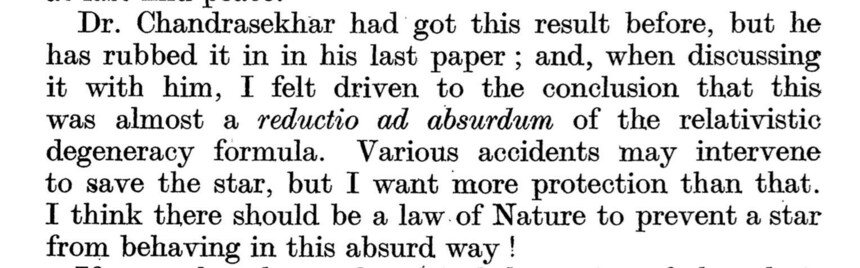
The issue also contains the entirety of Sir Arthur Eddington's ambush on his young protege, delivered in the next talk.

A few excerpts:

Eddington was sure that Chandra's result was unphysical. But he didn't really have a good argument; he just found the prospect distasteful. Despite their close friendship, he went after Chandra both in public and in private.

Eddington repeatedly tried to disprove Chandra's result, offering increasingly implausible mechanisms by which a massive star might avoid gravitational collapse into a black hole.

At one point Eddington understood general relativity and its consequences better than almost anyone. Now he was no longer in the vanguard. His ego couldn’t take the blow. He used his influence to blacklist Chandra, preventing him from working in England.

Somehow, the two men carried on a personal correspondence for years afterward, and Chandra never wavered in his admiration for Eddington the scientist. They clearly had a complicated relationship. But Eddington's behavior tarnished his legacy.

At the same time, many of Chandrasekhar's contemporaries realized that he was right and Eddington was wrong. Luminaries like Pauli and Dirac understood Chandra had discovered something new and deep about Nature.

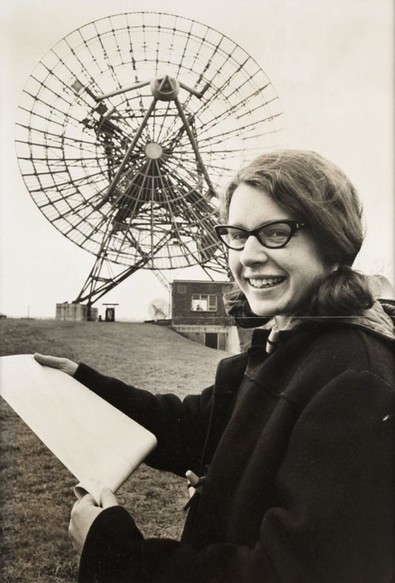
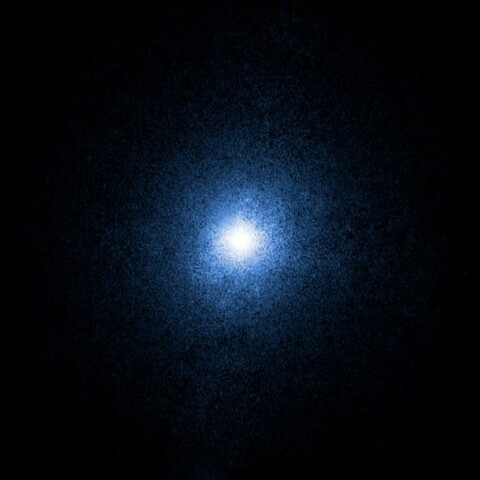
Definitive proof of Chandra's conjecture came decades later. Jocelyn Bell made the first pulsar observation in 1967; we now know that these are rapidly rotating neutron stars. The intense X-ray source Cygnus X-1 was identified in 1972 and eventually confirmed as a black hole.

@mcnees There was still plenty of doubt about whether black holes could be real phenomena all through the 70’s. When I started my physics degree in the early 80’s it was becoming clear to the broader physics community that they really existed. Revolutions take time.

@davebyrne @mcnees

I (a non-physicist) encountered it a couple of times in the early nineties – once from an experimental physicist, once from an astronomer. I don't know what the level of disbelief was – whether it was some of the effects of black holes, or their existence altogether – and it's not like I could grill them on the subject.

But it was interesting to find outliers in what was a generally accepted subject.

@mcnees - the fucker. I had no idea.
@mcnees just the concept of degeneracy pressure blows my mind every time I think about. 🤯 How crazy is it that a particle level effect has so immediate and extreme macroscopic consequences?
@mcnees That's the mass of a stable remnant WD core not the progenitor star's mass limit.