
1/ Proposed as a solution to the waste management crisis & a #sustainable #energy source, #waste-to-energy technology sounds, like a win-win solution. But as the growing local opposition in #SoutheastAsia shows, it is anything but.

A 🧵 on the reality of the effects of #incineration on local communities, an investigation supported by #JournalismFund, published in #EnergyMonitor

https://www.energymonitor.ai/sectors/industry/facing-headwinds-at-home-europe-and-japan-are-pushing-waste-to-energy-technology-across-south-east-asia/

Facing headwinds at home, Europe and Japan are pushing waste-to-energy technology across South East Asia

Foreign-backed waste-to-energy projects in the Philippines, Indonesia and Thailand are firing up local opposition over green credentials.

Energy Monitor

2/ Waste-to-energy plants burn waste that would otherwise end up in a landfill, producing heat electricity.

Pioneered in developed countries like #Germany & #Japan, the tech has found its way into #SEAsia, including #Indonesia, the #Philippines, & #Thailand.

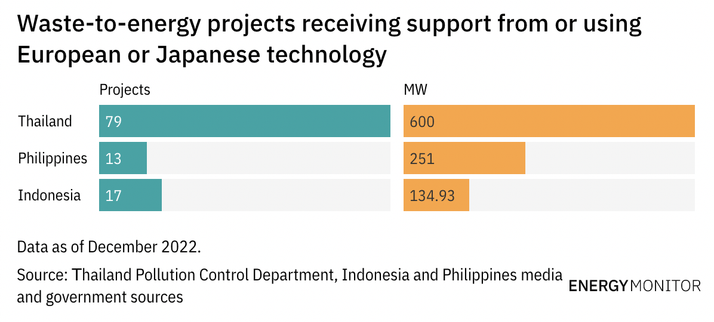
3/ There are at least >100 waste-to-energy #incineration projects recently constructed, or planned, across these 3 countries, promoted by local governments.
4/ However, we found that communities say they weren’t consulted properly, and they fear that incineration could lead to increased pollution and health risks.
5/ “There is a potential for #dioxin discharge… [which] will worsen #Jakarta's current air quality, which is already poor.” says Muhammad Aminullah of @WALHIJakarta. "Jakarta's waste [is] not suitable for waste-to-energy, [it] is mixed and wet, and not well sorted."

6/ There are also technical challenges.

In #SoutheastAsia, organic waste can make up ~50% of #waste – unsuitable for efficient burning. To reach the high temps that incinerators need, it will need more fuel: #plastic, made from #fossilfuels & releasing #GHG.

That alone could make waste-to-energy far less green than originally thought.

7/ Construction is well underway in the #Philippines as well, where ​​waste collectors who earn as little as ~$90/mo have no idea about the impact these plants might have on their livelihoods.

With the lack of transparency about these projects, locals are left to pick up the pieces

8/ “If they intend to carry out a good project, why have they done everything in such a fishy manner?” Chaloa Suwanachart asks. He leads the opposition to plans of a plant in #Thailand. For saying this, he, along with a journalist, were sued for defamation by the company leading the project.

9/ The lack of transparency and consideration of local contexts are only a few of the issues surrounding waste-to-energy. Learn more in this investigation published in #EnergyMonitor co-reported by Alexandra Buba 🇩🇪 Nicha Wachpanich 🇹🇭 & Geela Garcia 🇵🇭 with the support of #JournalismFundEU

https://www.energymonitor.ai/sectors/industry/facing-headwinds-at-home-europe-and-japan-are-pushing-waste-to-energy-technology-across-south-east-asia/

Facing headwinds at home, Europe and Japan are pushing waste-to-energy technology across South East Asia

Foreign-backed waste-to-energy projects in the Philippines, Indonesia and Thailand are firing up local opposition over green credentials.

Energy Monitor

10/ This was reported over several months in four countries: 🇯🇵 🇮🇩 🇵🇭 🇹🇭 shedding light on local communities’ plights.

"Incineration is not part of our climate solution. When people learn [that] incineration is dirtier than a coal plant, they feel this needs to be stopped.” #GAIA