Here is the #PaperThread with the promised details of the #neuroscience #zebrafish #behavior paper by En Yang in the lab and colleagues. If you are interested in circuits for path integration and their effect on behavior, here is a summary:

https://www.cell.com/cell/fulltext/S0092-8674(22)01466-0

1/n
Do fish “know” where they are in space? In this work, we used larval zebrafish to address this question, focusing on a behavior with a known goal: to not drift away during water flow (animation by Julia Kuhl)

2/n

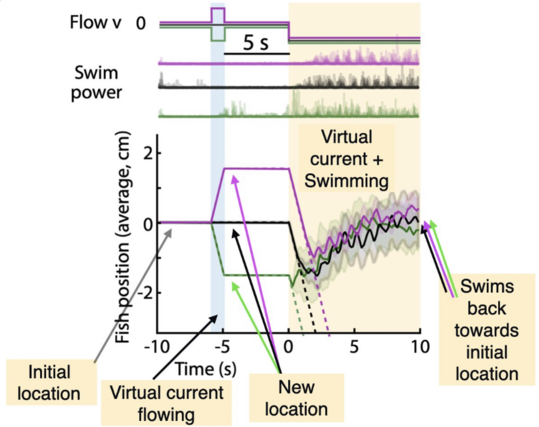
To figure out if animals keep track of where they are (relative to where they were), we placed them in a VR environment, displaced them, and checked if they try to find their way back. Something like this:

3/n

The data look like this for an example fish: we clamp their position in a 1D VR track, then displace them visually as if they encountered a surprise current, and see how this affects what they do next. Even much later, they swam to reverse their displacement!

4/n

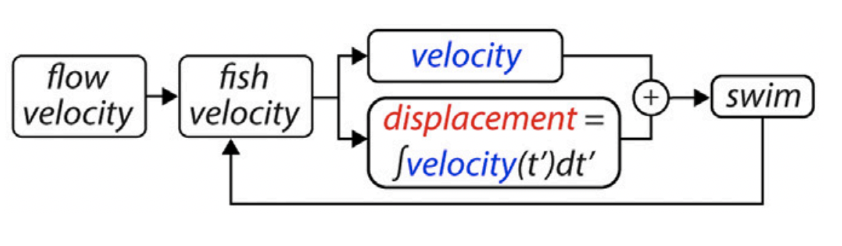
Fish behavior was, qualitatively, well described by a control system that integrates velocity (with a leak not shown here) to drive corrective swimming

5/n

How does the brain do it? To answer that question, we recorded whole-brain activity at the cellular level as fish were doing this positional stabilization behavior (which we called ‘positional homeostasis’). We could now look for positional integrators

6/n

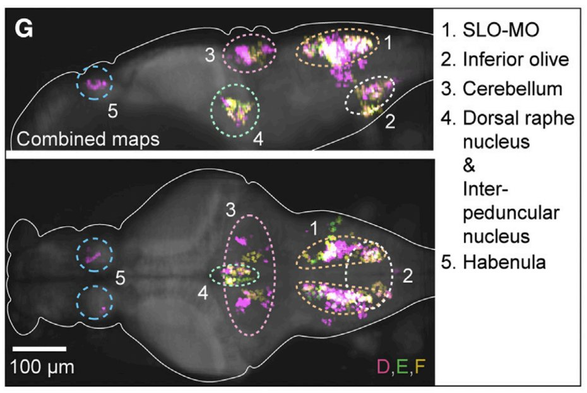
Analyzing the data produced multiple brain areas that encoded the location of the animal in the 1D track:

7/n

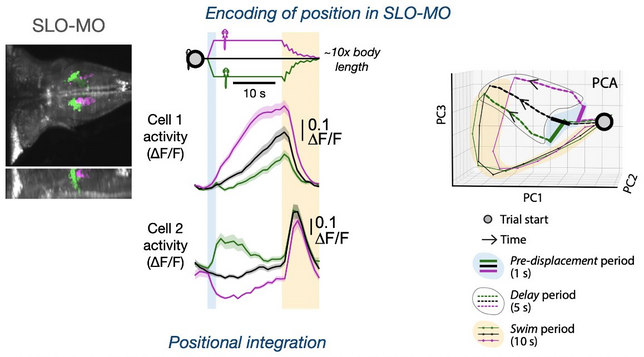
We could now look at how exactly the cells encoded fish location. We started with area SLO-MO. Individual cells there showed fairly complex dynamics, but on top of that integrated visual velocity so they represented fish location. This also worked in 2D

8/n

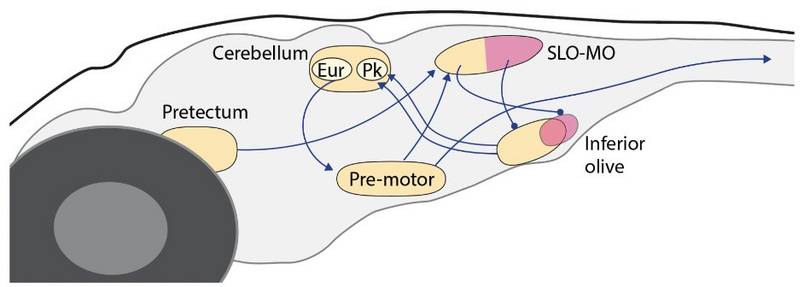
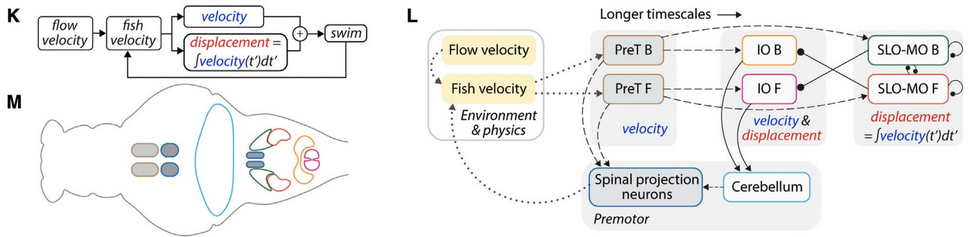
Location could be easily decoded as well using a linear decoder. Using other methods, we produced a provisional circuit diagram for the complete transformation [visual flow] → [integration] → [location memory] → [motor preparation] → [corrective swimming]:

9/n

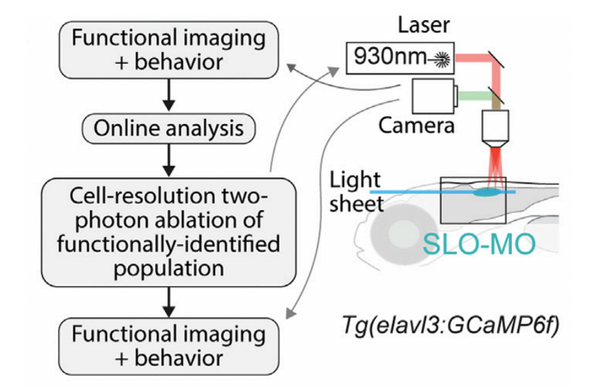
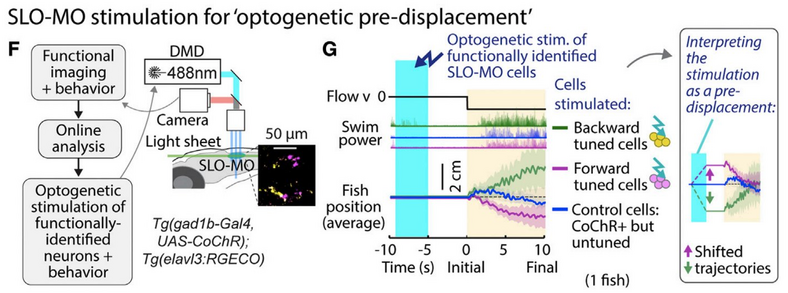
This diagram was a starting point for more mechanistic investigations. We tested the necessity of the core brain areas, and tried to ‘implant’ memories of position shifts by activating specific sets of neurons in the memory-storing SLO-MO area

10/n

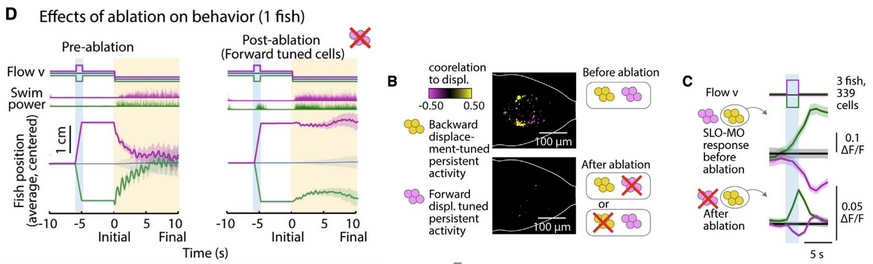
This is what happens to the behavior and to SLO-MO activity when you lesion that brain area: fish lose all memory of position shifts, and the rest of SLO-MO stops storing memories of position shifts, suggesting SLO-MO is the velocity integrator:

11/n

When we stimulated sets of neurons in SLO-MO that corresponded to forward or backward shifts, fish behaved seconds later as if they actually experienced those shifts:

12/n

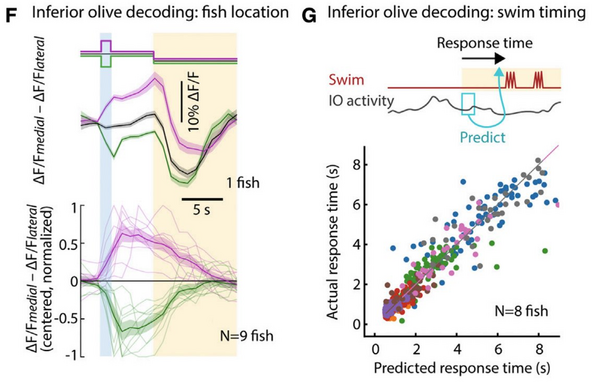
Going deeper into the network, the inferior olive also coded for positional shifts, and activity was predictive of when the fish would swim, suggesting we are getting closer to ‘motor’ along the sensory-memory-premotor-motor pathway:

13/n

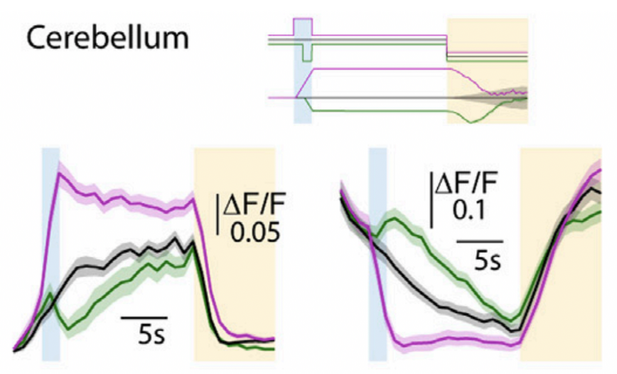
Even further down the network, the cerebellum also contained activity that correlated with positional shifts of the fish

14/n

To summarize, one way the fish brain tracks position changes is by integrating optic flow in SLO-MO, and passing it on to the inferior olive, then cerebellum, and finally premotor circuits to drive compensatory swimming

15/n

Do mammals have a SLO-MO that integrates optic flow or local movements? We hope mammalian researchers will test it – we think it might be in the vicinity of the nucleus prepositus hypoglossi

16/n

Credit to En Yang for leading this, and other authors Maarten Zwart, Ben James, Mika Rubinov, Ziqiang Wei, Sujatha Narayan, Nikita Vladimirov, Brett Mensh, and James Fitzgerald!

17/n

And thanks to the broader neuroscience and zebrafish communities for their super inspiring work that this study built upon!

18/n