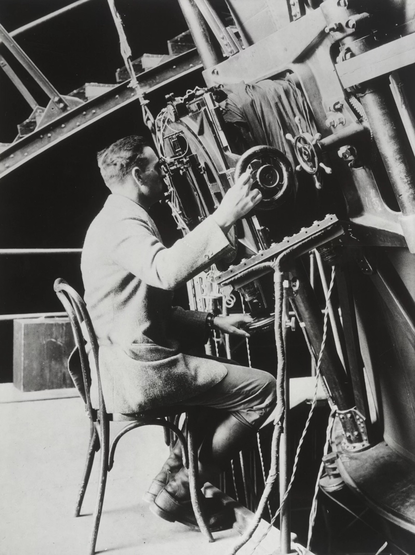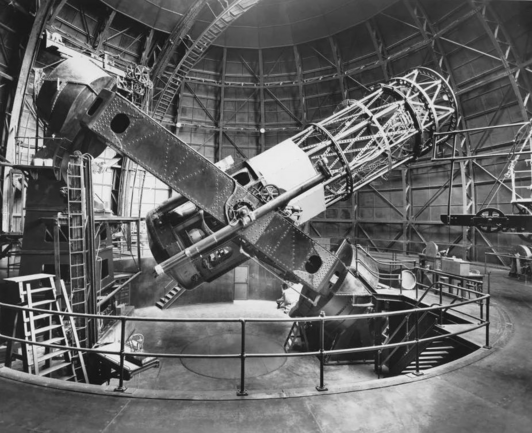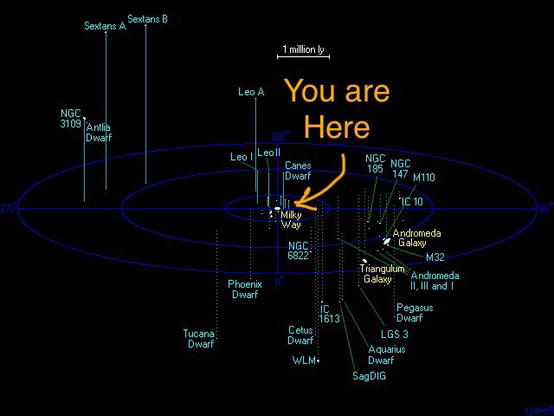
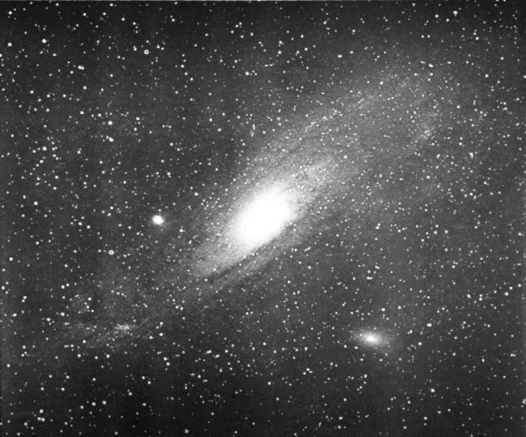
Edwin Hubble announced #OTD in 1925 that Andromeda and other spiral nebulae were in fact separate galaxies outside the Milky Way, in a paper read to an AAS meeting by H.N. Russell.

The Universe was more than just our little island of stars, far greater in extent than what many astronomers had allowed themselves to imagine.

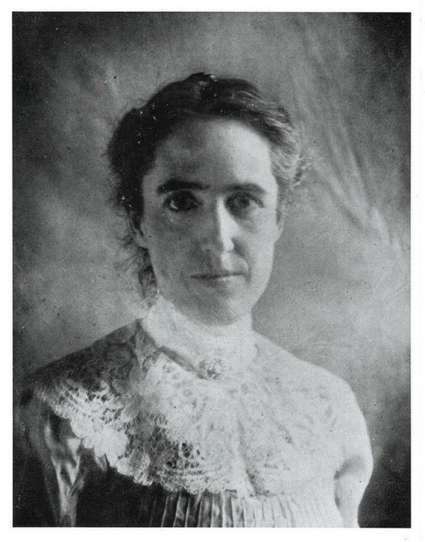
Hubble built on observations by Vesto Slipher, collaborated with Milton Humason, and relied on Henrietta Swan Leavitt’s work on Cepheid variables to reach this conclusion.

It seems hard to believe, but there are people alive today who were born into what scientists thought was a much smaller universe.

Former US President Jimmy Carter was three months old when Hubble made his announcement.

Betty White, who passed away just over a year ago, was always my favorite example of this. She was about to turn three years old.

Hubble’s announcement — Other galaxies exist! Our Milky Way is just one in a Universe full of them! — was made on the third day of the 33rd Meeting of the American Astronomical Society, in a paper read by H.N. Russell. The meeting started on December 30th; I don’t know if Hubble waited for New Year’s Day to be dramatic.

For astronomers, the announcement probably wasn’t a sudden revelation. Hubble had been discussing this result with colleagues, and word had gotten around.

It’s hard to imagine the pre-Hubble view of the Universe, though it was less than 100 years ago.

Just a year before Hubble’s announcement, many astronomers thought the collection of stars that make up our galaxy was… Everything.

Astronomer Harlow Shapley was perhaps the leading proponent of the establishment view. He had long argued that spiral nebulae seen by astronomers — shapes any kid would now recognize as galaxies — were just dust clouds inside the Milky Way.

Images: Huntington Library

But there had always been astronomers who suspected that the Milky Way was just one of many galaxies. This view goes at least as far back as Immanuel Kant’s “Universal Natural History and Theory of the Heavens,” which he published anonymously in 1755.

It was the identification of Cepheid variable stars in M31 and other spiral nebulae that allowed Hubble to prove they were so far away that they must be outside the Milky Way.

A Cepheid variable is a type of star whose brightness waxes and wanes over a period of time that tightly correlates with its maximum brightness.

Measure that period and you know its absolute brightness. Compare that to how bright it appears, and you can estimate its distance.

This important property of Cepheid variable stars was discovered by astronomer Henrietta Swan Leavitt. It makes them “standard candles” (a term she coined) that we can reliably use for establishing distances to cosmologically nearby galaxies.

Henrietta Swan Leavitt’s period-luminosity relationship for Cepheids is one of the first rungs on the “cosmic distance ladder,” the collection of methods used by astronomers to measure extragalactic distances.

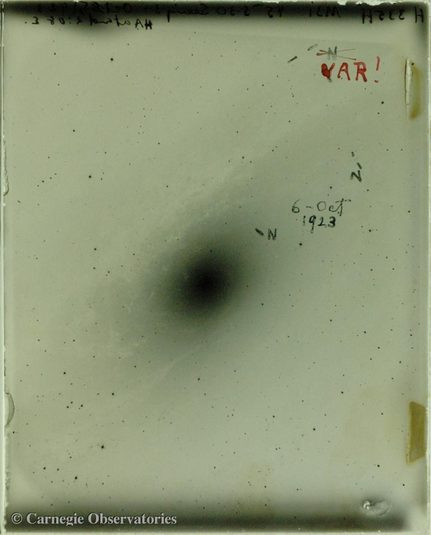
In the early morning hours of October 6, 1923, Edwin Hubble took a photo plate of M31 showing a Cepheid variable star. He originally mistook it for a nova - you can see where he has crossed out an “N” on the plate and excitedly replaced it with “VAR!”

Applying Henrietta Swan Leavitt’s period-luminosity relationship to subsequent observations, Hubble concluded that the distance to M31 was greater than reliable size estimates for the Milky Way.

Image: Carnegie Observatories

Hubble kept Shapley in the loop as he built the case for separate galaxies throughout 1924, alerting him to the discovery of Cepheid variables in M31, M33, and other spiral nebulae.

Shapley, who had long argued that the Milky Way was the whole Universe, doubted Hubble at first. But he eventually relented in the face of growing evidence.

Upon receiving one of Hubble's letters, Shapley remarked to doctoral student Cecilia Payne-Gaposchkin “Here is the letter that destroyed my universe.”

Astronomically, January 1st is a meaningless date. It is an arbitrary reference point in a system based on the approximate orbital period of an otherwise unremarkable star that is perhaps only notable for having a life-bearing planet.

But for those of us who reckon time by this system, today is the 98th anniversary of humanity taking a monumental step towards understanding our place in a Universe that is vast and puzzling, but ultimately knowable.

Happy New Year!

Image: Richard Powell

Following @madamscientist‘s suggestion and tagging this thread #ScienceSunday.
@mcnees
I was wondering early this morning why we do not use the winter solstice (Northern Hemisphere) to delineate years.
@Enema_Cowboy @mcnees If we are going there, the point to take for starting the year would be the (northern) vernal equinox. It is the custom to measure along-orbit positions from the ascending node, which this is - sort-of.
BTW this is sort-of how it was at times in the past:
https://www.daytranslations.com/blog/march-25-was-new-year/
Hence the 'wrongly' named months: September = 7th month, October = 8th, etc.
March 25 was the New Year Once Upon a Time

The New Year, while basically a religious festival, has so much history behind it, because it is related to the creation and adaption of the Gregorian calendar. When the early Romans had devised their calendar, there were only 10 months, with March being the first

Day Translations Blog

@Enema_Cowboy @mcnees

Y'know what yeah we really should. That along with a 13-month 28-day calendar (with year and leap days that don't count) is the way to go.

@auran @mcnees

I suspect that is the calendar used by my company's accounting department.

@mcnees I mean, I think it’s a long way down the street to the chemist.

@mcnees

You left out the best part (imho): In which Hubble's insanely huge universe turns out to be TOO SMALL.

That is, because he was unaware of the 2 kinds of Cepheid variables, his distance/universe-size estimates were off by a factor of 10.

... which put the age of the universe at ~1 billion years, ... this being roughly when geologists, in their initial attempts to get the age of the Earth came up with ~5 billion years

... a mystery that took another decade or so to resolve.

@mcnees Wild to think we've known about galaxies for less than a century. Makes me think about how much we still don't understand the universe, and wonder what the next astronomical paradigm shift will be.

Fingers crossed that it's "dark matter is consciousness / souls / gods / the rest of the multiverse / a source of unlimited free energy / all the lost socks [choose 2]"

@mcnees I didn't realise they had VAR back in those days...
@mcnees Oh this is the way to write about science, I love it - Applying her period-luminosity relation, he finds M31 is outside our galaxy - I mean, breathtaking science with the simplest plainest details and perfect attributions - I'm so happy because I didn't know this before!! I can imagine him doing the calculation & sitting back in wonder (and doubt, I'm sure!!!) when he saw the number. This is why I love what I do, because of such feelings, the clink clink when things fall into place...

@mcnees
I'd love to see a movie series giving us a view into the lives of undersung #WomenAstronomers of the past, like Caroline Herschel, Henrietta Swan Leavitt, Celilia Payne-Gopaschkin, and many others. All I've ever seen is brief narratives of some.

Newton said he saw further than others because he stood on the shoulders of giants (tho I've read he was being sarcastic.) But it's true for all scientists, and many of those shoulders belonged to women, most we never have heard much about.

@mcnees amazing I learned about these things studying astrophysics but never learned about the discoverers. The only astronomers I ever heard about were men
@mcnees I love that we have cepheid measurements alongside others as we continue to refine our understanding of astronomy. I would liken it to the way archaeologists supplanted pottery shard dating with radiocarbon and eventually found ways to use them both to support each other. Thank you for this thread!
@mcnees
A "standard candle" is actually an older term -- it was a recipe for a light source of fixed intensity. (And, in fact, an actual candle, made from whale fat)
@rjme @mcnees I was assuming he meant she was the first one to use it in relation to Cepheid variables... but I could be wrong.
@level98 @mcnees yeah. But the term itself was not “coined” by her. (And the whales part is a cool story)
@rjme @mcnees They must of had a whale of a time coming up with that definition (groan).
@rjme @level98 Yeah, sorry, I meant “coined” for astronomical use. Should have been more careful how I said it.