 Tim Bray
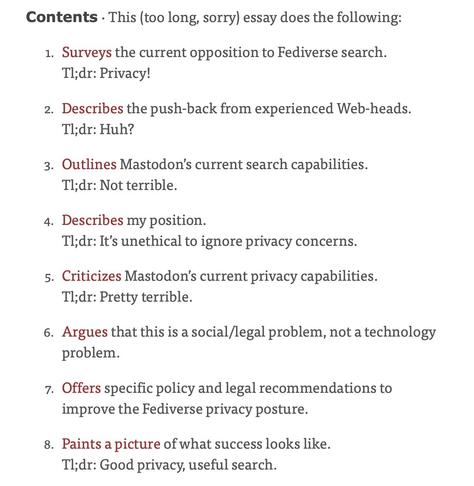
In which I put my head in the lion’s jaws and write 2700 words about privacy and full-text search on #mastodon: https://www.tbray.org/ongoing/When/202x/2022/12/30/Mastodon-Privacy-and-Search
I have questions about the practicalities of various search strategies.
1. How big will the search repository become? Twitter uses two big data centers and still outsources some of its activity to AWS and GCP, if various reports are correct. That is well beyond the capability of instance admins or even instance organizations to manage.
2. What is the time window of search. Right now, AFAIK, the hashtag search basically covers whatever the home instance has seen lately. That is a sort of ephemeral search that answers the question: "what's been said recently in my extended network?"
Twitter keeps everything from inception. That answers the question of "What has ever been said on this topic by anyone anywhere?" Those are two different search motivations and strategies, with huge cost differences.
3. If 3rd parties set up an expansive search engine, how will they pay for it?
If I have misunderstood the mechanics, please put me on the right path.
Sensible questions. But we have to get the policy issues right before we can even start worrying about them.
@timbray @vicuzumeri @BudGibson Tim, have you played around with Pixelfed? It’s not obvious on the app, but posting allows you to set the license and on the browser it shows you exactly what license is associated with a post.

A story of grappa: I visited Venice with some friends right at the end of the season. One of my friends was a regular, and her favorite restaurant set us up for their last night of the year. The food was spectacular, as was the wine. Then the house started pouring grappa. I wandered around empty Venice that night with friends, a camera, a tripod, and a brain full of grappa. This was one of the photos from that night. #travel #Venice #Italy #Night #canal #world
I am confused about where one can look for any policy decision in the Fediverse. If there's no centre of gravity for policy, the next best decision criteria is usually somewhere in the economics.
We will have to wait and see how this movie turns out.
FWIW, my expectation is that the Fediverse will evolve differently from previous Internet technology cycles.
To me, the big new factor is the growing maturity of open source technologists and developers around the world.
IMO, the hegemony of the Silicon Valley VC billionaire bros is up for grabs.
Mastodon is the work product of a German developer. The next killer app design iteration may come from Kazakhstan, Mexico or Nigeria.
If this occurs, the legal issues will be more complex ... maybe impossible to enforce.
A kick ass Kazakh server technology could become a huge factor if it were quickly embraced by India, Phillipines and South America. Or any combo like that.
Then who sets legal policy?
Right now, the monolithic SV companies are driven by US law and, increasingly, EU law.
But that could change.

 Bud Gibson
 Vic Uzumeri
 Jon
Jon Glenn Fleishman
 Matt
Matt