πŸ§ πŸ’πŸπŸ¦˜πŸ¦™πŸ¦ŒπŸ·πŸ»β€β„οΈπŸ¦«πŸ¦πŸ‘πŸ‡πŸˆπŸ¦”πŸ•πŸ¦‡πŸ¦­πŸ¦₯πŸ¦“
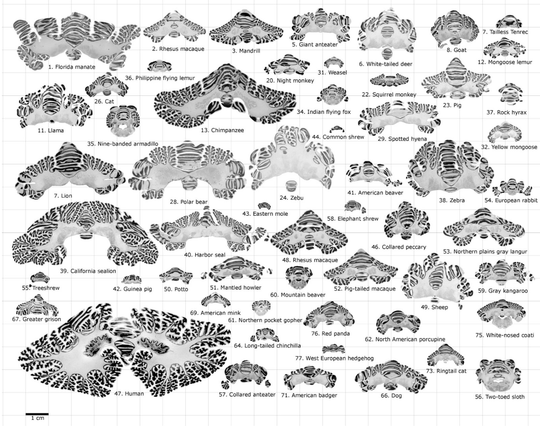
We’ve been diving into the mesmerising anatomical diversity and evolution of cerebellar folding across 56 mammalian species with @r3rt0 Nicolas Traut @AleAliSousa @sofievalk
https://www.biorxiv.org/content/10.1101/2022.12.30.522292v1

Check it out in a short tooting thread πŸ”½

@r3rt0 @AleAliSousa @sofievalk

2
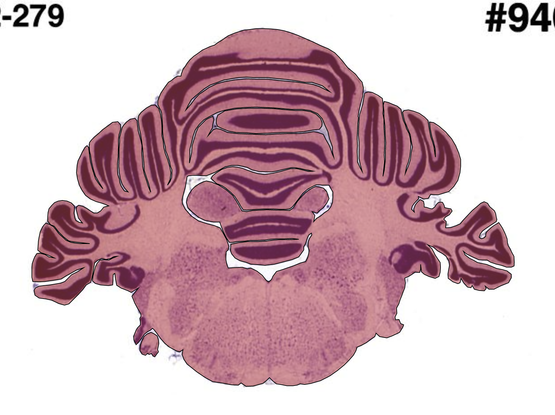
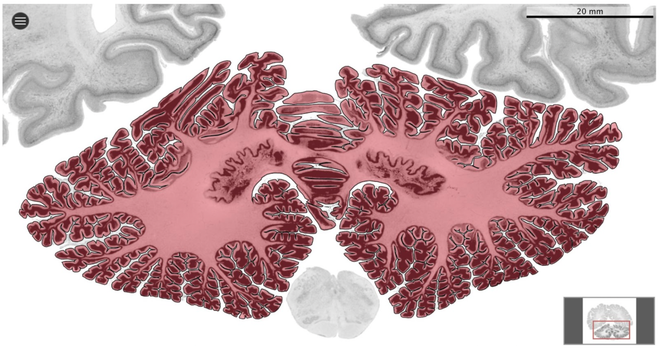
We used our Web tool MicroDraw to visualise and segment the histological data online, and created tools to study the geometry of cerebellar folia and to estimate the thickness of the molecular layer.

@r3rt0 @AleAliSousa @sofievalk

3
Phylogenetic comparative methods revealed that the evolution of cerebellar and cerebral neuroanatomy follows a stabilising selection process.

@r3rt0 @AleAliSousa @sofievalk

4
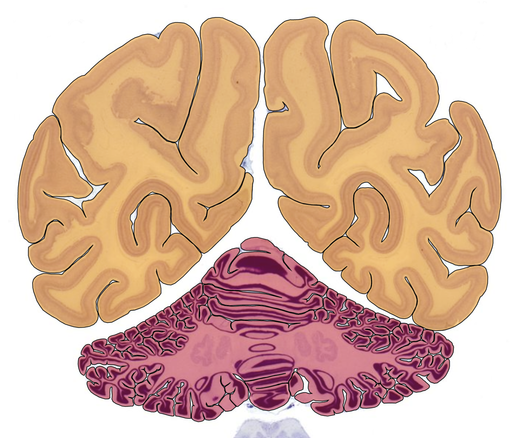
Cerebellar size and folding correlate strongly with cerebral size and folding.
Ancestral character state estimations showed that size and folding of the cerebrum and cerebellum increase and decrease concertedly through evolution.

@r3rt0 @AleAliSousa @sofievalk

5
The cerebellar and cerebral cortices are disproportionately larger than their volumes, as shown by their hyper-allometry. The cerebellum is slightly but statistically significantly hypo-allometric compared to the cerebrum.

@r3rt0 @AleAliSousa @sofievalk

6
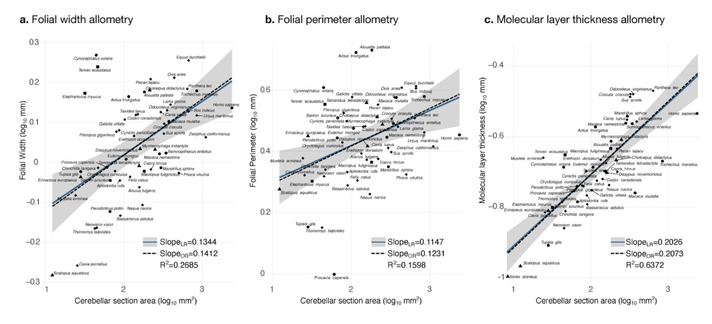
Folial width, folial perimeter and the thickness of the molecular layer increase slightly with cerebellar size, largely conserved when compared with changes in total cerebellar size, as revealed by the small allometric slopes.

@r3rt0 @AleAliSousa @sofievalk

7
Our results confirm the strong correlation between cerebral and cerebellar volumes across species, and we extended these results to show that the same strong relationship holds for cerebellar folding: larger cerebella appear to be disproportionately more folded than smaller ones.

@r3rt0 @AleAliSousa @sofievalk

8
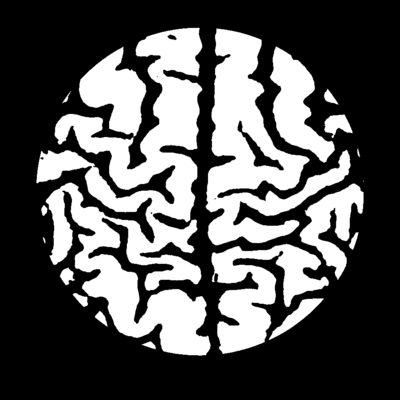
Comparing the allometric relationships between section length and area suggests that a similar process lies behind the folding of the cerebrum and the cerebellum, that can be explained by buckling and where wavelength of folding depends on cortical thickness.

@r3rt0 @AleAliSousa @sofievalk

9
We work collaboratively online! Please reach out and come join us at any time! ❀️ πŸ’ πŸ’ πŸ’

@k4tj4 @r3rt0 @AleAliSousa @sofievalk
Very cool work and cool data!!!! πŸ‘πŸ‘ are you guys planning to look at the cytoarchitecture on your histological data ? 🀩

@kepkeeloh @r3rt0 @AleAliSousa @sofievalk

Yes! Next up! The detection of the molecular layer in the histological data was a 1st step (allowed us to make sure that the vectorial and pixel data are well aligned, and that we can combine both). Roberto is much more advanced in the analysis of his ferret data, doing 3d profiles and histology-based surface reconstructions, etc. Wanna join our adventure 🀩 ? It works across the ocean πŸ’ž First step will be more segmenting... πŸ˜…

@k4tj4 @r3rt0 @AleAliSousa @sofievalk

Awesome!!!! I’m curious to look at the nissl sections of the various mammal species and see how the various brain areas compare with les primates 🀩!!

By segmentation you mean the identifying of the various layers within the cortex right? We can see the individual neurons on brain box?

Great start to 2023!!!!

@k4tj4 @r3rt0 @AleAliSousa @sofievalk what about the deep cerebellar nuclei?

@k4tj4 @r3rt0 @AleAliSousa @sofievalk

Such a very beautiful work, congrats for it! I have recently watched a lecture of a Brazilian professor (link to his contact below) that works in a similar research line. He uses math modelling to understand the dynamics of brain folding. Check it out:

https://www.if.ufrj.br/docentes/bruno-motta/

@inaciomdrs @k4tj4 @AleAliSousa @sofievalk Yes! We know Bruno's work well. He's doing some amazing stuff.