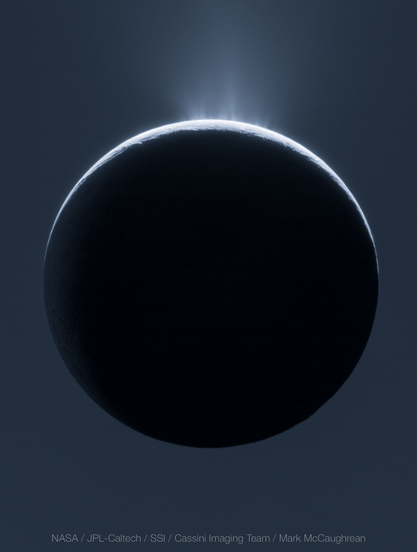
Enceladus.

The famous water plumes on the south polar limb, backlit by the Sun with a little extra reflected Saturn glow on one side, all seen against the E-ring.

HDR stack of two monochrome images taken by the ISS NAC on Cassini on 27 November 2015.

Downloaded from the PDS, aligned, processed, cleaned, upscaled by a factor of two, then tinted for aesthetic effect.

Credit: NASA / JPL-Caltech / SSI / Cassini Imaging Team / Mark McCaughrean
#astrodon #photography #spaceflight

@markmccaughrean Beautiful work
@eyeling Thank you – I haven’t played with raw Cassini data before, so spent an interesting afternoon working through some of the steps, including the HDR stacking to capture the bright limb & fainter jets & Saturn glow. Worked quite nicely 🙂
@markmccaughrean Beautiful processing work and final image!
@markmccaughrean Now here’s what I love about being on
Mastodon. Motivated by this, I read about Enceladus and my jaw dropped. Tremendous moon; fills me with wonder.
@shannonf Thank you – that’s very kind. Indeed, Enceladus is a fascinating world, one among many in our Solar System 🙂👍

@markmccaughrean So you are posting our images too?! ;-)

Please don't call them plumes. They are geysers. And all those geysers form the Enceladus plume.

@carolynporco Thanks, Carolyn – duly admonished 🙂

On the nomenclature, fully understood & apologies. Will use geysers henceforth.

On the posting though, I assume it’s ok for me to do so as I’ve given proper (?) credit. I spent several hours working with the raw data downloaded from the PDS, combining two images to get a better HDR take on the bright limb & geysers (🙂) as well as the faint stuff further out in the plume (👍) & the left limb illuminated by Saturn. Hadn’t seen that before.

@carolynporco Some technical questions though.

The raw images in the PDS are 8-bit, even though the ISS A/D is 12-bit. Am I missing dynamic range somehow by using them?

The calibrated images are 32-bit & I’d use them, but I don’t understand the units. Enceladus gets fainter (smaller numbers) as the integration time increases (these are 1 & 10 sec exposures), even though some parts also saturate. How do I scale them properly before combining them as HDR?