 Ben Raue
Today's blog post is about the Victorian Legislative Council, and how different electoral systems would have produced different seat results. It's a follow-up to a number of posts I did before the election based on 2018 data.

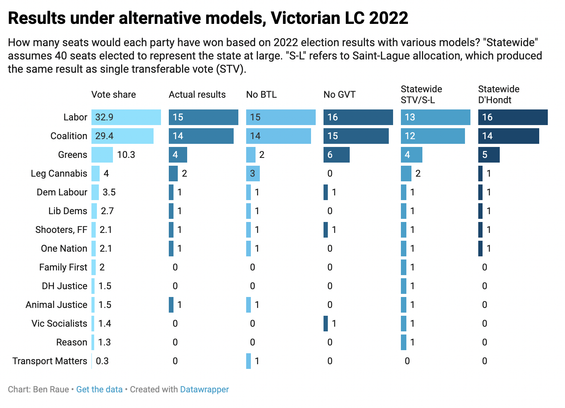
First up this chart just shows the results under various systems.
If every vote had been cast above the line, the Greens would have lost 2 of the 4 seats, they won - one to Transport Matters and one to Legalise Cannabis (on top of the two LGC did win).
The chart also shows the totals if the election was statewide with no regions, using either single transferable vote, Saint-Laguë or D'Hondt. The former two produced the same outcome.
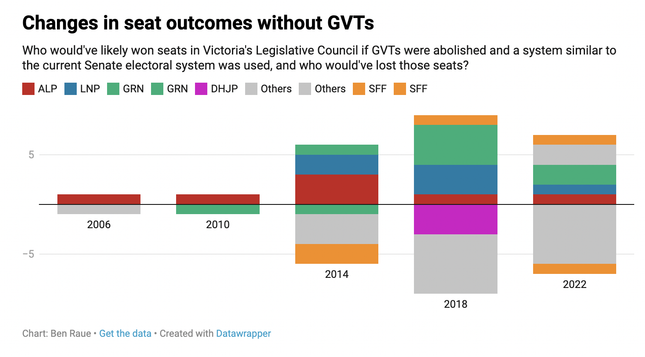
If the existing system was run using the 8 existing regions but with no group voting tickets (GVTs), then I think 7 seats would've changed hands.
- Greens would have gained 2 more.
- Labor and Coalition would have each gained one.
- The DLP and Shooters, Fishers and Farmers would have each gained a seat but lost the seat they did win.
- Victorian Socialists would have won a seat.
- One Nation, Liberal Democrats, Animal Justice would have lost their single seats.
- Legalise Cannabis would have lost both their seats.
Overall this compares to nine seats being affected by GVTs in 2018, six in 2014, and just one at the 2006 and 2010 elections.
I also calculated the results under statewide election. Under STV (basically the same system used for Senate and LCs in NSW, SA and WA) I think every party who did win a seat would've still won a seat. Four small parties would have also won a seat (Family First, Hinch Justice, Socialists and Reason), with the Coalition and Labor each losing two seats. Under this system every party winning 1.3% or more would've won a seat.
There are two other methods which are much simpler than STV which could be used to produce proportional results without the use of preferences, and I think are superior if the magnitude reaches a large number like 40.
They are grouped together as 'highest average' systems where the party who has the highest average votes per seat wins the next seat, until all seats are filled.
Under Saint-Laguë, the result would've been exactly the same as under STV.
D'Hondt is slightly more favourable to the major parties. It would have given Labor and Greens each one more seat than the real result, Legalise Cannabis one less, and Animal Justice would've missed out.
Note that under all these systems the overall left-right balance remains roughly the same. Most systems elect 22 members from Labor + Greens + Reason + Socialists + AJP + Legalise Cannabis + Transport Matters, except for the no-GVT M5 model which elects 23. So all would've paired the Labor government in the lower house with a progressive majority in the upper house, but the exact make-up varies substantially.
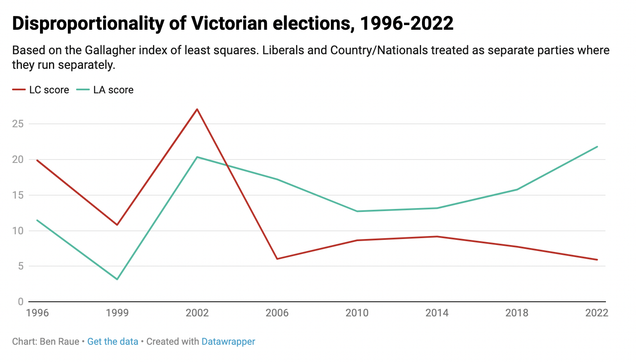
Finally, I've spent a lot of time bashing up on the upper house because of GVTs but I wanted to revisit my last blog post about how the Victorian Legislative Assembly had the most disproportionate result since 1967.
I calculated the Gallagher score which measures disproportionality between seat proportion and vote proportion, and found that the 2022 Victorian Legislative Council is the most proportional result in the history of the chamber.
While GVTs do cause some problems, the breakdown in the Druery alliance and the shift back towards more ideological preferencing has reduced the disproportionality.
And it's worth remembering that overall the upper house matches voting trends far better than the lower house.
Labor suffered a substantial swing in the lower house but gained a seat, with the 17% of people who didn't vote for Labor, Coalition or Greens left completely unrepresented.
On the other hand, the swing away from Labor is very clear in the upper house, with them losing three seats.
This chart compares proportionality in both houses since 1996. You can see the change in 2006 when the Vic LC changed from being elected through single-member electorates, with each electorate covering four LA seats, to proportional representation.
Finally you might wanna consider following @tallyroom which is my new second account.
For now it'll mostly be a bot just posting links to my blog posts but also a bit more professional option for the blog and podcast.
Keep an ear out for the bit in tomorrow morning's podcast where I cut out the plug for my Twitter account and replaced it with Mastodon?
 Barry Brannan
@benraue looks like the new account requires you to manually approve followers? is that intentional?
 doublelineblock (Will)
@benraue A few weeks back I tried modelling the Assembly under M5 STV, with electorates of four grouped districts. It’s not perfect thanks to dubious boundaries and uncertain preference flows, but I came up with
51 Labor; 46 Coalition; 8 Green; 4 Independent (Cupper, Sheed, Greco, Lowe/Torney); 1 Socialist (in the inner north-west).
The majors still have the advantage, but it’s far better than single-member districts. I was surprised both by the possible socialist win and the absence of any right minors, though they might have come close in the outer south-east.
51 Labor; 46 Coalition; 8 Green; 4 Independent (Cupper, Sheed, Greco, Lowe/Torney); 1 Socialist (in the inner north-west).
The majors still have the advantage, but it’s far better than single-member districts. I was surprised both by the possible socialist win and the absence of any right minors, though they might have come close in the outer south-east.
@doublelineblock yeah it's not perfectly proportional but fairly proportional. I think there's a lot to like about M5, it produces a fair degree of proportionality without incentivising large amounts of fragmentation in the party system and relatively stable govt. In this scenario there'd be a clear majority for a Labor/Greens govt.
Look up the paper on the "electoral sweet spot" that argues low-M PR has a lot of the benefits of PR and the benefits of single-member.
@doublelineblock I think I've come around to thinking the ideal system is M5-7 districts in the lower house which will likely lead to 4-6 significant parties and 2-3 parties in govt, and then something close to pure statewide PR in the upper house which allows in smaller parties.
In this scenario you would've had a Labor/Greens majority in the LA but not in the LC, but there would've been a broader progressive majority. Thus providing accountability but not deadlock.
@benraue I generally agree! I’d say moderate magnitudes are best, giving decent proportionality without fragmentation or instability — I’ll check out that paper you mentioned. And though a near-purely proportional upper house has its challenges, I think it best preserves the advantages of our semi-parliamentary system.
@benraue I’d agree that a different form of PR like Sainte-Laguë or D’Hondt works better at very large magnitudes, but I don’t know if a non-preferential system would win broad acceptance in the Australian context. (I think the best model with a chance of success is a 96-member assembly and a 32-member council with statewide STV. Better representation in both chambers with much lower quotas and smaller districts, but it’s not too radical.)
@doublelineblock yeah I agree about it being hard for people to accept.
The Wran govt originally proposed D'Hondt for the NSWLC in the 1970s but the Coalition was convinced it was a plot against them and they ended up going for M15 STV (later M21). Likewise a clunky party list system with a little bit of preferencing was used for the first 2 SA LC elections.
@doublelineblock I think part of it is that politically involved people (including politicians) really value maximising the value of their vote with preferences, even though under high-M systems the preferences don't really make that much of a difference, and an anxiety around 'vote-splitting', which again matters less as M goes up.
Whereas in reality, a system that requires a lot of preferences to maximise the value of your vote has a discriminatory effect. At a certain point to just give everyone a first preference and stop there.
@benraue Yes, although at high magnitudes STV loses its advantages and non-preferential PR loses many of its disadvantages, a lot of politically active (myself included!) people value their preferences. But the Vic election has shown that most people are happy just to put a 1 in a box and move on, and there are serious fairness issues with a system that requires navigating a lot of complexity for a maximally effective vote. Preferential voting has dominated our elections for so long though that making the case for change isn’t easy.