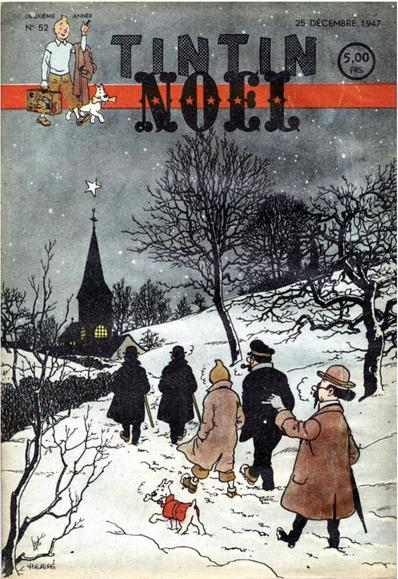
Time to remember the magnificent cover from the 25th of December, 1947, “Edition Nöel” of the “Journal de Tintin”. Yes, it’s not a photo, nevertheless notice the absence of any #publiclighting, the #starrysky, the grey snow (it’s night, but that does not mean absolute darkness - natural #darkness is brighter than many could imagine). One might speculate that there’s no moon either, since there are no shadows. We are missing this possibility due to #lightpollution from millions of useless lights.
Edgar Rice Burroughs (better known for creating Tarzan) published A Princess of Mars in 1912. In his fantasy Martian cities the lighting is designed so that all the light is directed where it is needed, and does not escape as #LightPollution.
@GeorgeCzernuszka interesting! Didn’t know that. I’ll definitely look for it. Thanks!!
@raulclima The motivation in the book may just have been to explain why we on Earth have not seen any evidence of the Martian civilisation. Yet Wikipedia tells me that light pollution was already affecting astronomical observations even in the 19th century.
@GeorgeCzernuszka Interesting. And, yes, the first (identified) victims of light pollution were observatories, back in the 19th century (and the population, of course, deprived from the night sky). Until then – pollution from factories apart (that became another problem too) – there were no major restrictions for observatories to be operating within city limits or near cities. (There are also a few records of impacts of light on birds and insects from late 19th, early 20th centuries.)