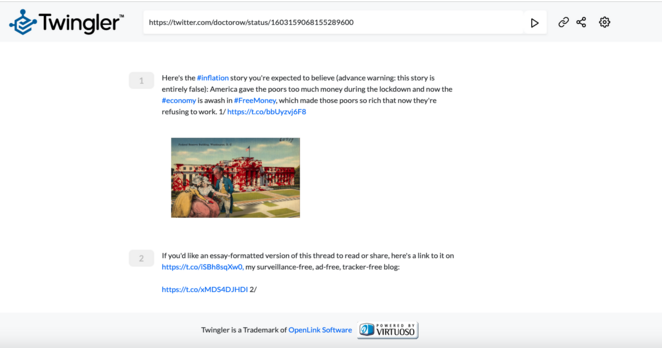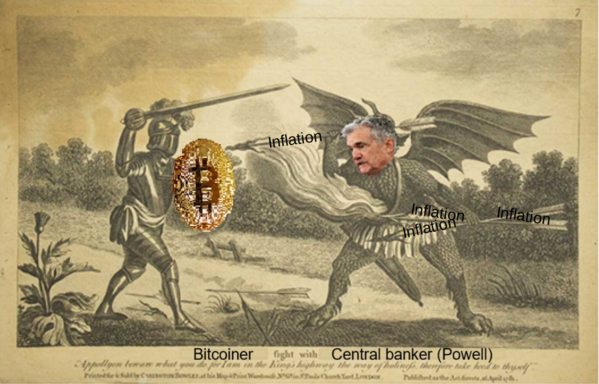
Here's the #inflation story you're expected to believe (advance warning: this story is entirely false): America gave the poors too much money during the lockdown and now the #economy is awash in #FreeMoney, which made those poors so rich that now they're refusing to work, which means the economy isn't making anything anymore. With all that extra money and all those missing workers, prices are skyrocketing.

1/

To hear ghouls like Lawrence Summers tell it, there is only one answer to this. We have to immiserate the poors: jack up interest rates, kick off a #recession, destroy millions of jobs, until the poors are stripped of their underserved fortunes, and, humbled, they return to their labors:

https://pluralistic.net/2021/11/20/quiet-part-out-loud/#profiteering

2/

Pluralistic: 20 Nov 2021 – Pluralistic: Daily links from Cory Doctorow

As noted: this is bullshit. Countries all over the world experienced inflation during and after the lockdowns, irrespective of whether they handed out relief money to keep people from starving to death while their workplaces were shuttered. America has slightly higher inflation than some other OECD countries, but the causes have nothing to do with overly generous relief packages.

3/

"The Causes of and Responses to Today’s Inflation," a Roosevelt Institute paper by Nobel-winning economist Joseph Stiglitz and macroeconomist Regmi Ira, debunks this false inflation narrative, revealing it as a sham aimed at destroying workers' lives, offering a far more plausible explanation for inflation:

https://rooseveltinstitute.org/wp-content/uploads/2022/12/RI_CausesofandResponsestoTodaysInflation_Report_202212.pdf

5/

More than that, though, the authors show how sharp interest rate hikes actually harm the economy, deepening the recession and *increasing* inflation. They compare #MonetaryPolicy inflation remedies to medieval #bloodletting, where "doctors" did "more of the same when their therapy failed until the patient either had a miraculous recovery (for which the bloodletters took credit) or died (which was more likely)."

6/

Let's start with the case against bloodletting. #InflationHawks warn us of the #WagePriceSpiral, which is when inflation goes up and powerful workers bargain for higher wages, which drives up costs, and thus prices, and thus wages. This is the fairy-tale version of what happened in the 1970s and it's entirely true except for the fact that it was #OPEC's #embargo driving up oil prices that caused inflation, a fact that makes it entirely false, but oh well.

7/

Still, let's be generous to bed-wetting, seventies-haunted inflation hawks and pretend that we're worried about a wage-price spiral. Good news! There isn't one. Wage growth peaked in June at 4.8% and by October it had declined to 4.2%, making real wages 2.3% *lower* than they were in Oct 2021.

8/

How is it that America's all-powerful workforce was willing to take a paycut rather than demanding wages that keep pace with inflation? "Weak unions, globalization, and changes in the structure of the economy."

But there's another factor at play here: workers don't think inflation is going to get worse, so they're not demanding inflationary raises.

9/

For all the fearmongering about #InflationaryExpectations: "Inflationary expectations have also remained tame, which is consistent with our interpretation of the data."

https://www.newyorkfed.org/microeconomics/sce#/

Workers also aren't spending too much. While demand is up slightly, the evidence is that working people "treat
excess savings as wealth and spend it gradually over their lives."

10/

Survey of Consumer Expectations

Provides information by age, geography, income, education, and numeracy about consumers' inflation expectations and their views about job prospects, earnings growth, and expectations about future spending and access to credit

People may have accumulated savings by eating in during the lockdown, but they're not going out for dinner every night to make up for it, instead, you hold those savings in reserve, as "precautionary balances." This is why "in total, the economy has largely remained below trend."

To the extent that people are buying things with their pandemic savings, they're not buying #NonTradedGoods (basically, imports).

11/

Buying imports doesn't produce the "multiplier" effect of domestic purchases. If you buy a loaf of bread from the corner baker for a dollar and they spend that dollar at the tavern across the street and the bartender spends it on a manicure down the road, that dollar generates three dollars in economic activity. But if you spend a dollar on goods from abroad, the dollar leaves the country and any multiplier effect happens there, and doesn't heat up the US economy.

12/

Wages did go up slightly, but only slightly. The Employment Cost Index is only up 1.6% relative to 2019. Almost all those gains have gone to the 25% worst-paid workers in America. Contrary to the inflation scare story about too much savings, these workers don't earn enough to have *any* savings, even post-pandemic.

US spending on non-traded categories (recreation, transport services) is the same or lower than pre-pandemic levels.

13/

Food and hotel expenditures are slightly higher (which doesn't mean were buying more food than we were in 2019, just that it costs more).

So if inflation isn't caused by greedy workers and free money and too much demand, what *is* causing it?

14/

Here's a clue: when it comes to domestic goods, the products that have risen most steeply in price are also producing the highest profits for their manufacturers. In other words, they're charging you more, even if they're not paying their workers or suppliers more.

15/

Those additional profits also aren't producing multiplier effects, though: the biggest price-gougers are spending their profits on stock buybacks and dividends, meaning that they're funneling that money to rich people, who then stash it offshore. A billion dollar stock buyback doesn't result in a billion loaves of bread being bought at the corner bakery.

16/

The five root causes of today's US inflation are:

I. energy and food price-spikes;

II. changes in the kinds of goods we want;

III. supply interruptions (mostly for cars);

IV. higher rents (resulting from work-from-home moves);

V. market power (AKA price-gouging).

None of these can be fixed by jacking interest rates or forcing workers into unemployment.

17/

I. Food and energy spikes: The three major causes here are Russia invading #Ukraine, #omicron, and #China's #ZeroCovid policy, all of which interrupted the flow of food and energy and the inputs for food and energy production. We made less of this stuff, and so the price went up.

18/

The largest spike in oil pricing came right after the Russian invasion of Ukraine, and was made worse by sanctions. But that was February. By October, oil prices were back to pre-pandemic, 2015-era levels, thanks to adjustments in the global economy, which include a shift to #renewables. Every new renewable installation reduces demand for oil and directly impacts global oil pricing.

19/

Meanwhile, there's an obvious answer to high food prices: "For half a century, US and EU governments have paid their farmers not to produce. If the war continues, presumably that policy could or should end—and again, as that happens, food prices would fall."

20/

II. Changes in demand. We many not want more stuff than we did in 2019, but we do want *different* stuff. As supply chains broke down during the lockdown, people substituted one kind of good for another. For example, half the US toilet-paper supply in 2019 was on oversized rolls intended for commercial customers. This is made in different mills, out of different stock, than the toilet paper we use at home.

21/

When lockdown hit, 100% of toilet paper demand shifted to home rolls, triggering shortages (the TP hoarding story was just another pandemic urban legend). Because grocery stores don't have accounts with distributors for commercial bumwad, it wasn't easy to simply order from the languishing stores of commercial paper. People substituted kleenex and paper towel, triggering more shortages.

22/

@pluralistic I have n=1 one data from Europe that very much implies I made up for not eating out during the height of the pandemic. And we never even had a real lockdown, lol.

But also interestingly this was budgeted out and I shifted the budgeted money for those expenses to um shopping.

So I don't know, some people are weird.

@pluralistic. This is the crime of the century or maybe of two centuries.

@pluralistic Duh. I've been shouting this from the rooftops. Any firm who pays interest as part of its cost of doing business will pass along increases in that marginal cost.

But according to the magical thinking of conventional economics, they don't because Invisible Hand or some lunatic woo nonsense.

@pluralistic Just heart breaking. If only, our anger were carefully targeted at those pulling the strings.

@pluralistic

What are you talking about? Uncle T and Uncle B gave me a few grand a couple years back and I have been living high on the hog ever since.

/s

@pluralistic I'm told that if you post the first post of a long thread publicly, then change the "public" setting to "unlisted", it won't clutter up the feed with 30+ posts for one thread. People can then boost the initial post and everyone can still read and respond to the thread without it showing up 30+ times.
@annaraven
You have misunderstood how "unlisting" works (unlisted toots are hidden only for nonfollowers on the same instance, not followers). As noted in my bio, I post long threads from this account and there are many ways to get my essays if you don't like my Mastodon style - RSS, newsletter, Medium, Tumblr, a blog, etc. I recommend unfollowing me here and subscribing to one of those if you prefer. Links at pluralistic.net.
@pluralistic I tell people that inflation is both due to supply chain disruption due to COVID as well as the "price" that we are paying for avoiding a significant recession by using fiscal stimulus to allow people to keep their jobs and their homes. In the absence of fiscal stimulus, the housing market would have totally imploded and people would have been displaced making the problem 10x worse.
@pluralistic The response to COVID was wayyyyyyyy better than the response to the GFC because funds got into the hands of those who needed them to avoid disruption in job and housing markets.

@pluralistic ,

Here's another version of this wonderful thread via an #hypermedia page (without any surveillance code) for easy reading.

https://linkeddata.uriburner.com/twingler/?uri=https://twitter.com/doctorow/status/1603159068155289600

Twingler - New Web of Data Contribution

Twingler

@pluralistic look, I really like your content, another great thread. Truly!

But, the way you post here on Mastodon really makes my timeline here suck. Worked fine on birb site because of timeline algorithm I suppose.

Maybe mark followup posts as "unlisted" ?

@aeischeid You have misunderstood how "unlisting" works (unlisted toots are hidden only for nonfollowers on the same instance, not followers). As noted in my bio, I post long threads from this account and there are many ways to get my essays if you don't like my Mastodon style - RSS, newsletter, Medium, Tumblr, a blog, etc. I recommend unfollowing me here and subscribing to one of those if you prefer. Links at pluralistic.net.

@pluralistic yeah, I'm no Mastodon expert, just trying to figure it out.

I do usually read at pluralistic.net BTW, but like following on social to see comments and such.

Attempting to add a filter for "Long thread/" and see how that works. Nice to have that option to try!

@pluralistic this seems to work well enough for me, tried a couple options with the slashes, but the regex must get confused about that.

Anyway, so long as you don't change to include "Long thread" on the first post I'm happy, and that is the important part, right ;)

@aeischeid You have misunderstood how "unlisting" works (unlisted toots are hidden only for nonfollowers on the same instance, not followers). As noted in my bio, I post long threads from this account and there are many ways to get my essays if you don't like my Mastodon style - RSS, newsletter, Medium, Tumblr, a blog, etc. I recommend unfollowing me here and subscribing to one of those if you prefer. Links at pluralistic.net.
@pluralistic do you know who made this postcard?

@pluralistic

I'll go back to work once I get through all that stimulus money!

@pluralistic whoever is doing your graphics, they're killing it lately
@dizave it's me! With the Gimp, and whatever pd/cc source material I can find
@pluralistic the more I learn the more I believe inflation has always been a lie, it’s just less surplus for the ruling class to collect, so they increase prices because *their* profits aren’t high enough.
@pluralistic Guess they spent it in Shops and payed extra Taxes
@pluralistic
This. This whole 🧵.
All of it! 🗣️🗣️🗣️📢📢📢💯💯💯