 Molly White
She characterizes various regulatory suggestions from the crypto-critical as "taking technological choices out of people's hands."
"Risk is a natural component of markets, and failure is often necessary for development."
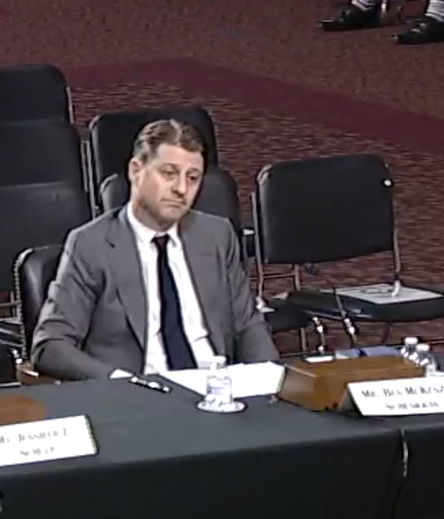
Now Ben McKenzie, who says the crypto industry depends on "misinformation, hype, and, yes, fraud".
McKenzie is outlining how he does not believe that cryptocurrencies are currencies, and how he believes that every cryptocurrency is a security.
"In my opinion, the cryptocurrency industry represents the largest Ponzi scheme in history." - McKenzie
Sen. Brown asks if this kind of fraud exists at other crypto firms.
Allen: Yes
O'Leary: Yes, at unregulated exchanges
Schulp: Most likely
McKenzie: It's endemic.
McKenzie outlining the cross-pollination between execs at online gambling and fraud enterprise Ultimate Bets and the crypto industry: Stuart Hoegner at Tether and Dan Friedberg at FTX
O'Leary not great at yes or no questions. He claims the comparison to gambling are outdated and like early comparisons of the stock market to gambling.
Sen. Toomey pushing back on McKenzie's claim that all cryptocurrencies—including Bitcoin—would be securities.
Not surprised there.
He's having Schulp make that argument for him.
The argument, a common one, is that Bitcoin is too decentralized to be classed as a security.
O'Leary outlines the potential for blockchains, saying that 1/3 of the MIT class wants to work in the crypto industry.
Maybe not the best argument given that SBF was an MIT grad...
O'Leary is blaming FTX's collapse on Changpeng Zhao (CZ) of Binance.
Hilary Allen explains how "proof of reserves" and other crypto industry attestations don't replace proper auditing.
Allen also says that arguments that crypto needs to be regulated completely differently from existing systems because "it's decentralized" doesn't hold water, and explains how the Bitcoin software and mining pools are highly centralized.
Sen. Menendez (D-NJ) asks O'Leary if he might not have lost money if FTX had complied with existing regulations.
He says absolutely, but FTX wasn't regulated.
Compelling.
Sen. Menendez (D-NJ) is worried about the extent to which crypto might be integrated with traditional finance, adding contagion risk.
Mendendez asks McKenzie how we could combat the advertising.
McKenzie says we should use the right terminology, classify cryptos as securities, possibly treat crypto as gambling and restrict advertising, and require disclosures.
Sen. Tester (D-MT) opens with skepticism, asks Allen how her concerns expressed in front of the Senate last year have developed.
She expresses her gratefulness that banking regulators have largely siloed crypto, and limited FTX's explosion from affecting traditional finance.
But she expresses concerns over how crypto and traditional banking are increasingly intermingling, and she says we need to "firm up" the separation between the two.
"We have to think about how much of this we're willing to tolerate in the name of innovation." - Hilary Allen
Allen explains how the subprime mortgage crisis exposure was around $1.3T, and the reduction in the crypto industry "market cap" (which she also expresses skepticism about) was on that order, so if crypto and tradfi had not been segregated, its failure could've been catastrophic.
Sen. Tester asks if, had the two been closely coupled, the government might have had to bail out crypto like it had to bail out banks in 2008. Allen says yes.
O'Leary points to LedgerX as the "only entity that didn't go to zero" in the FTX collapse as proof that proper regulation could have protected FTX investors.
He conveniently ignores the other US-based entities involved the bankruptcy.
Sen. Hagerty (R-TN) is concerned about a "similar implosion by Binance", which he says would be catastrophic for the crypto industry and for consumers. Asks how US regulators could work with global regulators to bring transparency to Binance.
Sen. Hagerty outlines ties he believes exist between Binance and the CCP, seems very concerned about that. Schulp decides to sidestep discussing those ties.
Sen. Warner (D-VA) is up. He's also concerned Binance and possible ties to the CCP.
Talks about the "clunkiness" of Bitcoin, lack of scalability, environmental cost.
Allen says we're sort of partway down the iceberg, points to the earlier Terra/Luna collapse.
McKenzie points out the existence of the "Exchange coordination" signal chat which included both CZ of Binance and SBF of FTX, describes it as an example of centralization in the industry.
McKenzie making sure to raise his concerns about the connections between Alameda and Tether.
Sen. Lummis (R-WY) is up. She's been among of the biggest crypto advocates in the Senate.
"Digital assets are not on trial. Fraud and organizations are on trial. Let's separate digital assets from corrupt organizations."
She namedrops Kraken, Coinbase, and Bitstamp as shining stars of the crypto exchange industry.
Wonder how those donations are looking.
Her first question might as well come from a talking Bitcoin.
Lummis: "Why do digital assets and DLT have the power to make our capital markets safer and more efficient?"
Shamelessly plugs her and Gillibrand's bill, "Responsible Financial Innovation Act", which she says she'll reintroduce next year.
Sen. Warren (D-MA) is up. Hold on to your butts, this is going to be a stark difference from Lummis.
Warren characterizes crypto as a tool for crime. She asks Allen about claims from the crypto industry that blockchains are uniquely transparent. "Does the fact that the blockchain is public mean it is more difficult for criminals to launder money using crypto?"
Allen explains that blockchains are "the worst of both worlds", and enable criminals to launder money while also making it difficult for average people to maintain privacy.
Allen explains that blockchains are "the worst of both worlds", and enable criminals to launder money while also making it difficult for average people to maintain privacy.
Allen explains that the claims that crypto could be more efficient, made by Schulp but also many others, rely on crypto sidestepping regulations on things like anti-money laundering. She describes crypto as "regulatory arbitrage".
 Uncle 6 🌁
@molly0xfff “regulatory arbitrage” is at the heart of this godforsaken valley, especially that hellmouth over in Shallow Alto
@molly0xfff Uber is not a taxi company. AirBnB is not a hotel company. Crypto is not banking. /sure_jan.gif