 Dr Christopher Berry
First paper from my student Christian Chapman-Bird inferring how precisely
LISA will infer the properties the population of extreme mass ratio inspirals. We use machine learning to make this calculation computationally feasible https://arxiv.org/abs/2212.06166
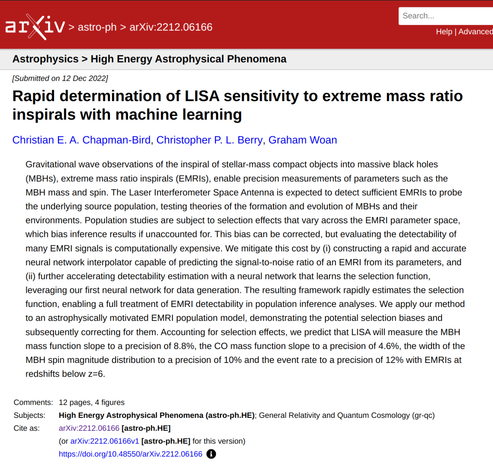

Rapid determination of LISA sensitivity to extreme mass ratio inspirals with machine learning
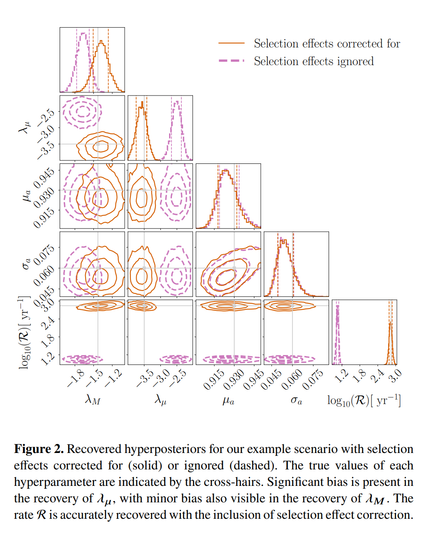
Gravitational wave observations of the inspiral of stellar-mass compact objects into massive black holes (MBHs), extreme mass ratio inspirals (EMRIs), enable precision measurements of parameters such as the MBH mass and spin. The Laser Interferometer Space Antenna is expected to detect sufficient EMRIs to probe the underlying source population, testing theories of the formation and evolution of MBHs and their environments. Population studies are subject to selection effects that vary across the EMRI parameter space, which bias inference results if unaccounted for. This bias can be corrected, but evaluating the detectability of many EMRI signals is computationally expensive. We mitigate this cost by (i) constructing a rapid and accurate neural network interpolator capable of predicting the signal-to-noise ratio of an EMRI from its parameters, and (ii) further accelerating detectability estimation with a neural network that learns the selection function, leveraging our first neural network for data generation. The resulting framework rapidly estimates the selection function, enabling a full treatment of EMRI detectability in population inference analyses. We apply our method to an astrophysically motivated EMRI population model, demonstrating the potential selection biases and subsequently correcting for them. Accounting for selection effects, we predict that LISA will measure the MBH mass function slope to a precision of 8.8%, the CO mass function slope to a precision of 4.6%, the width of the MBH spin magnitude distribution to a precision of 10% and the event rate to a precision of 12% with EMRIs at redshifts below z=6.

 Leo C. Stein