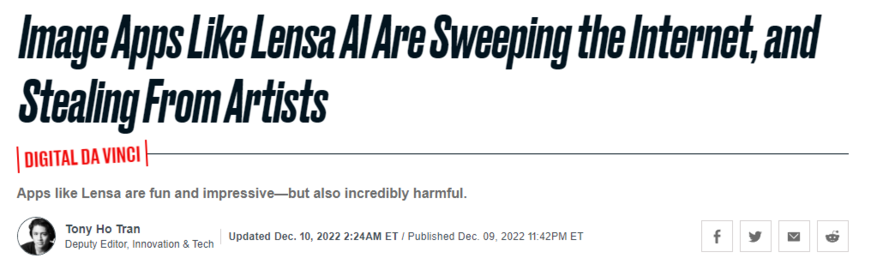
AI's aren't sentient. They can't "steal."

Programmers and institutions select the data with which to train the model. They take art and writing from artists and authors without credit or payment. The software then remixes and mimics what it is given.

Displacing agency by attributing intent to the AI is exactly how people and institutions erase human action in the creation of technology. It also leads to further perceptions of technology as acultural, unbiased, and, in essence, magical.

@Manigarm This is an interesting point, and certainly correct.

It's also exactly how humans learn to become artists and writers - by studying, mimicking, and eventually adding to the existing body of work. We don't generally consider that theft, unless the copying is exact or deceptive.

Yet AI feels somehow different, much more like plagiarism. Perhaps it's that the ONLY input an ML system has is others' art, with no real-world human experience of its own to contribute.

@Manigarm I think part of it is that we expect art and literature to have a creator, an actual person whose work expresses a human point of view, one that encompasses something beyond the literal work itself. By lacking an author who stands behind it, is AI-generated art somehow inherently fraudulent? Maybe.

@mattblaze @Manigarm I think a substantial part of the reason also comes down to market effects.

What makes plagiarism grate for creators (artists, writers etc) is that their work is high-intensity, and they object to plagiarists in part because those plagiarists avoid the costs of developing the creative talent/expertise to produce cheaper alternatives and that impacts the creator's ability to get ROI on their work. AI does that to an *insane* scale, essentially annihilating the whole market.

@mattblaze @Pwnallthethings @Manigarm Playing devil’s advocate here: isn’t the whole point of technology to take things that are hard for humans to do, and build machines that make that work effortless?

@Manigarm @Pwnallthethings @mattblaze I guess what I’m trying to say is that “it’s harder for humans to do this than machines” isn’t enough of an argument.

But trying to define what the missing “this” is, that question’s going to take you straight into the hardest problems of consciousness and computer science. I don’t envy the person trying to win that fight, long term.

@matthew_d_green @Manigarm @Pwnallthethings @mattblaze cultivating artistic talent is not something we should outsource to computers and thereby make harder to monetize. It's already hard enough to make it and real artists do so much to enrich our lives. Tech should be displacing things to allow more artists to thrive, not less.

@Manigarm @mattblaze @Pwnallthethings @joshz2012 I attended a music conservatory and my best friend joined the Navy so he could have a paying job playing guitar. You don’t have to convince me.

That does not mean I know what to do about this.

@matthew_d_green @Manigarm @mattblaze @Pwnallthethings Oh sure, I just mean to say I think your point about tech being implicitly about making things easier is right on, but that's only a positive good when it crowds out things we'd agree aren't expressions of human potential, like... Garbage collection. But I get there's no way to stop it from going in all directions.