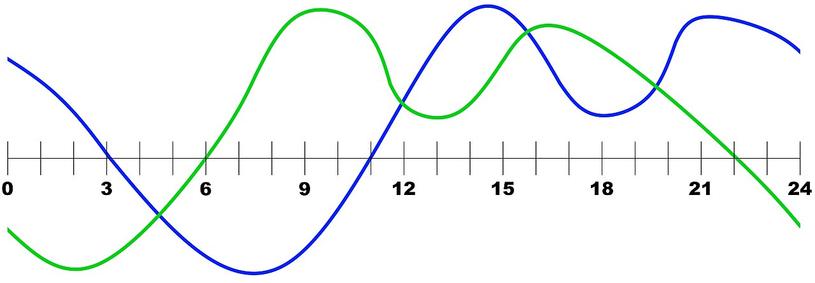
I woke up at 7pm today. Tomorrow I'll probably get up at 9pm. Around this time next week, I'll be waking up at 7am.

This is normal for me. I have a rare-ish circadian rhythm disorder known as #Non24. My sleep cycle doesn't track with the sun. It's not at all rare amongst people who are blind, but it's rare amongst sighted people.

I also suspect it's actually more common than believed & there are people out there reputed to be lazy, immature, or erratic when they just can't sleep normally.

@sysop408 I was just chatting with @OldUncleMike about this! He also has a Non24 circadian rhythm.

I have a delayed sleep syndrome that shifts my circadian cycle back so I normally go to sleep at 2-3am and wake up 9-10am.

But it’s mostly a 24-25 hour cycle that I can keep in check. I just have a hard time syncing with most folks during regular biz hours. I think non24 and delayed/skewed circadian cycles are definitely more common, but as you said, people just get called lazy or whatever…

@eatthelove @sysop408 @OldUncleMike Interesting. I've always had odd sleeping habits that I've always just called insomnia. As a young woman, I fell asleep around 2:00 AM and woke around 9:00 AM. Normal hours were hard for me, as well. It affected my life in odd ways. I tended to work second shift a lot when I worked in hospitals. That was fine, business hours were impossible for me.

@Oldandcranky YES. A lot of folks think they have insomnia, when it just a different circadian rhythm.

When I discovered the term "delayed sleep phase syndrome" everything clicked. I had been going through life as if I was permanently jet-lagged.

https://en.wikipedia.org/wiki/Delayed_sleep_phase_disorder

Shifting to a freelance work-at-home lifestyle and allowing myself to sleep my body's natural rhythm was life changing. I was no longer mentally and physically exhausted all the time.

@sysop408 @OldUncleMike

Delayed sleep phase disorder - Wikipedia

@eatthelove @Oldandcranky @sysop408 @OldUncleMike

DSPS/N24 person here. If anything disrupts my natural sleep pattern (3am to 11am/noon), especially trying to get up early to sync w/ diurnal folks' expectations, it sends my sleep cycle wildly out of control. My sleep cycle tends to creep forward a little on its own, and if I just let myself "free run" it can have me in completely N24 mode. But my body & mind seem happiest and healthiest when I'm sleeping in that 3am to 11am/noon sweet spot.

@madameximon how did you figure out that you bounce between DSPS & #Non24 & how'd you figure out your ideal sleep times?

Have any tricks that help you figure out how to get back on track once you've started to free run?

I wear a Fitbit to track my sleep & HR. It helps with minor deviations, but once I go off course it's sometimes months of trying to find it again. Seeing my resting HR creep up & up is a giveaway that I'm off track. Fitbit body temp tracking hasn't been as helpful.

@sysop408 The first time I started free-running was during winter break in college, and my sleep cycle ran forward for an entire month. Thankfully I got it back to something sort of stable by the time the semester started, but it did negatively impact my grades that semester. That's when I started paying attention to the possibility that my nocturnal cycle could turn into something even harder to manage.
@sysop408 Figuring out my ideal sleep times has been the result of doing a lot of gig work over the course of 3 decades, and having severe struggles any time I got a "normal" job. I can push through a day schedule on a temporary (1-2 day) basis, but the older I get, the less that works. I've also had chronic sleep deprivation for much of that time, and I'm certain that contributed to my cancer battle (I'm in remission now).

@sysop408 Since I don't want cancer to come back, I am protective about my sleep, but of course the diurnal world does not respect that. So, I have an assortment of herbal sleep aids that I cycle through to avoid dependence on any one.

Getting back on track during a free run is tough. Finding physical activities to wear myself out with is the only thing that consistently helps, though monitoring caffeine & sugar intake to maximize the crash can sometime be useful too.