“At the moment, it’s looking a lot like the end of essays as an assignment for education.” ChatGPT writes better than most people. I asked it some typical school test questions yesterday and I realized: It also teaches better than most teachers.
https://www.nature.com/articles/d41586-022-04397-7
AI bot ChatGPT writes smart essays — should professors worry?
The bot is free for now and can produce uncannily natural, well-referenced writing in response to homework questions.
Obviously, ChatGPT doesn't replace school, but for mid school level scientific questions I'd argue that, structurally, it does a better job than frontal 1 to 20 teaching.
The whole group and power dynamic at school is gone. As a pupil can ask specific questions and you're never bored, and you never need to feel inferior or stupid. No one else hears what you don't understand.
A dialog structure is a much better setting to learn for the individual than the typical lecturing one to many approach.
The destructive potential of ChatGPT powered disinformation is simply terrifying.
AI imagery, it works, looks and feels carcinogenic. Social Media x AI is total hell. ChatGPT *is* scary.
There are some interesting parallels with chess computers. Chess computers don't play chess, they simulate chess. They now simulate it better than the world champion. The same can happen with AI generated content. Only the very best in their field will be able to use that technology in a controlled way.
ChatGPT has already reached a level where in many cases, I'd rather communicate with it than spending time with an average, superficial social media, bestseller book or news article. Because most human created content is not more original or insightful than AI generated content. Most information online already is of lower quality than what ChatGPT does. It's a lot of mindless, heartless recycled data without much thinking. Often it's less researched and less comprehensible.
It's terrifying how some of the most ardent critique against the quality of ChatGPT can be easily redirected at the vast majority of human writing. It's recycled, unorgininal, not felt, not properly understood, not structured and without empathy for the reader. The inevitable crisis this will unleash not only on teaching, programming, writing, learning and politics could be seen as a challenge. A challenge to be understand better, think clearer, to express ourselves with more empathy.
If the parallel with chess holds, AI won't automatically destroy everything or lead to a better world. Chess computers didn't destroy chess but they didn't make it more interesting either. They changed the game in a way where people now play like computers, and they undermined the trust in the originality of the player. All we talk about in chess these days is "Who is cheating?"
At school, work and in everyday life, these questions have become more common and more complicated: Who is cheating, how can you prevent it and even: what is cheating? Is it cheating if programmers use AI to write their code because they do a better job? Is it unethical if AI is answering all customer support questions because they answer more precisely? Is it bad if pupils rather ask their cellphone about hydrogen bridges than listening to a boring teacher?
What if simulated understanding becomes the norm? Well, again, it already is the norm. Pupils that can simulate understanding already get the best grades. Business people that simulate being a manager get the highest salaries. A lot of professionals now are simply professional actors. How do you discern real understanding from simulated understanding? You can't. Not from outside. Only you know whether whether it's just words or whether you really feel what you say.
Testing AI for writing I realized how much energy it costs to think. To express my intuitive understanding in an accurate way. To bring the confused mix of contradicting spaghetti emotions into verbal shape.
I can tell AI with much less effort to do that for me by giving it an abstract order. The result is not the same but often fairly close to what I would have said and with less typos and human errors. The more complex the thought the bigger the relief when I let the computer do it for me.
However, if I let the computer express what I feel based on an instruction using lists and abstract language, won't I weaken my ability to express myself? And as my ability to express myself weakens... will that weakness not lead to weaker instructions? In order to get accurate results I need to write precisely what I want. The vaguer the instructions the less the AI produces what I intended.
Again, using the example of computer chess: I can't say for sure if, overall, chess programs have weakened my playing ability, but I know for sure that they have not improved my ability to think ahead. They lead to a sloppy attitude where, if my move doesn't work, I'll take it back and try something else. This is the exact opposite of what chess is in a game against humans. Computers are great for training openings, studying positions and Blitz, but in terms of chess ethos they mostly corrupt.
@reichenstein Are we seeing here the logical culmination of the Taylorisation of our education system? It’s not a new idea that our education systems are geared around creating square pegs, regardless of the shape of the hole. Many great thinkers have made this observation from Einstein to Ken Robinson. So, as is very briefly mentioned in the article, will this development help shift is towards what employers and societies say we really need…
@reichenstein
That is, critical thinking and creativity.
https://www.kqed.org/mindshift/40217/sir-ken-robinson-creativity-is-in-everything-especially-teaching
These are values that often seem at odds with the education system, where obedience, correctness, acceptance, conformity are prized above all else. ChatGPT is the ultimate realisation of the education system. The perfect pupil and the perfect teacher.
So will the counter cultural values of creativity and critical thinking now come to the fore?

Sir Ken Robinson: Creativity Is In Everything, Especially Teaching | KQED
Creativity can seem like an abstract concept, but having a definition can give a learner the power to practice it on a regular basis.
 Oliver Reichenstein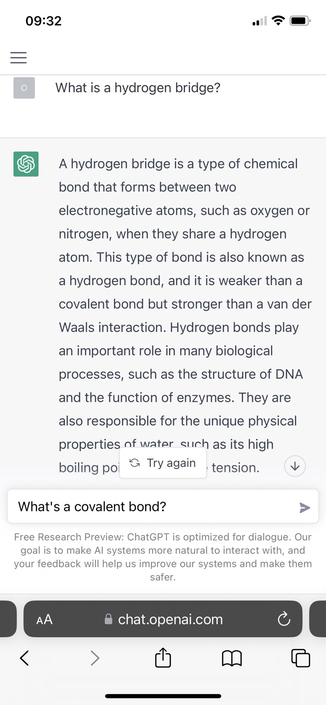
 Charles Roper