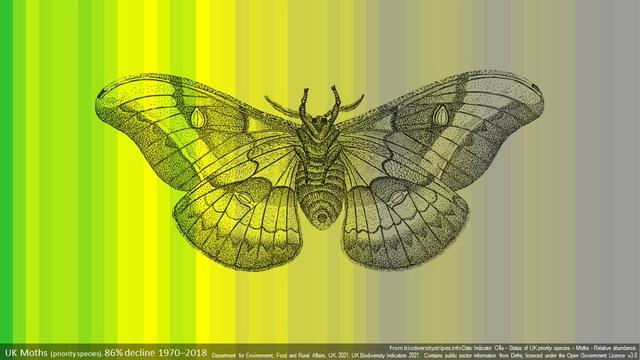
The abundance of moths in the UK has declined by 86% since 1970.

The world is changing from green to grey.

Part of a new series of 'biodiversity stripes' by Miles Richardson at http://www.BiodiversityStripes.info

BIODIVERSITY STRIPES

The biodiversity stripes show the variety and abundance of nature over time. From greater in green to less in grey.

BIODIVERSITY STRIPES
@ed_hawkins Hi Ed, do you have a source for this % you could point me to? Thanks!
UKBI - C4a. Species - abundance | JNCC - Adviser to Government on Nature Conservation

@ed_hawkins Ah, OK. By the looks of it this is a highly biased list of species, almost all of conservation concern. Proper moth people would know better than me... The State of Britain's Moths report suggests an overall decline of 33% from the late 1960s for a much wider selection of species. Still bad, but nowhere near 86%.
@mothyblackburn Thanks - point taken. Should at least make the distinction between all moths and moths of conservation concern.
@ed_hawkins It seems like insects in general are declining catastrophically everywhere. I recently had to do a 500 km road trip through a rural agricultural area. Normally, my windshield would be covered by insect detritus, necessitating a full cleaning by hand. Not this time. There were barely any squashed insect remnants on the front of my car. Anecdotal, of course, but I've seen this more than once. Something is seriously wrong with our ecosystems.
@Westcoastbirder @ed_hawkins You’re observations are correct, they ARE in catastrophic decline everywhere.
@Westcoastbirder @ed_hawkins *Your πŸ™„πŸ€¦πŸ»β€β™€οΈ
@ed_hawkins Ditto here in North America with insects and butterflies being the most noticeable and the Monarch Butterfly being the most famous one.