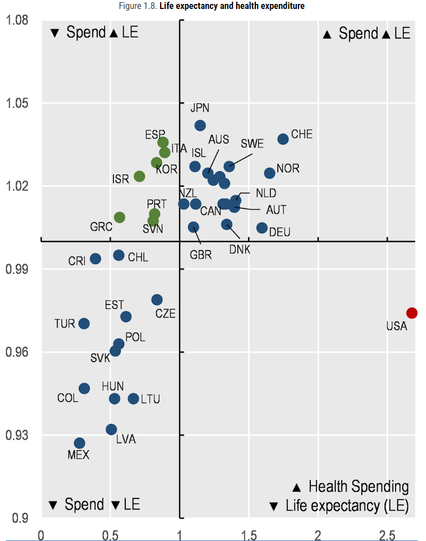
Here's a scatterplot of health spending per capita (x axis) and life expectancy (y axis) in OECD countries. The lines represent averages.

One country sits alone in the bottom right quadrant due to its much higher health spending and below-average life expectancy.
Source: https://www.oecd-ilibrary.org/sites/ae3016b9-en/1/3/1/index.html?itemId=/content/publication/ae3016b9-en&_csp_=ca413da5d44587bc56446341952c275e&itemIGO=oecd&itemContentType=book

Home

OECD's dissemination platform for all published content - books, podcasts, serials and statistics

@conradhackett a bit of American exceptionalism
@oakster @conradhackett How much of the USA’s position is attributable to gun violence?
@conradhackett @RockerDoc surely almost nothing. It doesn’t change the expense side of the equation, just life expectancy. And I’d still say that’s small. Very small. The numbers to find that out should be easily available

@oakster @conradhackett @RockerDoc

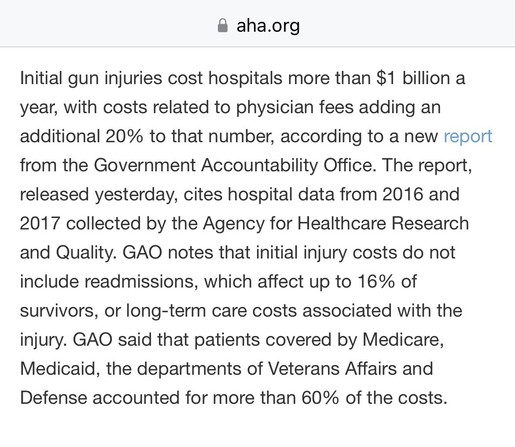
Rocker > American Hospital Association estimated gun violence cost hospitals $1,000,000,000 annually for 2016-2017. Add 20% for doc fees.

In 2020, total health care costs were $4,000,000,000,000.

Gun violence is an insignificant contribution to total costs.

WHY CAN’T I PASTE ANYTHING in iOS app?????

@oakster @conradhackett @kegill Lots of young deaths from guns => many years of life lost. So I’d expect a far bigger impact on mortality (and thus life expectancy).

@RockerDoc @oakster @conradhackett

Life expectancy has dropped dramatically since 2019 due to Covid. It’s comparable to influenza in the ‘20s.

From 2020-21, US life expectancy dropped from 77.0 to 76.1 years, the lowest since 1996. “The 0.9 year drop in life expectancy in 2021, along with a 1.8 year drop in 2020, was the biggest two-year decline in life expectancy since 1921-1923.”
https://www.cdc.gov/nchs/pressroom/nchs_press_releases/2022/20220831.htm

Life Expectancy in the U.S. Dropped for the Second Year in a Row in 2021

National Center for Health Statistics

@RockerDoc @oakster @conradhackett

In 2017 & 2018, firearms accounted for more individual years of potential life lost (YPLL) than motor vehicle crashes.

“Traumatic injuries remain the leading cause of death in the USA for individuals up to the age of 46 years.”

2018: 1.42 million v 1.34 million YPLL
38,929 firearm deaths
White males, suicide (4.95 million YPLL, 2009-2018)
Black males, homicide (3.2 million YPLL, 2009-2018)

https://tsaco.bmj.com/content/7/1/e000766

Firearms: the leading cause of years of potential life lost

Objectives Data from the Centers for Disease Control and Prevention (CDC) show that firearm deaths are increasing in the USA. The aims of this study were to determine the magnitude of potential years of life lost due to firearms and to examine the evolution of firearm deaths on the basis of sex, race, and geographical location within the USA. Methods Data was extracted (2009–2018) from the National Vital Statistics Reports from the CDC and the Web-based Injury Statistics Query and Reporting System database. Years of potential life lost was calculated by the CDC standard of subtracting the age at death from the standard year of 80, and then summing the individual years of potential life lost (YPLL) across each cause of death. Results The YPLL in 2017 and 2018 was higher for firearms than motor vehicle crashes (MVCs). In 2018, the YPLL for firearms was 1.42 million and 1.34 million for MVC. Males comprised the majority (85.4%) of the 38 929 firearm deaths. White males had the most YPLL due to suicide, with 4.95 million YPLL during the course of the 10-year period; black males had the most YPLL due to homicide with 3.2 million YPLL during the same time period. The largest number of suicides by firearms was in older white males. Firearm-related injury deaths were highest in the South, followed by the West, Midwest, and Northeast, respectively. Conclusion Firearms are now the leading cause of YPLL in trauma. Firearm deaths have overtaken MVC as the mechanism for the main cause of potential years of life lost since 2017. Suicide in white males accounts for more YPLL than homicides. Deaths related to firearms are potentially preventable causes of death and prevention efforts should be redirected. Level of evidence Level III—Descriptive Study.

Trauma Surgery & Acute Care Open