Advent of Systems Seeing: Day 3

ReCenter

Take a look over the rich picture you did yesterday. Pick a person or group that is significant to the situation you’re exploring, and center the next frame on them. Draw a Rich Picture of the people, systems, organizations, etc. that they're encountering, as broadly related to their concerns on the previous rich picture.
Again, add in interactions, and annotate brief details (their responsibilities, concerns, goals or intentions, etc., as well as brief annotations on the interactions (blockers, assumptions, etc.).

For example, if your first rich picture focused on the healthcare system, exploring pressures the healthcare system is under, you might now recenter on the parents of a sick child, their concerns and the systems and people they interact with, etc.

Reminder: Timebox to 15 to 20 minutes.

Having trouble? Just give it a go. There’s no “right” answer!

“Try faking it.” — Brian Eno and Peter Schmidt, Oblique Strategies

Why this reframe?

“The richer this context, the more chance that fruitful avenues can be found to move forward.”
— Kees Dorst, Frame Innovation: Create New Thinking by Design

#AdventOfSystemSeeing

‘Sensemaking is the ability or attempt to make sense of an ambiguous situation. More exactly, sensemaking is the process of creating situational awareness and understanding in situations of high complexity or uncertainty in order to make decisions. It is “a motivated, continuous effort to understand connections (which can be among people, places, and events) in order to anticipate their trajectories and act effectively.”’
– Gary Klein, Brian Moon and Robert Hoffman, Making Sense of Sensemaking
“problems do not present themselves to practitioners as givens. They must be constructed from the materials of problematic situations that are puzzling, troubling, and uncertain. In order to convert a problematic situation to a problem, a practitioner must do a certain kind of work. He [sic] must make sense of an uncertain situation that initially makes no sense.”
— Donald Schön, The Reflective Practitioner
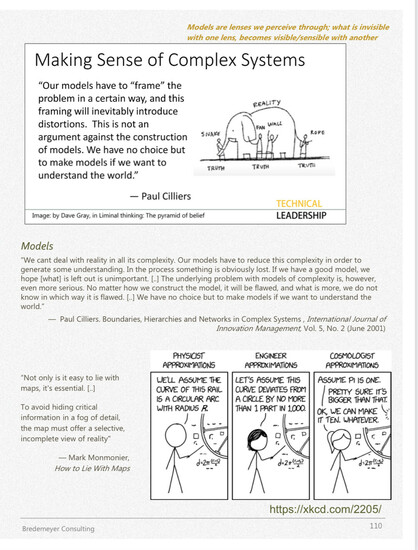
"Not only is it easy to lie with maps, it's essential. [.]
To avoid hiding critical information in a fog of detail, the map must offer a selective, incomplete view of reality"
- Mark Monmonier, How to Lie With Maps
“We suffer from Spatial Blindness.
We see our part of the system
but not the whole;
we see what is happening with us
but not what is happening elsewhere;
we don’t see what others’ worlds are like,
the issues they are dealing with,
the stresses they are experiencing;
we don’t see how our world impacts theirs
and how theirs impacts ours;
we don’t see how all the parts influence one another.”
— Barry Oshry, Seeing Systems
Dr David Roy (@[email protected])

Attached: 1 image The world map according to fish.

Aus.Social
@RuthMalan ❤️ for referencing that most inspiring of systems thinkers, Paul Cilliers.
One of my fondest memories is spending an evening at his home in Stellenbosch talking about philosophy, science, and music. A brilliant mind taken from us much too soon.
@RuthMalan Isn't sense making using sensor data (sight, sound, touch, taste, smell and neural-skin-interface) to make a relational model of our situational reality. For instance, we don't describe out environment with Ultra-violet light characteristics because we humans don't detect it, so it not relational or meaningful. But it exists.
@dahukanna @RuthMalan between the technologies we’ve developed that extend our senses, and the intersubjective models we’ve developed through culture and communication, I’d be wary of limiting “sense-making” to what a single body can achieve

@scottmatter @dahukanna

I am so excited by what Dawn said, especially this: “make a relational model of our situational reality” — it captures so much!!!

@scottmatter @RuthMalan catching up on conversations:
I agree even though a singular body (= individual) can sense-make and those singular instances should collectively aggregate a shared sense-making model (commons).
Ultimately, as George E.P. Box says, "Essentially, all models are wrong but some are useful".