 Daniel Lakens
In the next few days we will get to see if there is a difference between Mastodon and Twitter. On Twitter, people are already calling for the editor of Perspectives on Psychological Science to be replaced because of this: https://psyarxiv.com/xk4yu. Let's see if we get the same dog-piling and outrage here, or if this platform works differently.
 Andrew Przybylski
 SLLancaster
@lakens How dare people be outraged by outrageous behavior!?
@SLLancaster Have you ever read 'So you've been publicly shamed' by Jon Ronson? https://www.amazon.com/So-Youve-Been-Publicly-Shamed/dp/1594634017 I can recommend it. You will never look with anything but disgust at an online outrage mob.
 Liadh Timmins
@lakens @SLLancaster what do you propose we do instead in order to solve the problem that had been identified at POPS then?
@liadh @SLLancaster Well, there is always the option to have a normal conversation instead. How do you resolve problems in your offline life? Maybe we can use those solutions online as well?
 Natasha A Tonge
@lakens @liadh @SLLancaster Agree that pile-ons get really uncomfortable to watch, esp. the sarcastic tweets. But I wonder: 1) where's the threshold for pile-on and 2) about in-person parallels. If many ppl are upset & express their honest negative reactions, is it still a pile on? Is it the language/quote tweets/subtweets that make it feel more antagonistic than in-person criticism? Could inperson vs online pile-on just be difference of private vs public shaming?
@Nattonge @liadh @SLLancaster Spoken like a true scientist :) I also don't know the necessary and sufficient conditions of a pile-on vs. people collectively expressing a negative evaluation. The latter is important, and creating awareness is also important.
The APS already indicated they will examine it. For me, all calls on social media that the editor needs to be removed from his position are probably too close to a pile on.
@Nattonge @liadh @SLLancaster I also think calling this racist behavior is too far in that direction (there is a large US European value difference here - actually the same one that led to these commentaries, I predict, even though it is not discussed).
What do you think? I had some hope a new platform (that did not adopt quote tweeting to prevent pile-ons) would lead us to rethink these things. Where do you see a line?
@lakens @liadh @SLLancaster this might be where personal preferences and experiences matter. I've never been a public figure & with that caveat, think behind-the-scenes outrage isn't a pile on by the public shaming definition but seems equally uncomfortable. Imagining this alternative: everyone emails the editor private calls for resignation with list of perceived offenses detailed. If the goal is to preserve an individual's comfort, both seem to fail
@Nattonge @liadh @SLLancaster I think it is fine to make people a bit uncomfortable. But it is indeed the scale of things. Getting 500 emails saying you are a racist is not productive nor necessary. Some people really can not deal with being the focus of so much outrage, which is important to keep in mind. It is difficult not to overdo it in a mob.
@lakens @liadh @SLLancaster regarding the line for calling something racist - I often question how that US-Europe difference unfolds. I would be most curious about how/whether non-White Europeans in various countries have a similar threshold as non-White Americans for labeling discrimination and/or racism in a descriptive encounter. I strongly suspect there are commonalities just also wondering about convergence on definitions/where the line is drawn
@Nattonge @lakens @SLLancaster I also wonder how it varies in white Europeans. My experience as a white European who has lived in cities of various sizes is that white Europeans are more likely to be willing to call behaviour racist the more contact they have with non-white Europeans.
@Nattonge @lakens @SLLancaster frankly I think the culture difference is that Europeans are substantially behind USians in terms of racial progress with regards to attitudes, but because we have stronger social safety nets and less lethal police forces our attitudes do not cause as much damage.
@liadh @Nattonge @SLLancaster interesting, I mostly hear people say the opposite. And even more, in discussions we have about this at my university there is anonymous agreement we 'do not want to end up like the US'. This is also said in discussions about this in Dutch government. I guess there are some differences between countries and people.
@liadh @Nattonge @SLLancaster we recently studies people's negative experiences with racism at my university in the context of why ECR's leave academia https://journals.plos.org/plosone/article/authors?id=10.1371/journal.pone.0274976 As you can see racism was experienced (Regrettably I do not think that will ever be 0) but self-reports are luckily quite low.

Leaving academia: PhD attrition and unhealthy research environments
This study investigates PhD candidates’ (N = 391) perceptions about their research environment at a Dutch university in terms of the research climate, (un)ethical supervisory practices, and questionable research practices. We assessed whether their perceptions are related to career considerations. We gathered quantitative self-report estimations of the perceptions of PhD candidates using an online survey tool and then conducted descriptive and within-subject correlation analysis of the results. While most PhD candidates experience fair evaluation processes, openness, integrity, trust, and freedom in their research climate, many report lack of time and support, insufficient supervision, and witness questionable research practices. Results based on Spearman correlations indicate that those who experience a less healthy research environment (including experiences with unethical supervision, questionable practices, and barriers to responsible research), more often consider leaving academia and their current PhD position.
@lakens @Nattonge @SLLancaster Sorry, to be clear I mean that contact with non-white people is correlated with a higher rate of labelling some things racist. Low contact with non-white people is correlated with a lower rate of calling things racist and almost exclusively focussing on expressed attitudes. All my experience though, not sure if there is research that supports or contradicts this.
@lakens @Nattonge @SLLancaster I think we often see the U.S. as a foil. “Racism in the U.S. looks different and terrible, so things much be must better here.” In Ireland (my home country) people heavily criticise the U.S. for anti-Black racism like police killings or specific stereotypes, but say incredibly racist things about Irish travellers (similar to roma) and reason that it’s different because our racism is correct in some way.
@lakens @Nattonge @SLLancaster In your study, do you mean the variables for which you did difference tests for experiences across subgroups? That’s good they were low, though I wonder if that’s the best way of measuring racism in the NL. I think Europe also has better preventative structures to stop interpersonal racism, as you say people/county are not necessarily the same.
@liadh @Nattonge out of our sample of 391 PhD students, 16 reported experiencing racist comments on campus. That is not nothing, and warrants action (there is now a social safety plan in place, offering procedures to report such events, anonymously if needed) but the number could have been a lot higher (and there were other bad practices, especially research ethics related, that were more often experienced and negatively related with leaving academia)
@lakens @liadh interesting! I've seen similar (we call them climate surveys) results at institutions I've been at in the US. Lots of variance in how the q is asked in my experience. Hard to answer sometimes. A shame there's no institutional data to compare your sample to. Wondering what you think of Figure 8 results around favoritism, cultural competency etc. differences between Dutch and non-Dutch? Also what's overlap typically between non-Dutch and racial/ethnic minority?
@Nattonge @liadh Well, we thought the difference was interesting enough to plot. :) Mainly students from China, India, and Middle East. It is difficult to know without qualitative research. Where all Dutch students are employees, some Chinese students come on scholarships that make them more dependent on supervisors. It is indeed similar to a climate survey (except of our interest in questionable research practices). Would be good if these were more available to get some idea of differences.
 Andrea Kis
@Nattonge @lakens @liadh Indeed, would be nice to see institutional data but it's not yet available (to my knowledge). Exactly because of what you also state (i.e., difficult to measure and compare results), I really find Figure 8 important in many regards and hope that we or others will have the time/opportunity to engage a bit more with this topic. I just looked at the demographic data and the overlap between minority status and nationality looks like this in our sample:
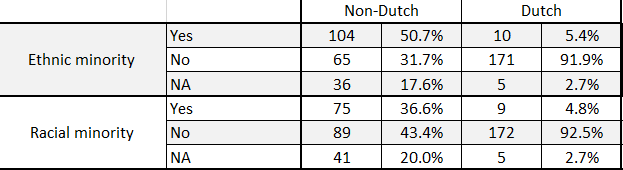
@andreakispsy @lakens @liadh thanks for posting Andrea and clarifying Daniel. This makes me think that one potential difference between a US and NL experience is that students may have 3+ attributions to sort through: am I having a supervisor problem because of race, immigrant status, or other (language? Culture?) In NL vs for Black Americans the options are fewer: often no nationality attribution. That NA category definitely catches my attention too. Religion? Language?
@lakens @liadh @Nattonge just to clarify: this is not the rate of PhDs experiencing racist comments on campus. As we put it in the paper: "A total of 32 respondents (8%) reported experiencing that their supervisors engaged in at least one serious transgression: racism (4%)..." - so this is only from supervisors. I would expect the rate of PhDs experiencing racist comments on campus to be higher (based on this result).
@liadh @Nattonge @lakens @SLLancaster I actually tend to agree with this statement. I feel that the lack of research in the NL for example is not scientifically justified, especially given recent controversies around racially/ethnically motivated decision making, interviews, and reports on institutional racism such as this one: https://ec.europa.eu/migrant-integration/library-document/institutional-racism-netherlands_en. I do not feel equipped to make a direct comparison to the US, but I do think more research is warranted (in other EU countries too).

@lakens @SLLancaster I mean outcome wise. You consider replacing the editor to be a bad solution. What is a good solution to improve the editor’s competence in his role?
@liadh @SLLancaster transparency, and limiting what they can do. The editor tried to freewheel creating some discussion by inviting reviewers to submit a paper. This of course happens - I published a paper in psych methods last year that was a critical review, where the editor decided to publish the original and my review. Here, the weird thing is he got a bunch of agreeing people to write comments. Even though these comments are indeed interesting to read, the procedure was weird.
@liadh @SLLancaster Ajour al should have a better procedure - if you want A discussion, make it public, invite others, make the rules transparent. I am willing to bet that is also what the result of the APS committee will be that is investigating this.
@lakens @SLLancaster long-term I agree that might actually be more impactful. Racist and questionable behaviour would be lower across editors. But those fixes can only go so far. An editor has immense power and their judgement is paramount. As well, the confidence of the field is shook. Even if we could improve the editor’s abilities, I think lots of authors, particularly from marginalised backgrounds, will avoid PoPS until his tenure ends.
 J. Ritchie (mastodon.social)