Here's a maths fact that I find surprisingly useful in everyday life.

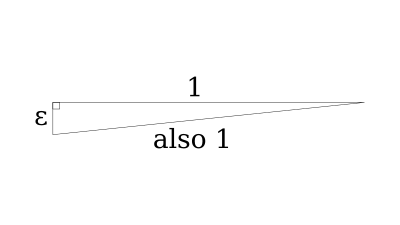
Suppose you have a long thin right-angled triangle, say with sides 1 and ε. Then Taylor expanding Pythagoras' Theorem gives that the hypotenuse is approximately 1 + ε²/2. Since ε is small, ε²/2 is tiny. So the hypotenuse is basically the same length as the side!

I'll give some examples of places where this comes up. Would love to hear others! (1/2)
#Math #Mathematics #Maths #Geometry #Pythagoras

1. It's not very important to hold a measuring tape exactly straight. If you're measuring something 2m tall and you accidentally hold the tape 5cm to the side, the error in the result is less than 1mm.

2. It's very hard to pull a long rope taut. If you stretch a 100.01m rope across a 100m gap, it can be pulled down by 70cm in the middle.

3. If a race car changes side of the track while they're driving down a straight, they travel almost no extra distance.
(2/2)

In this video https://youtube.com/watch?v=PtKhbbcc1Rc Matt Parker says that if you calculate the area of the UK by including height data (at 90m resolution) it increases the value by 1% compared to if it was flat.

That implies the average gradient of the UK is 13.7%, which is a lot! Enough for a 'steep road' sign. I found it hard to believe that the UK is actually that lumpy. I guess I must have mostly lived in the flat parts.

Does "land area" assume a country is perfectly flat?

YouTube
In fact if you look at the Laura Graham's data that he links to, you can see that the change is mostly driven by Scotland. England only has an average 8.6% gradient, whereas Scotland is 19.3%.
@OscarCunningham Rob Eastaway (not here yet) has a nice bit about this. The thing that made it stick in my head is that it explains why electricity wires droop so much between pylons - when the heat makes the wire expand by a small percentage, they droop surprisingly far down!
@christianp @OscarCunningham Yeah that’s why they tension overhead railway wires with fixed weights hanging over a pulley, as someone was saying the other day (I forget if that was here or on the other site).
@OscarCunningham In a previous life I did some surveying. When measuring distances with a steel tape, we had tables that showed catenary curve length adjustments depending on temperature and tension (via weights) on the tape. The adjustments were usually small, but not insignificant.
@OscarCunningham It's useful because I don't have to line up my measurement axis with (say) a magnetic field very accurately to get a good reading. I'm off by a factor of cos(epsilon)
@OscarCunningham These are great PRACTICAL examples. I was expecting abstract physics-class examples 'cause that's my life. :)
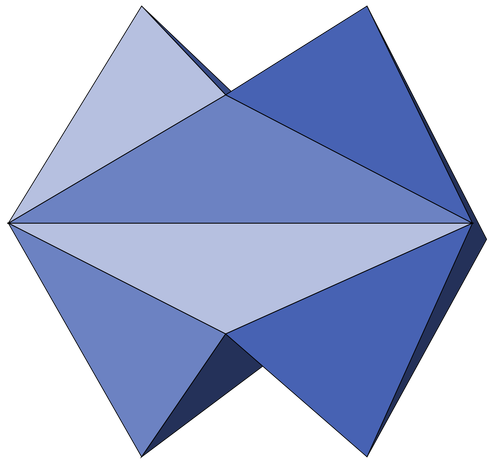
@OscarCunningham This is ultimately why Jessen's icosahedron (https://en.wikipedia.org/wiki/Jessen%27s_icosahedron) is rigid in theory but flexible in practice: there is a way to move its vertices by O(ε) while only changing its edge lengths by O(ε²), because the relative displacement of any pair of adjacent vertices is orthogonal to the edge between them.
Jessen's icosahedron - Wikipedia

@OscarCunningham This is the key fact that makes the tall prism example work in my recent blog post https://11011110.github.io/blog/2022/11/21/straight-line-through.html
A straight line through every face

While updating my online publications list for something else I noticed that I had neglected to discuss one of my papers from earlier this fall: “Geodesic pa...

@OscarCunningham It's kinda like the small angle approximation for sin(x) as well (once you combine this with the observation that \( \varepsilon \approx\) the arc subtended by its opposite angle). And that's used a lot in physics and engineering! E.g. for showing that a pendulum takes about the same amount of time to return to its starting point no matter where you drop it from
@OscarCunningham you should check this book : https://www.ams.org/books/mbk/085/mbk085-endmatter.pdf There, Arnold uses heavily approximations using Taylor expansions. The first problem has to do with the eccentricity of Mars' orbit, as calculated by Kepler.
@OscarCunningham When I would play golf with my father as a kid (he was, unlike me, a very good player), he would be concerned that the yardage markers were measured from the center of the fairway, while he was several yards off center. He knew a few yards could make a difference in club selection, and I would do hypotenuse calculations for him, but thanks to this observation you’ve made, it rarely made as much of a difference as he thought!
@OscarCunningham That's a complicated way of saying as A -> 0, cos(A) -> 1.
@vartak Well, not just that it tends to 1 but also that cos'(0) = 0.
@OscarCunningham Maybe not a common example, but one that is a common thumb rule for microscopists is that for a sample object placed sufficiently far away from the detector, the path length of light coming from different areas of the object is (almost) the same.