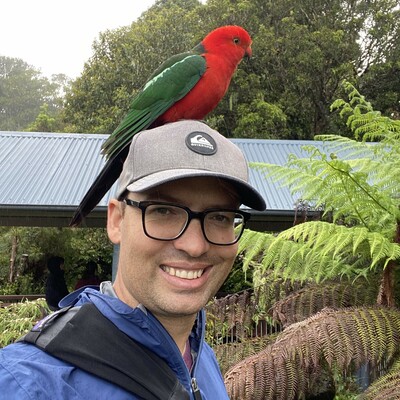
Over the next five days, I'll be driving around interior Queensland and New South Wales with Australian Phrymaceae (monkeyflower) specialist Bill Barker, who is the former chief botanist of the State Herbarium of South Australia. We will both be journeying into territory that neither of us has ever been to before to better understand diversification in this group. I am mainly going to be a field assistant to Bill, as I have a lot to learn from this established taxonomist.

Day 1 was successful start. We went to Joe Blatchy’s ranch to see the Mimulus gracilis and stumbled upon a large patch of Glossostigma, which is an odd looking member of the Phrymaceae. The cup like shapes of Glossostigma in the photo are filled with seeds that Bill thinks might be dispersed by rain droplets.

We then drove for 4 more hours to Taroom, QLD and had to slow down for a young kangaroo crossing the road.

Day 2 started out at Taroom, QLD, from which we headed north to look at a site with an old #herbarium record of an interesting variety of #Mimulus gracilis. It was not at the location we were looking for, but then Bill told me to pull over and he immediately found the thing on the side of the road. Here is him being very excited about seeing this plant for the first time in the field.
We then drove back south and stumbled upon a yet a different variety of Mimulus gracilis. This would make for three varieties in two days.
For me, one of the biggest discoveries of the day was that Mimulus gracilis grows as an underground interconnected web, with shoots emerging all over the place. What is really cool about this is that the shoots are all interconnected by a root system, rather than by an underground shoot. It means that this species is likely capable of giving rise to shoots from roots. I’d love to know how that works at the developmental genetic level.
The other #plants we encountered today were incredible, including these Lillies.
The #birds of Australia never cease to astound me. Today’s highlights included:
A Wedge-Tailed Eagle eating a kangaroo, two Bustards, and a cryptic colored Rosella
But, fieldwork would not be complete without some challenges, like getting a flat tire 70km from the closest town. Fortunately, some locals waved us down and informed us that our tire was low.
Day 3 brought us to an amazing population of a variety of #Mimulus gracilis that has taken on more radial symmetry and points its flowers towards the sky to attract #pollinators.
This location was amazingly lush and had an abundance of butterflies (and regular flies), as well as a poor striped marsh frog that had a large parasite attached to its rear leg.
We also stumbled on another Phrymaceae friend, the mudmat Glossostigma.
We then headed off from the Roma area through Surat, QLD and found another Mimulus gracilis population along the highway.
We reached St. George mid-afternoon and then drove west into the arid zone where we found Elacholoma prostrata, from another genera of the Phrymaceae. I would have never found it without Bill as it was not flowering at the time and a lot of other plants look like it.
The prostrate plants out in the arid zone are amazingly beautiful. We took a few more photos and headed back towards town seeing about a dozen kangaroos on the drive back.
The populations of Phrymaceae that we have visited so far can be seen on this map on iNaturalist as green dots and current location in blue. These are all the sites in this region on iNat for this family in this region. It’s like going back to the late 2000s in the US, when herbarium specimens were still the best way to find populations.
Day 4 was just as successful as the previous days. Two more varieties of Mimulus gracilis and a third Glossostigma (mud mats) population. Bill has been a delightful travel companion and I’ve learned so much from him.
Day 5: I dropped Bill of in Bingara, NSW, where he is continuing on with his collections with another Botanist. In the last leg of the journey, we finally had a lively discussion about the naming of monkeyflowers. Through that conversation, we fully gained a mutual appreciation and understanding of each other’s views as well as a way forward.
Our final set of populations visited can be seen in the map below. As I mentioned earlier, this is also the full set of observations that have been added to iNaturalist for the Phrymaceae in this part of the world. There are surely numerous other populations out there in this region. I hope that others will add to these observations and in the process help to move the science in this group forward.

In a fitting conclusion to the trip, the last stretch of road was the Allan Cunningham Road, which, according to Bill, was named after a #botanist who had travelled through the region 200 years prior collecting the same #monkeyflowers. His work had left a two century mystery about these species that Bill hopes our latest trip will help resolve.

Regardless, I have now learned new and amazing things about #Evolution in this family of plants, which will help make it a model clade.