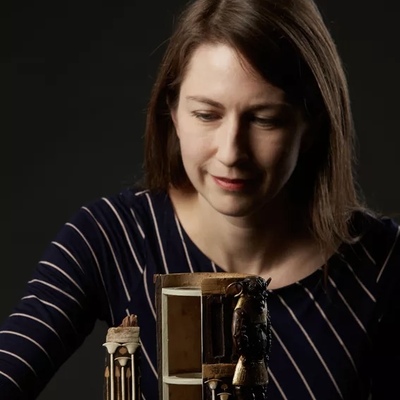
 Margaret Maitland
This feels like a new start, so I might as well introduce myself properly! I’m an Egyptologist & I curate the ancient Mediterranean collections at National Museums Scotland in Edinburgh. My research interests are varied: ancient Egyptian society and inequality, esp. in the Middle Kingdom; historiography of Egyptology, museum collecting and display, esp. in the context of empire & colonial legacies; and re-contextualising ancient Egypt & Nubian collections in museum displays & schools resources.
I wanted to be an Egyptologist from the age of 6, when I read about Tutankhamun at school & went home to tell my parents that’s what I would be when I grew up! They indulged my interest in museums & Egypt, from dressing up as Tut for Halloween to taking me to my 1st conference aged 11! During my undergraduate degree at the University of Toronto, my fate was sealed when I first read ancient Egyptian literature in translation- to hear voices speak from across millennia was utterly captivating!
I did my doctorate at the University of Oxford on representations of social hierarchy in the art & literature of Middle Kingdom Egypt (c2055-1650 BC). I studied decorated tomb chapels, like this one at Beni Hassan, & participated in excavations at sites like Kom Firin, a Ramesside town & temple. I worked as a trainee curator at the British Museum on the UK touring exhibition ‘Pharaoh: King of Egypt’ & at the Great North Museum: Hancock in Newcastle before I was appointed at NMS.
I led the redevelopment of our ‘Ancient Egypt Rediscovered’ gallery which opened at the National Museum of Scotland in 2019, and curated the 2017 exhibition ‘The Tomb’, about a Theban tomb that was used and reused for over a thousand years until it was sealed intact with an early Roman family burial in 9 BC, which later became the first Egyptian tomb to be systematically excavated in 1857.
I’m currently writing a book on the overlooked Scottish archaeologist Alexander Henry Rhind as a case study for understanding excavation and collecting in 19th century Egypt and its legacies today. Rhind was an outsider, a pioneer of prehistoric archaeology in Scotland, who conducted the 1st systematic excavations in Egypt in the 1850s. Considering Rhind’s work in context illuminates colonial biases that slowed the adoption of archaeological methodology in Egypt and hindered heritage protection.
I’m also supervising a Collaborative Doctoral Award 'Imagining Ancient Egypt in the Age of Empire' at Glasgow Uni on historic Egyptian displays in Scottish museums & mentoring my colleague Dr Dan Potter in his AHRC Early Career Fellowship ‘Buying Power: British Archaeology &the Antiquities Market in Egypt & Sudan 1880–1939’. And as Head of the Mediterranean, Africa, Americas & Oceania Section at NMS, I'm lucky to work with an amazing team of curators pursuing lots of different exciting projects!
Many moons ago, I was the 1st Egyptologist on Twitter. I’m aware of how privileged I’ve been to study ancient Egypt & of my responsibility to share. Twitter helped make that possible. But the real potential of social networks is how much we can all learn from *each other*, from different voices & perspectives. We can marvel at monuments like the Great Pyramid, but I think that the communities that ordinary people build are even more impressive. I can’t wait to see what we build together here.
 b_wildered2 ✅
@eloquentpeasant What lovely words. Thank you for writing them.
 BALGallery
 Orange
@eloquentpeasant I really liked that about Twitter! I learned so many things I wouldn’t have from being on it! I’m so pleased to see people such as yourself coming over here too! 🤗🤗🤗
@orange555 Thank you so much! I’m glad to hear you agree and it’s lovely to see you here too! 😊
 Beeda's Thingamajigits
@eloquentpeasant that's wonderful!